DIY Off-Grid Shower Setups for Summer Camping
Nothing beats a rinse after a long day on the trail — but most campsites don’t come with plumbing. The good news: you don’t need hookups to stay fresh. With a little DIY ingenuity (or a few clever gadgets), you can build an off-grid shower that actually works. For the big-picture system (water storage, heat, hygiene, and camp layout), see our Ultimate Camping Guide (With Video). If you’re prepping for outages, this also fits into our Power & Blackouts hub (link to your hub).
This post contains affiliate links. I may earn a small commission at no extra cost to you. Learn more.
Pro tip: handle bugs first so your shower isn’t a mosquito magnet. Start with The Ultimate Guide to the Best Mosquito Repellents in 2025
In this guide, you’ll learn:
- ✅ Five proven DIY off-grid shower setups (from solar bags to propane heaters)
- ✅ A buyer’s guide so you know which type is right for you
- ✅ Troubleshooting tips to keep your shower running smoothly
- ✅ FAQs that answer common camping-shower questions
How to Choose the Right Off-Grid Shower System
Not every off-grid shower works in every situation. A solar bag that’s perfect at a sunny car camp won’t help much if you’re deep in the woods in October. Here’s what to look at before deciding:
Capacity
- A quick rinse usually takes 2–3 gallons per person.
- Families or multi-day trips may need 5+ gallons.
- Small bags are lighter; larger containers mean fewer refills.
Heating Method
- Solar → free and simple, but weather-dependent.
- Wood-fired → reliable anywhere with firewood, but bulkier.
- Propane → delivers instant hot water, at the cost of carrying fuel.
- Battery pump / bucket → best for portability and bug-out setups.
Portability
- Backpackers need lightweight setups like pump showers or solar bags.
- Car campers can use larger rigs: PVC pipe frames or propane towers.
- Semi-permanent camps or homesteads work best with gravity-fed builds.
Budget
- <$50 → solar bags or DIY bucket systems.
- $50–$150 → pump showers with rechargeable batteries.
- $150+ → propane heaters and full shower panels.
Ease of Use
- Some setups are true plug-and-play.
- Others require tending a fire, mixing water, or balancing a tripod.
- Think about who’s using it: solo prepper vs. family with kids.
1. Solar Shower Bag (Simple & Affordable)
Best For: Car campers or basecamps with 4–6 hours of direct sun
The simplest off-grid shower is also one of the most reliable: a black PVC solar shower bag. The dark material absorbs sunlight to warm your water naturally, while the attached valve controls the flow. Hang it from a tree branch or tripod with paracord so gravity provides pressure.
💡 Pro Tip: Lay the bag on a dark tarp or reflective blanket while it heats — this speeds warming and keeps it off the cold ground. A stick-on thermometer strip helps you avoid scalding water.
- 5-gal black solar shower bag
- 10 ft paracord + locking carabiner
- Dark tarp or reflective blanket
- Optional: stick-on thermometer strip
Build & Use
- Fill & Seal: Draw water from a clean source and fill the bag fully.
- Heat: Lay flat in sun; rotate halfway through 4–6 hours.
- Hang: Suspend ~6 ft high so water pools near the valve.
- Test & Mix: Squeeze a little out — mix with cool water if too hot.
- Shower: Open valve for a 5–10 liter rinse per person.
Pros: Zero fuel, lightweight, packable.
Cons: Sun-dependent, cools quickly at dusk.
Recommended Gear
Survival Frog Solar Shower Bag
- 5-gal capacity heats to 110°F in ~4 hr
- Built-in shut-off valve for water conservation
- Packs flat for storage
2. Portable Wood-Fired Shower (Fuel-Only Option)
Best For: Campsites with abundant firewood and no propane access
When sunlight isn’t enough, you can heat water the old-school way: over a campfire. Set a 4–6 gallon stainless pot on a small wood fire, stir until it reaches ~110–120 °F, then transfer the water into a hanging shower bag or bucket. Suspend it from a tripod, or connect it to a rechargeable pump for steady flow. Add cold water if it gets too hot, and you’ve got a propane-free shower powered by nothing but a woodpile.
💡 Pro Tip: Keep an instant-read thermometer handy. Anything over 125 °F can scald.
Materials & Parts
- 4–6 gal stainless or cast-iron pot
- Collapsible fire ring or rock base
- 6–7 ft tripod (steel or aluminum)
- Heat-rated PVC tubing + clamps
- Garden-hose shower head
- Firewood, gloves, stirring rod / thermometer
Build & Use
- Build Fire Base: Arrange a safe fire ring or stone platform.
- Heat Water: Place pot on embers; stir until ~120 °F.
- Set Frame: Assemble tripod or stand.
- Transfer Water: Pour into shower bag or bucket; dilute if too hot.
- Shower: Hang and rinse using gravity or pump.
Pros: Reliable heat source, no fuel canisters.
Cons: Bulky gear, requires fire-tending skills.
Recommended Gear
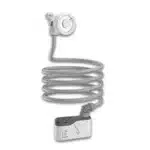
- Rechargeable 10 L pump (≈1.2 GPM)
- Runs ~50 minutes per charge
- Compact and easy to pair with any DIY setup
3. Gravity-Fed PVC Pipe Shower (Semi-Permanent Basecamp)
Best For: Long-term campsites, hunting cabins, or semi-permanent off-grid setups
A gravity-fed PVC shower is the closest thing to a “real” off-grid bathroom. Elevate a 5–10 gallon reservoir — like a solar bag or jerry can — on a sturdy stand 4–6 feet above head height, then run a garden hose down into a vertical PVC riser with a valve or shower head. Crack the valve, and gravity delivers a steady, rain-like stream with zero electricity or noise.
💡 Pro Tip: Paint the PVC pipe black and let it sit in the sun. It’ll preheat the water before you turn the valve.
Materials & Parts
- 10 ft PVC pipe (¾″) + 2 × 90° elbows + 1 × T-joint
- ¾″ brass ball valve or sprayer head
- Garden hose + PVC adapter + PTFE tape
- 5–10 gal container on ≥4 ft platform
- Hose clamps or zip ties
Build & Use
- Assemble Riser: Dry-fit 6 ft riser with a 2 ft arm.
- Attach Valve: Seal threads with PTFE tape.
- Elevate Reservoir: Place container on platform ≥4 ft above head.
- Connect Hose: Run line from reservoir to riser.
- Shower: Open valve for continuous flow until the tank empties.
Pros: Quiet, reliable, no moving parts.
Cons: Bulky, requires a sturdy platform.
Recommended Gear
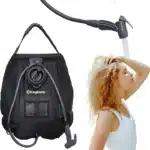
BRoadout KO2402 Solar Shower Bag
- 20 L capacity with built-in temperature display
- Heavy-duty carabiner & hook for suspension
- Designed for car camping or semi-permanent setups
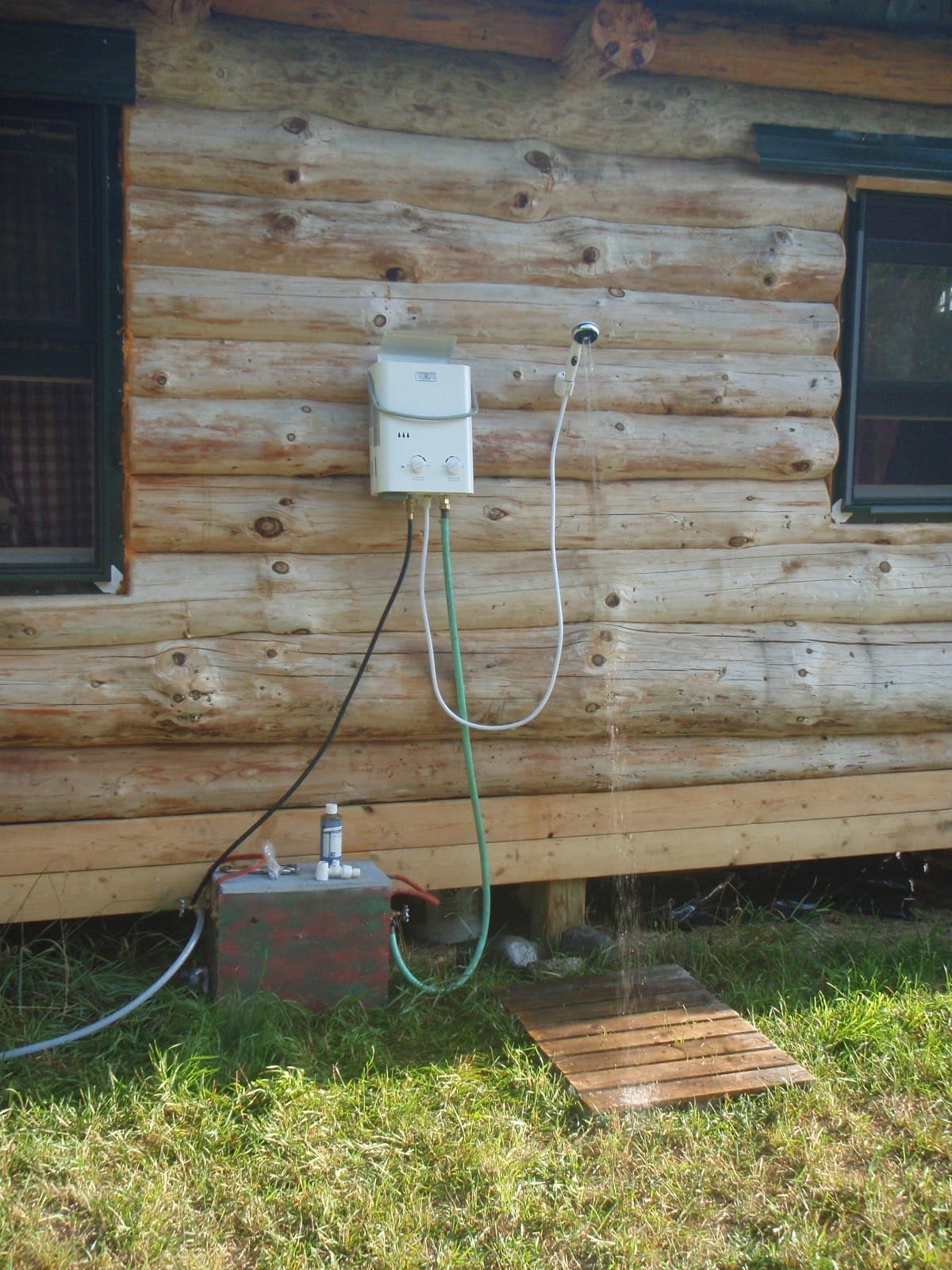
4. Propane-Powered Instant Heater (Luxury Option)
Best For: Car campers, RVers, or families who want a “real shower” off-grid
If you want the closest thing to your home bathroom at camp, a propane-powered shower is the way to go. Mount a stainless-steel shower panel to a sturdy stand, connect it to a portable propane water heater, and you’ll have hot water on demand. Most systems deliver 1.5–2.5 gallons per minute at an adjustable 100–120 °F — plenty for back-to-back showers, rinsing pets, or washing dishes.
💡 Pro Tip: Always use propane showers outdoors or in well-ventilated areas to avoid carbon monoxide buildup.
Materials & Parts
- Portable propane water heater (1.5–2.5 GPM with piezo ignition)
- 16 oz propane canister or 20 lb tank + regulator
- Inlet/outlet hoses + water strainer
- Shower panel with rainfall or handheld sprayer
- Sturdy stand (tripod, PVC, or post mount)
Build & Use
- Setup: Place unit on stable ground; connect propane + regulator.
- Hook Water: Run inlet to bucket, reservoir, or nearby stream; purge air.
- Ignite: Use built-in igniter; dial water temp to 100–120 °F.
- Shower: Switch between rainfall or handheld spray until water/fuel runs out.
Pros: Instant hot water, precise temperature control.
Cons: Heavy, requires propane fuel.
Recommended Gear
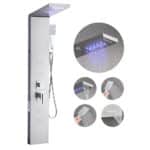
- Stainless steel rainfall + handheld jets
- 59″ reinforced hose
- Works with portable propane heaters for instant hot water
5. Batch-Bucket & Pump Shower (Lightweight & Portable)
Best For: Backpackers, ultralight campers, or bug-out situations
The batch-bucket shower is the most portable way to get clean off-grid. Fill a bucket with warm water, drop in a rechargeable pump, and you’ll have steady water pressure without lifting heavy containers overhead. A compact pump like the Flextail Max delivers about 1.2 gallons per minute — plenty for a quick rinse while still conserving water.
💡 Pro Tip: Wrap your bucket in reflective insulation or a sleeping pad to keep water warm longer.
Materials & Parts
- Two 5-gal buckets + lids
- 12V DC submersible pump + 5A fuse
- 12 Ah lithium battery + solar charger
- ½″ tubing + hose clamps
- Plastic shower head (~1 GPM)
- Bucket insulation wrap
Build & Use
- Prep Buckets: Drill cable hole; seal with caulk.
- Install Pump: Submerge in bucket of warmed water.
- Connect Tubing: Clamp hose to pump and shower head.
- Power On: Run from rechargeable battery; prime pump.
- Shower: Use burst-spray method to conserve water.
Pros: Lightweight, portable, rechargeable.
Cons: Limited volume, depends on battery charge.
Recommended Gear
- Rechargeable USB-C design
- 10 L capacity (≈1.2 GPM flow)
- Up to 50 minutes run time per charge
Mobile-Camp Suitability Chart
| System | Car Camp | Backpacking / Mobile | Best For |
|---|---|---|---|
| Survival Frog Solar Bag | ✔️ | ✔️ | Simple, budget-friendly rinse |
| Wood-Fired Shower | ✔️ | ❌ | Long stays, no propane needed |
| Gravity PVC Shower | ✔️ | ❌ | Semi-permanent basecamps |
| Propane Heater + Panel | ✔️ | ❌ | Family comfort, RVs, festivals |
| Bucket & Pump Shower | ✔️ | ✔️ | Backpacking, bug-out, ultralight |
Troubleshooting & Maintenance Tips
Even the best off-grid showers need a little care. Here’s how to keep each system working reliably in the field:
Cleaning Solar Shower Bags
- Rinse bags with a vinegar + baking soda solution after trips to prevent mold and bacteria.
- Store them dry and out of direct sunlight to extend the life of the PVC.
Preventing Leaks in PVC or Gravity Builds
- Always use PTFE tape on threaded joints before connecting valves.
- Check hose clamps and zip ties before every use; tighten as needed.
- Replace worn gaskets or washers to stop slow drips.
Cold Weather Protection
- Keep solar bags or buckets inside your tent overnight to prevent freezing.
- Wrap hoses in foam pipe insulation if temps drop near freezing.
- For propane systems, drain all water lines after use to avoid cracking.
Conserving Water
- Use the “rinse–soap–rinse” method instead of letting water run continuously.
- Opt for low-flow shower heads (~1 GPM or less).
- Fill a small basin for washing hair or gear, then use the shower for a quick final rinse.
Pump & Battery Care
- Recharge pumps fully before trips, and carry a backup power bank or solar charger.
- Flush pumps with clean water after use to prevent clogging.
- Store lithium batteries in a cool, dry place between uses.
Off-Grid Shower Use Cases & Scenarios
Not every off-grid shower works for every trip. Here’s how to match the right system to your situation:
Weekend Camping
If you’re heading out for just a couple of nights, a solar shower bag or pump-and-bucket system is usually enough. They’re inexpensive, pack small, and set up in minutes. You won’t get luxury, but you’ll get clean without hauling propane or PVC frames.
Family Car Camping
When kids are involved, comfort becomes more important. A propane-powered heater paired with a shower panel delivers hot water on demand, even if several people need to rinse back-to-back. This setup is heavier and pricier, but it turns a campsite into a near-home bathroom experience.
Bug-Out or Survival Situations
In emergencies or long-term bug-out scenarios, reliability and portability matter most. A bucket-and-pump setup shines here because it works anywhere, conserves water, and doesn’t depend on sun or propane. Pair it with a small solar charger for endless reuse.
Remote Homesteads or Hunting Camps
For semi-permanent sites, a gravity-fed PVC system or wood-fired shower makes the most sense. They’re bulkier to build, but once in place, they provide repeatable, low-maintenance showers without needing to haul fuel. Great for hunters, off-grid cabins, or survival retreats.
Festival or Overland Travel
If you’re traveling in a van, RV, or overland rig, a propane heater is your best bet. It delivers unlimited hot water (as long as you have propane) and integrates easily into mobile living setups. For shorter trips, a solar bag hung from a roof rack can also do the job.
FAQs About Off-Grid Showers
Q: How do you shower off-grid without electricity?
A: The simplest method is a solar shower bag, which uses sunlight and gravity to provide warm water. If there’s no sun, you can heat water on a stove or fire and transfer it to a bucket or bag. Rechargeable pumps also work well and can be powered by a small solar charger.
Q: How much water do you need per person for an off-grid shower?
A: Most people can get clean with just 2–3 gallons if they use the rinse–soap–rinse method. A 5-gallon solar bag is usually enough for two people. Families or longer showers may need 5+ gallons per person.
Q: Can solar showers work in cold or cloudy weather?
A: Yes, but they take much longer to heat — sometimes 6–8 hours instead of 3–4. In cold climates, you may need to supplement with fire-heated water or use a propane system for consistent results.
Q: What’s the cheapest off-grid shower setup?
A: A solar shower bag costs less than $25 and works surprisingly well in sunny conditions. A DIY bucket-and-pump system can also be made for under $40 using parts from a hardware store.
Q: Are portable propane showers safe to use?
A: Yes, as long as you use them outdoors or in a well-ventilated space. Always follow the manufacturer’s safety instructions, keep propane tanks upright, and never run the heater inside a tent or enclosed shelter.
Dial your setup with water carry, heat source, and hygiene add-ons — then round out your camp systems in the Ultimate Camping Guide (With Video).
Conclusion
Whether you go with a $20 solar bag, a fire-heated bucket, or a propane-powered shower panel, there’s an off-grid shower setup for every camper. The right choice depends on your trip style — weekend hikers can get by with a lightweight pump system, while families or long-term basecamps may want the luxury of on-demand hot water.
The key is balancing comfort, portability, and reliability. Start simple, experiment with a budget-friendly option, and upgrade when you need more convenience. With the right setup, you’ll never dread a sweaty day on the trail again.
👉 Ready to level up your camp comfort? Check out:
Further Reading:
- Staying Fresh While Camping
- Permethrin Gear Treatment
- Treat Bug Bites Naturally
- Stay Cool Without Power
- Emergency Water Storage (Beginner)
- Emergency Solar Radios 2025
Stay clean, stay prepared — and make your next trip refreshingly unforgettable.