Primitive Fire‑Starting Guide: 8 Time‑Tested Ways to Spark Life in the Wild
Primitive fire starting is more than warmth—it’s clean water. Fire allows you to boil contaminated water when filtration fails. Learn modern purification methods in the Ultimate Water Purification Guide. This guide teaches primitive fire starting step by step, with proven woods, tinder prep, and ignition methods you can master fast. For the complete system and modern backups, start with our hub: Ultimate Survival Fire Starters Guide 2025.
This post contains affiliate links. I may earn a small commission at no extra cost to you. Learn more.
This guide is part of a complete survival system. Build your full skillset with the Core Survival Skills Guide.
🔥 Redundancy Rule: Primitive Skills + Modern Backup
Primitive firecraft builds confidence. Redundancy keeps you alive.
Even seasoned bushcrafters carry at least one modern ignition tool because cold, fatigue, and wet weather don’t care about purity.
A smart survival fire kit includes:
- ✔ Ferro rod (primary spark source)
- ✔ Magnesium block (wet-weather boost)
- ✔ Stormproof lighter (fast flame)
- ✔ Waterproof matches (low-skill backup)
- ✔ Reliable tinder tabs or fatwood
Skill first. Backup always.
🪓 1. Tinder & Kindling Prep (Success Starts Here)
Primitive ignition fails ninety‑percent of the time because the tinder bundle isn’t ready to nurse a fragile coal. Think layers:
- Tinder fuzz ≤ 1 mm: Dry grass, shredded cedar bark, jute twine teased apart.
- Kissing sticks 3–5 mm: Pencil‑lead size twigs—dead, crisp, and snappable.
- Kindling 1–2 cm: Finger‑thick sticks, ideally resin‑rich (fatwood) or bone‑dry hardwood.
🌧️ If everything is damp, snap dead branches still hanging chest‑high—core wood stays drier than groundfall—and split larger logs to expose the moisture‑free heartwood for spindles, fireboards, and kindling. Pocket‑warm those pieces inside your jacket while you set camp; fifteen minutes of body heat can dry the surface enough to grab a coal on the first try.
🔥 Magnesium Fire Starter Block — Wet Weather Insurance
When natural tinder feels damp and frustrating, magnesium changes the game.
Shave a pea-sized pile of magnesium, then ignite with a ferro spark. It burns at approximately 5,400°F — hot enough to dry marginal tinder instantly.
Best used when:
- Ground litter is soaked
- Snow camping
- High humidity conditions
- Shoulder-season cold weather
Keep shavings tight and compact for best ignition.
A simple magnesium + ferro combo tool like this keeps your fire plan intact even when conditions aren’t.

Magnesium weighs almost nothing. There’s no excuse not to carry one.
Rain changes everything — here’s how to start a fire in wet weather when materials are soaked.
| Best for … | Softwoods (ignite / friction fast) | Hardwoods (dense / durable) |
|---|---|---|
| Fireboard + Tinder Shavings | Cedar (red or white) Basswood Cottonwood Yucca stalk | — |
| Spindle (Hand‑ & Bow‑Drill) | Willow Aspen Elderberry stalk | — |
| Fire Plough Shaft & Bearing Block | — | Oak Maple Birch Hickory |
Pair a softwood fireboard (cedar, basswood, cottonwood) with a hardwood shaft (oak or maple) for the fire‑plough—the density difference builds heat and coals faster.
🪵 2. Hand-Drill Method — Primitive Fire Starting Benchmark
What You Need
- Spindle: 45–55 cm long, 1–2 cm thick; yucca, mullein, or cedar work best.
- Fireboard: Thumb‑thick slab of the same or slightly softer wood.
- Coal catcher: Thin bark or leaf under the notch.
Steps
- Carve a shallow 1 cm pilot divot in the board.
- Spin the spindle between bare palms, applying downward pressure until you burn‑in a seat.
- Cut a V‑notch reaching the divot’s edge—45° angle.
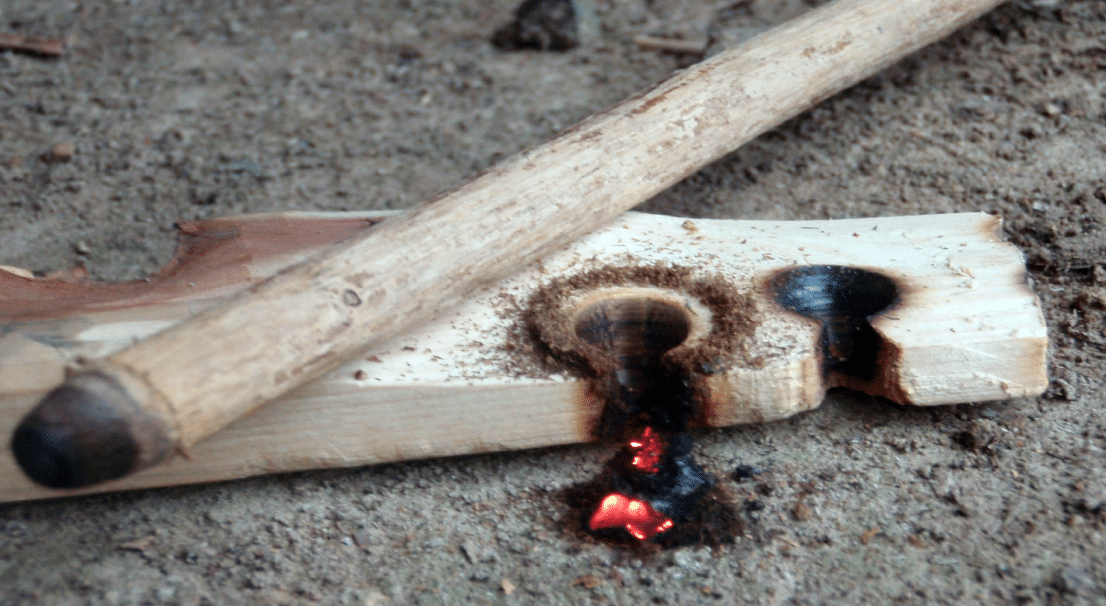
- Resume drilling with faster strokes. Gray char dust collects and smolders into a coal.
- Tip the coal into your tinder bundle; cup, breathe, and coax to flame.
Troubleshooting: Palms burn? Cut a wrist‑to‑elbow sleeve from an old T‑shirt to reduce friction. Coal won’t form? Your dust should be coffee brown; pale tan means the wood is too moist.
🏹 3. Bow‑Drill Method — Higher RPM, Less Hand Abuse
Gear Checklist
- Bow: 60–70 cm flexible branch + cordage (550 paracord, leather lace, or rawhide).
- Spindle & fireboard: Same woods as hand‑drill, spindle slightly thicker (2 cm).
- Bearing block: Rock or hardwood wedge, dimpled with a knife tip.
Execution
- Wrap the bowstring once around the spindle.
- Kneel with one foot pinning the fireboard; hold bearing block on top.
- Saw steadily; speed builds friction until smoke appears.
- Continue 20 seconds past first smoke—premature stops kill the ember.
Beginner-friendly kit: For practice at home, the Practical Survival Bow-Drill Kit saves you carving time and helps build muscle memory.
🚜 4. Fire Plough — Simpler Carve, More Elbow Grease
- Best wood combo: cedar board + oak shaft builds heat fastest.
- Groove tip: carve a shallow “U,” wedge thin bark at the end to trap dust.
- Push angle: keep shaft ≈ 15°; low angle piles dust instead of shaving it off.
Carve a 30 cm groove down a softwood board. Rub a hardwood shaft vigorously down the channel; dust collects at the bottom, heats, and ignites. Jam a wedge at the far end to trap dust. Expect sweat—this is calorie expensive.
Primitive methods are powerful, but combining them with modern ignition tools gives you the highest success rate. See our complete fire starters guide for a full breakdown of reliable gear.
⚒️ 5. Flint & Steel — Stone‑Age Sparks That Still Work
Ingredients
- High‑carbon steel striker (old file or a purpose‑made “C” striker).
- Sharp flint, chert, or quartz edge.
- Char cloth or amadou fungus to catch low‑temp sparks.
Strike steel at 30–45° across the rock’s edge. Orange sparks land on char cloth, glowing like cigarette ash; fold the ember into a tinder nest and blow.
DIY char cloth: 100 % cotton squares baked in a tin can with a pinhole over campfire coals for 10 minutes. Jet‑black means success.
🌩️ 6. Ferrocerium Rod — “Modern Primitive” Reliability
Ferro rods throw sparks exceeding 3,000°C — hot enough to ignite marginal tinder, damp shavings, or scraped fatwood.
Unlike disposable lighters:
- Works wet
- No fuel required
- Windproof spark
- Thousands of strikes
- Long shelf life
Technique matters:
- Scrape slowly to pile ferro dust into your tinder.
- On the final stroke, snap hard and fast.
- Keep the rod still — pull the striker back to avoid scattering the nest.
Recommended Size
Choose a 4–5 inch rod minimum. Tiny keychain rods are backup only.

A full-sized ferro rod belongs in every bug-out bag and winter kit.
☀️ 7. Solar Ignition — Harness Free Photons
- Magnifying lens: Old reading glasses or 3–5 × Fresnel card focuses a pin‑point on dark tinder.
- Parabolic mirror: Polish the bottom of an aluminum soda can with chocolate or toothpaste; angle to concentrate sunlight on charred cotton.
Works best 10 a.m.–2 p.m. under cloudless skies; blackened tinder accelerates ignition.
Turn that flame into a meal with a stable bushcraft cooking tripod.
🧪 8. Chemical Tinder Tricks — When Nature Meets Chemistry
Carry these “cheat codes” sparingly (they’re not truly primitive, but life savers):
- Potassium permanganate + glycerin: Few crystals plus a teaspoon glycerin ignite in 30–60 seconds.
- AA battery + fine steel wool: Touch wool to both terminals; glowing filaments light dry grass instantly.
Store chemicals in separate vials. Mis‑mix in your pack and you’ll have more excitement than you wanted.
🔥 Building & Maintaining the Fire
Fire Lays
- Teepee: Fast heat and light; best for quick boil or morale.
- Lean‑to: Wind‑shielded; angle large split logs over the flame.
- Log cabin: Steady burn, less tending—perfect for cold nights.
Feather Sticks & Fatwood
When ground tinder is damp, carve feather sticks (thin curls still attached) or shave resin‑rich fatwood for a diesel‑like boost.
Want longer burn time from small tinder? Try waxed options from
Does All Wax Burn? Survival Fire Hacks.
Coal Extension
Bury fist‑size punk wood in ash to preserve coals overnight. Next morning, fan gently—instant relight.
🛡️ Safety & Leave‑No‑Trace
- Clear a 1‑m radius: Down to mineral soil; remove duff.
- Keep water nearby: At least 4 L or shovel and dirt.
- Extinguish cold‑out: Stir ashes; back of hand feels zero warmth.
- Pack out charred remains: Char cloth, batteries, chemical tins—don’t litter wild spaces.
🔥 Stormproof Lighter — Speed in Bad Conditions
Primitive skills build resilience. A stormproof lighter builds speed.
Torch-style lighters offer:
- Wind resistance
- Focused flame
- One-hand ignition
- Reliable cold-weather performance when kept warm
Rechargeable plasma lighters also work well for grid-down kits when paired with a power bank.
This isn’t about replacing primitive skills — it’s about layering reliability.
Cold hands and hypothermia are not the time to test your ego.
🔥 Build a Complete Survival Fire Kit
Redundancy wins.
A balanced fire kit includes:
- ✔ Full-sized ferro rod
- ✔ Magnesium block
- ✔ Stormproof lighter
- ✔ Waterproof matches
- ✔ Resin-rich tinder (fatwood or wax tabs)
One ignition method is confidence.
Three methods is preparation.
If you want an all-in-one solution:

Build once. Replace rarely. Practice monthly.
For a full breakdown of modern and primitive ignition tools, see the
Ultimate Survival Fire Starters Guide.
🔥 Common Primitive Fire Mistakes
- ❌ Tinder not fine enough to catch a coal
- ❌ Using damp wood without splitting to dry core
- ❌ Stopping drilling too early before ember forms
- ❌ Skipping backup ignition tools
🏁 Final Flame Thoughts
Primitive firecraft marries physics with grit. Start with the bow‑drill until muscle memory locks, then level‑up to hand‑drill for true Stone‑Age cred. Keep a ferro rod as fail‑safe—purists may scoff, but hypothermia never cared about bragging rights. Practice monthly, rain or shine, and your spark will never depend on plastic lighters again.
Further Reading:
- How to Use a Survival Knife (Video)
- Fire Starters That Work in Extreme Heat (Top 7 for 2025)
- Starting a Fire in Wet Weather
- Does All Wax Burn? Survival Fire Hacks
Stay savvy. Stay safe. And keep that flame alive.