
Lost Without a Compass? Use the Shadow Stick Method to Find Direction
When you’re lost in the wilderness and need to navigate without a compass, the shadow stick method becomes one of the simplest and most reliable ways to find true north. By using only the sun, a stick, and the ground beneath you, you can orient yourself with surprising accuracy. It’s a timeless bushcraft technique that requires no batteries, no signal, and no luck—just patience and observation.
This post contains affiliate links. I may earn a small commission at no extra cost to you. Learn more.
If you’re off-grid with no signal, you still need a way to coordinate or get help — here’s how to communicate when the grid goes down when modern systems fail.
Why Learn the Shadow Stick Method?
Learning how to find north without a compass is one of the core wilderness navigation skills every survivalist should master.
Even if your GPS dies and your map blows away, a patch of sun turns into reliable bearings.
🧭 Add a Precision Navigation Backup
The shadow stick works — but it’s slow and dependent on sunlight.
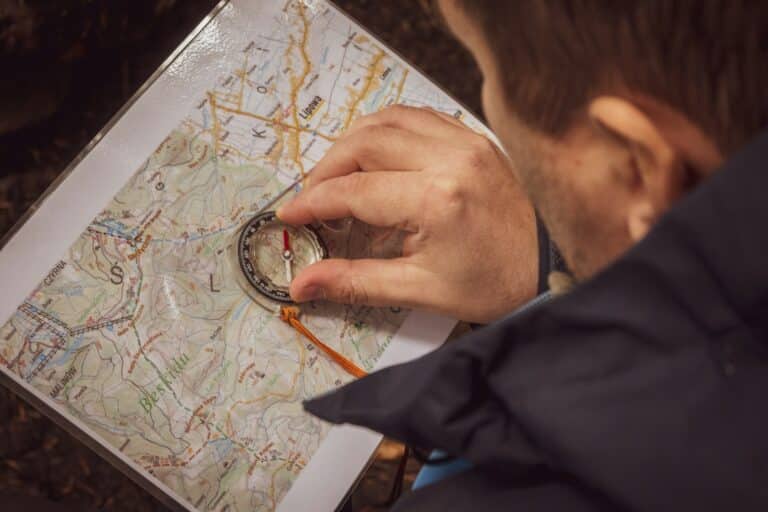
Pair this skill with a dependable compass so you can:
- Confirm bearings instantly
- Navigate under cloud cover
- Travel accurately over distance
Recommended Baseplate Option:

If you prefer a rugged military-style setup, a lensatic compass is another reliable option for precision sighting and durability.
Choose the style that matches how you travel. The skill remains the same — the tool refines it.
Gear Checklist
- 🪵 Straight stick—roughly arm-length and thumb-thick
- 🪨 Two or three markers—pebbles or short twigs work
- ☀️ Sunny, level ground—sand, dirt, or short grass
- ⏱️ (Optional) watch/phone timer if you want to track the wait period
Six-Step How-To
- Plant the stick perfectly vertical. Sight it against the sky or a trekking pole to remove tilt.
- Mark the first shadow tip (Point A). Drop a pebble at the tip. In the Northern Hemisphere, this point ≈ West.
- Wait 10–15 minutes. Longer—up to an hour—sharpens accuracy. Use the downtime to hydrate or scan for hazards.
- Mark the new shadow tip (Point B). Pebble #2 lands at the fresh tip, ≈ East.
- Draw a straight line A → B. That’s your East-West baseline.
- Face True North. Stand on the line with Point A (West) on your left shoulder, Point B on your right. Spin 180° for South.
Speed hack: A 5-minute gap still yields a “good-enough” line when daylight is fading—just accept ±15° of potential drift and verify at first light.
⚠️ Why You Should Still Carry a Compass
The shadow stick gives you an East-West line.
It does NOT give you:
- Bearing degrees
- Triangulation
- Night navigation
- Route tracking
- Fast course correction
Use the stick to confirm direction. Use the compass to move accurately.
Field Accuracy Boosters 🔧
Shadow Stick Method FAQs 🧭
Does it work south of the equator?
Yes—Point A marks East and Point B marks West; simply reverse the labels.
How accurate can I expect?
±5° with a 30-minute wait and good technique; rush it and drift can stretch to ±15°—still better than blind guessing.
What if clouds roll in midway?
Stop and restart once strong, defined shadows return. Diffuse light smears the tip.
Can this double as a sundial?
Mark each hour’s shadow tip for six hours; label the points. You’ll create a rough solar clock plus multiple East-West checks.
Any winter or latitude limits?
Above ~60° latitude in winter the sun skims the horizon. Shadows are long but move slowly. Combine this method with a watch-bearing trick for backup.
Common Mistakes & Quick Fixes
| Stick not vertical | Baseline skews—sight it against a pole or two-stick plumb frame. |
| Too short a wait | Points overlap—extend the interval or mark a third tip. |
| Slope underfoot | Shadow shortens unevenly—shift to flatter ground. |
| Forgot hemisphere flip | East/West reversed—note your latitude and swap labels if south of the equator. |
Why the Shadow Stick Works (30-Second Science)
Earth spins eastward at roughly 1,000 mph, so every fixed object casts a shadow that slides west-to-east. Stamp two shadow tips in time and you’ve drawn a mini-map of that rotation—your instant East-West line. Trail Hiking Australia outlines the same method. No silicon, no battery—just geometry.
🎒 Build a Minimalist Navigation Kit
If you want to turn this skill into a reliable system, carry:
- Baseplate compass
- Signal mirror
- Waterproof map case
- Emergency whistle
- Ferro rod
Compact. Lightweight. Redundant. The kind of gear that turns a primitive skill into a dependable system.
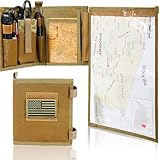
This keeps you prepared when sun, terrain, or time aren’t ideal.
Next Challenge
On your next day hike, stash the compass in your pack. Navigate a one-mile leg using only the shadow stick method. Log any drift, adjust, and repeat until your line is razor-straight. Real-world reps beat theory every time.
Takeaway: Gear fails. The sun doesn’t. Lock the shadow stick method into your skillset and you’ll never be truly lost—only between sticks.
Conclusion:
Once you master this technique, you’ve built the foundation for every other wilderness direction-finding skill. From here, level up by learning how to signal your location to rescuers with mirrors, smoke, or sound — see How to Signal for Help in Remote Wilderness Areas.
📡 Upgrade Your Wilderness Signaling
Knowing direction is step one.
If you actually need rescue, you must be able to signal location clearly.
A proper glass signal mirror reflects sunlight for miles — far more effective than improvised flashing.

Pair navigation with signaling and you dramatically increase survival odds.
Direction is critical, but it’s only one piece of the broader Wilderness Survival Guide (2026) system.