What Size Generator Do I Need to Run a Well Pump?
What size generator do I need to run a well pump? Most residential well pumps need a generator capable of producing approximately 3,500 to 7,500 starting watts, but the correct size depends on the pump’s horsepower, voltage, startup demand, and any other equipment you plan to operate. A smaller 1/2-horsepower pump may work with a generator near the lower end of that range, while a 1-horsepower or larger pump may require 5,000 to 10,000 starting watts.
This post contains affiliate links. I may earn a small commission at no extra cost to you. Learn more.
The generator must provide enough continuous wattage to keep the pump running. It must also handle the brief but substantially higher electrical demand created when the pump motor starts. A generator that appears large enough based only on running watts can still overload, trip a breaker, or fail to start the pump when the pressure switch calls for water.
Well-pump generator sizing becomes more complicated because two pumps with the same horsepower do not necessarily have identical electrical requirements. A submersible pump installed hundreds of feet underground may behave differently from a shallow-well jet pump. Motor design, control boxes, pressure settings, wire length, pump condition, and the generator’s ability to maintain voltage during startup can all affect performance.
You must also decide whether the generator will operate only the well pump or supply several essential household circuits. A generator that can start the pump by itself may not have enough remaining capacity to run a refrigerator, freezer, lights, furnace blower, or other equipment simultaneously. Adding those loads requires a larger generator and a deliberate load-management plan.
This guide explains how to identify your well pump, estimate its running and starting requirements, compare generator sizes by pump horsepower, and account for additional household loads. It also covers the difference between 120- and 240-volt pumps, safe connection methods, and common sizing mistakes that can leave a private well unusable during an outage.
Quick Answer
For many homes with a 1/2- to 1-horsepower well pump, a generator rated for 5,000 to 7,500 starting watts is a practical planning range. However, you must verify the pump’s voltage, running amperage, starting amperage, and horsepower before buying a generator. If the pump operates on 240 volts, the generator must provide 120/240-volt output. A high-wattage 120-volt-only generator still cannot operate a 240-volt well pump.
Emergency Scenario
A storm knocks out power to a home supplied by a private well. The homeowner has a portable generator, but the pump will not start because it requires 240-volt power and a higher startup surge than the generator can provide. Although plenty of water remains underground, the pressure tank cannot refill. Correctly identifying the pump and sizing the generator beforehand prevents this problem during an actual outage.
Start by Identifying Your Well Pump
Before choosing a generator, determine exactly what kind of well pump you have. Do not select a generator based only on the depth of the well or the size of the circuit breaker. Those details can provide clues, but they do not reveal the pump’s complete electrical requirements.
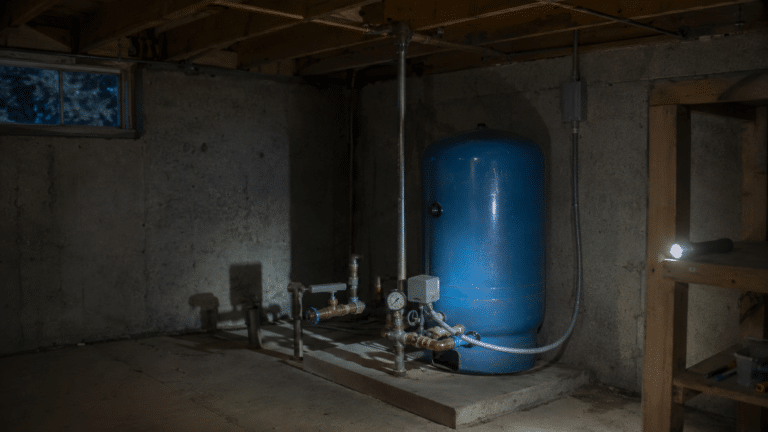
The most useful information includes the pump’s horsepower, operating voltage, running amperage, and starting amperage. You may find these specifications on the pump documentation, an installation record, a control box, or a label near the pressure tank. Because submersible pumps are located underground, their motor labels are usually not visible without pulling the pump from the well.
Check the Well and Pump Records
Start with any paperwork left by the well installer. A well-completion report, pump invoice, service receipt, or owner’s manual may identify the pump manufacturer, model number, horsepower, voltage, and installation depth. If you do not have these records, contact the company that installed or last serviced the well. Many well contractors retain equipment and service information for their customers.
The well cap may also contain an installer’s name, identification number, or basic information about the system. However, the well depth written on a record does not automatically tell you the pump’s horsepower. Pump size also depends on water level, desired flow rate, pipe size, pressure requirements, and the vertical distance the water must be lifted.
Inspect the Control Box and Electrical Panel
Some three-wire submersible pumps use a separate control box mounted near the pressure tank or electrical equipment. A label on the outside may show the compatible horsepower and voltage. Many residential submersible pumps operate on 230 or 240 volts, although some smaller pumps and shallow-well jet pumps use 115 or 120 volts.
The electrical panel can help confirm whether the pump uses a single-pole 120-volt circuit or a double-pole 240-volt circuit. Nevertheless, breaker size should not be treated as the pump’s actual running amperage. Breakers are selected to accommodate motor startup and protect the circuit, so a pump connected to a 20- or 30-amp breaker does not necessarily draw that amount continuously.
Safety Warning
Do not remove a control-box cover, pressure-switch cover, well cap, or electrical-panel cover to search for specifications unless you are qualified to work around energized equipment. Exposed terminals may remain dangerous even when the pump is not running. A well contractor or licensed electrician can safely identify the motor and measure its electrical demand.
Have the Pump’s Startup Demand Measured
If the documentation is missing, an electrician or well professional can measure the pump’s running current and the brief inrush current produced during startup. This provides a more reliable generator-sizing number than a generic horsepower estimate, particularly when the pump is older or other equipment shares the circuit.
Record the information once it is found and keep it with your generator instructions and emergency plan. If you are still learning how the complete system behaves when utility power fails, read Does a Well Pump Work During a Power Outage? before choosing a backup-power setup.
Running Watts and Starting Watts Are Not the Same
A well pump creates two different electrical demands that must be considered when sizing a generator. Running watts describe the power needed after the motor reaches normal operating speed. Starting watts describe the brief surge needed to start the motor and begin moving water.
The starting demand is usually the more important number. A generator may have enough continuous output to keep a pump running but still lack the surge capacity needed to start it. When that happens, the generator may bog down, its voltage may drop, or an overload breaker may trip before the pump begins operating.
Why Well Pumps Need Extra Power at Startup
An electric motor initially draws considerably more current than it uses during normal operation. The surge generally lasts only a fraction of a second or several seconds, but the generator must respond quickly enough to maintain acceptable voltage and frequency throughout that period.
Startup requirements vary by motor design. A conventional pump motor may briefly draw several times its normal running current, while a pump controlled by a variable-frequency drive or soft-start system may have a lower startup demand. This is why multiplying horsepower by a single generic wattage figure does not always produce an accurate answer.
Understand Both Generator Ratings
Portable generators normally display two output ratings. The running-watt rating is the amount of power the generator can supply continuously. The starting-watt or surge-watt rating is the higher amount it can provide temporarily.
| Generator Rating | What It Means | How It Affects a Well Pump |
|---|---|---|
| Running watts | Power the generator can provide continuously | Must cover the pump’s normal demand plus any other loads operating at the same time |
| Starting watts | Temporary output available for motor startup | Must be high enough to handle the pump’s initial surge without excessive voltage drop or overload |
For example, suppose a pump requires approximately 1,500 watts while running but briefly needs 4,500 watts to start. A generator rated for 3,500 running watts and 4,000 starting watts would appear large enough based on its continuous rating, but its surge capacity would still be too low for that pump. A model with at least 4,500 starting watts would be required, and additional capacity should be allowed for uncertainty and other connected equipment.
Do Not Rely Only on Volts Times Amps
Multiplying volts by amps provides a useful planning estimate, but an alternating-current motor also involves power factor, efficiency, and startup characteristics. The result may represent apparent electrical demand rather than the exact wattage the generator must deliver. This is especially important during motor startup.
Use the pump manufacturer’s generator recommendation, starting-current specification, or a professional measurement whenever possible. Generic calculations and horsepower tables should be treated as planning tools rather than guaranteed compatibility.
What Size Generator Is Needed for Each Well-Pump Horsepower?
Pump horsepower provides a useful starting point when the exact startup amperage is unavailable. Most residential well pumps fall between 1/2 and 1 1/2 horsepower, although smaller and larger systems are possible. As horsepower increases, both the normal operating demand and the startup surge generally increase.
The following ranges are conservative planning estimates for conventional residential pump motors. They are not a replacement for the pump manufacturer’s specifications or a measured startup-current reading.
| Pump Horsepower | Estimated Running Demand | Possible Starting Demand | Generator Size to Investigate |
|---|---|---|---|
| 1/2 horsepower | 750–1,200 watts | 2,000–3,500 watts | 3,500–5,000 starting watts |
| 3/4 horsepower | 1,000–1,600 watts | 3,000–4,500 watts | 4,500–6,000 starting watts |
| 1 horsepower | 1,500–2,000 watts | 4,000–6,000 watts | 5,000–7,500 starting watts |
| 1 1/2 horsepower | 2,000–2,800 watts | 5,500–8,000 watts | 7,500–10,000 starting watts |
| 2 horsepower | 2,500–3,500 watts | 7,000–10,000 watts | 10,000–12,500 starting watts |
The “generator size to investigate” column does not mean every generator within that range will operate every pump of that horsepower. The generator must also provide the correct voltage, enough continuous wattage, sufficient motor-starting capacity, and a compatible connection.
Example: Sizing for a 1-Horsepower Pump
Suppose a 240-volt, 1-horsepower pump uses approximately 1,800 watts after starting and may need up to 5,000 watts during startup. A generator rated for 5,500 running watts and 6,875 starting watts may be a reasonable candidate if the well pump is the primary load.
However, a generator advertised as producing 6,000 watts is not automatically suitable. That figure may represent its temporary peak output rather than continuous output, and the unit may provide only 120-volt power. The complete specification sheet must confirm that it has 120/240-volt output and can sustain the pump’s starting demand.
Allow Additional Capacity Instead of Sizing to the Exact Number
A generator should not be selected with its maximum rating exactly equal to the estimated pump demand. Voltage drop, temperature, altitude, fuel type, generator design, long wiring runs, and other connected loads can reduce real-world performance. Propane and natural-gas output may also be lower than the gasoline rating on a multi-fuel generator.
When accurate pump data is available, selecting a generator with approximately 20% to 25% capacity above the calculated peak load provides a more useful margin. Larger margins may be needed when the generator must start the pump while refrigerators, freezers, furnace blowers, or other motor-driven equipment are already operating.
Make Sure the Generator Provides the Correct Voltage
Generator wattage does not matter if the unit cannot supply the voltage required by the well pump. Many residential submersible pumps operate on 230 or 240 volts, while some smaller submersible pumps and shallow-well jet pumps use 115 or 120 volts.
A 120-volt-only generator cannot operate a 240-volt pump, even if its advertised wattage exceeds the pump’s starting requirement. The generator must specifically provide 120/240-volt output through a compatible receptacle or approved connection.
How to Tell Whether the Pump Uses 120 or 240 Volts
A single-pole breaker usually indicates a 120-volt pump circuit. A double-pole breaker with two connected handles usually indicates a 240-volt circuit. The pump paperwork, control-box label, or installation record should provide better confirmation.
Do not assume the voltage based only on whether the pump is submersible or located above ground. Although deeper submersible pumps commonly use 240 volts, manufacturers produce some smaller models in both 120- and 240-volt versions.
Check the Generator Receptacles
A generator capable of producing 240 volts normally includes a four-prong 120/240-volt receptacle, such as an L14-30R or 14-50R. The presence of the proper receptacle does not automatically mean the generator is large enough, but it confirms that the unit can provide both legs of a residential 240-volt supply.
Smaller inverter generators frequently provide only standard 120-volt receptacles. These units may work well for refrigerators, lights, electronics, and certain 120-volt jet pumps, but they generally cannot power a conventional 240-volt submersible well pump.
Practical Tip
Check voltage before comparing wattage, fuel type, noise level, or price. If your pump requires 240 volts, immediately remove every 120-volt-only generator from consideration. This prevents buying a generator that appears powerful enough but cannot connect to or operate the pump.
Account for Other Appliances Running at the Same Time
If the generator will power more than the well pump, add the running demand of every appliance that may be operating when the pump starts. The pump’s starting demand must be added to the running watts already being used by the other equipment.
For example, assume a well pump needs 5,000 watts to start and 1,800 watts to run. At the moment the pump starts, the generator may already be powering the following equipment:
- Refrigerator: 150 running watts
- Freezer: 150 running watts
- Furnace blower: 600 running watts
- Lights and small electronics: 300 running watts
Those additional loads total approximately 1,200 watts. Adding the pump’s 5,000-watt startup demand produces a temporary requirement of approximately 6,200 watts. Allowing a 20% reserve raises the practical target to roughly 7,440 watts.
In this example, a generator with approximately 6,000 running watts and 7,500 starting watts may be a reasonable minimum to investigate. The final selection still depends on voltage, actual appliance demands, generator performance, and whether another motor starts at the same time.
Avoid Starting Several Motors Together
Refrigerators, freezers, air conditioners, furnace blowers, and sump pumps also produce startup surges. If one of these appliances starts while the well pump is starting, the combined demand may exceed the generator’s capacity even though each appliance can run independently.
Load management can reduce the generator size required. Allow the generator to stabilize, start the largest motor load first, and then add smaller circuits gradually. During an outage, you can temporarily turn off high-demand equipment while the well pump refills the pressure tank.
The well pump does not normally need to run continuously. Depending on household water use and pressure-tank capacity, the generator may only need to operate the pump periodically. Once the pressure tank is full, the pump circuit can be switched off before other heavy loads are used.
Do Not Count the Entire Breaker Panel
Sizing a generator does not require adding the rating of every breaker in the home. Breaker ratings represent circuit limits, not the amount of power each circuit continuously consumes. Create a realistic list of the essential equipment you intend to operate and calculate its actual or manufacturer-listed demand.
Connect the Generator to the Well Pump Safely
Most submersible well pumps are hardwired into the home’s electrical system. They cannot simply be unplugged from a wall outlet and connected to a generator. Supplying backup power normally requires a transfer switch, approved panel interlock, or dedicated transfer equipment installed for the pump circuit.
Manual Transfer Switch
A manual transfer switch isolates selected circuits from utility power before connecting them to the generator. This allows the well pump and other essential circuits to receive backup power without energizing the utility lines.
A dedicated single-circuit transfer switch may be practical when the generator will operate only the well pump. A larger transfer switch can supply several selected household circuits, provided the generator is sized for their combined demand.
Electrical-Panel Interlock
An approved interlock mechanically prevents the main utility breaker and generator-supply breaker from being switched on simultaneously. This can provide flexibility because different household circuits can be selected during an outage. However, the homeowner must actively manage those circuits to prevent overloading the generator.
Interlocks must be specifically approved for the electrical panel in which they are installed. A homemade device or an interlock designed for a different panel is not an acceptable substitute.
Plug-Connected Jet Pumps
Some above-ground 120-volt jet pumps use a standard cord and receptacle. These may be easier to operate from a generator, but the cord, receptacle, grounding arrangement, and generator output must still match the pump’s requirements. Outdoor connections must also be protected from rain and standing water.
Never Backfeed a House
Never attempt to power a well pump or household wiring by connecting a generator to a regular wall outlet or dryer receptacle. Backfeeding can energize utility lines, electrocute utility workers, start a fire, and damage the generator or household equipment. Have a licensed electrician install an approved transfer method before an outage occurs.
Test the completed setup after installation. Confirm that the generator starts the pump without severe engine bogging, unstable voltage, repeated breaker trips, or unusual pump behavior. Testing also reveals whether other circuits need to be turned off before the pump starts.
Choose the Right Type of Generator
Once the required wattage and voltage are known, compare generator types based on how the well will be used during an outage. Portable, inverter, and standby generators can all operate certain well pumps, but each has different limitations.
Conventional Portable Generator
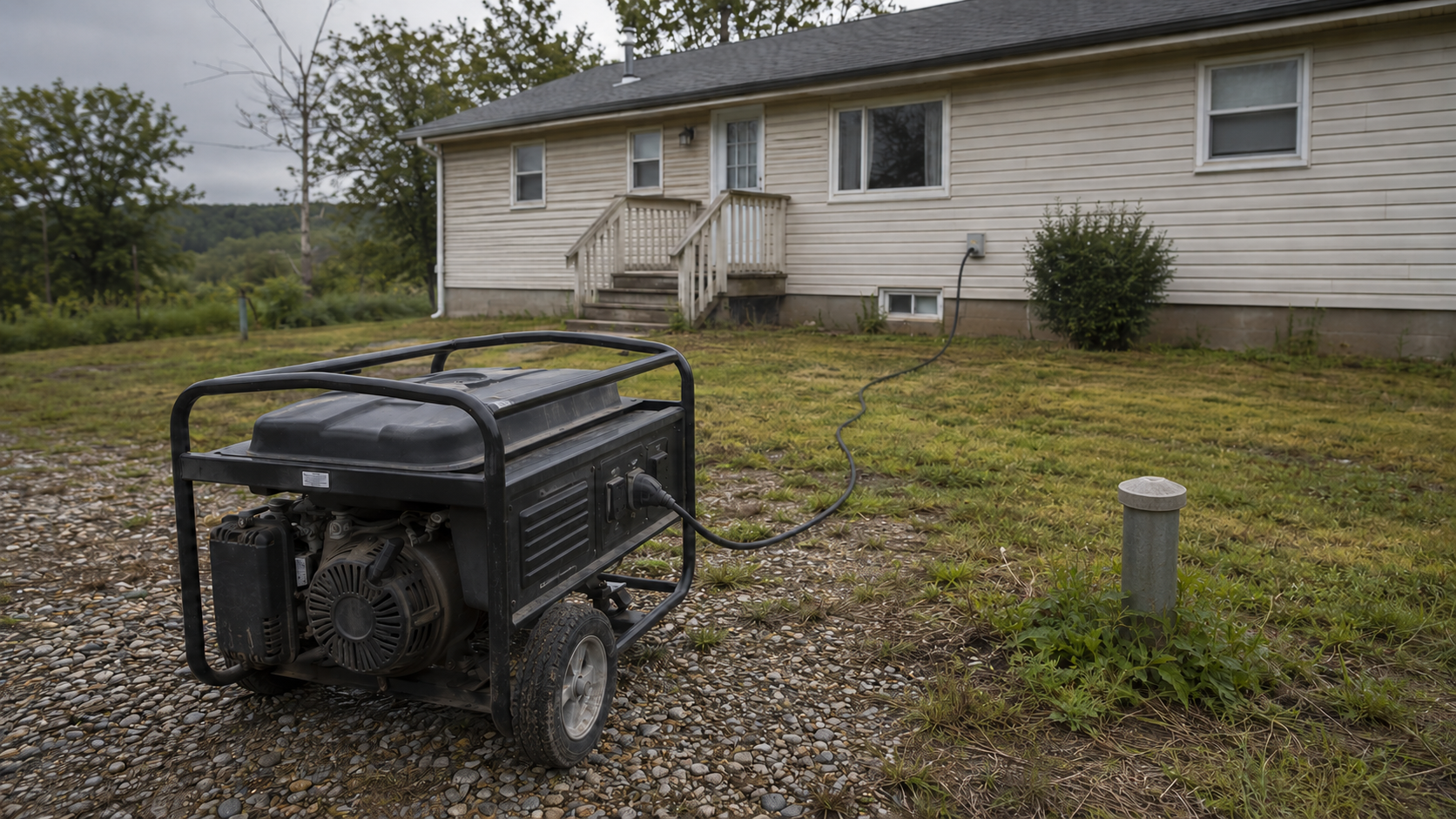
A conventional portable generator is often the most affordable choice for powering a 240-volt well pump. Models in the 5,000- to 10,000-watt range commonly provide 120/240-volt output and enough surge capacity for residential motor loads.
The disadvantages include noise, exhaust, manual setup, and fuel storage. Portable generators must remain outside, away from doors, windows, vents, garages, and crawl spaces where carbon monoxide could enter the home.
Inverter Generator
Inverter generators generally operate more quietly and efficiently at lighter loads while producing stable power for sensitive electronics. However, many smaller models provide only 120 volts. Larger 120/240-volt inverter generators are available, but they usually cost more than conventional units with similar output.
Do not assume two small inverter generators connected with a parallel kit will produce 240 volts. Many parallel systems increase available 120-volt amperage without creating the split-phase 120/240-volt output required by a residential submersible pump.
Whole-House Standby Generator
A permanently installed standby generator can start automatically and supply the well pump along with selected household circuits. It is the most convenient option for frequent outages, households that may be unattended, or anyone unable to set up a portable generator.
Standby systems cost considerably more and require professional sizing, installation, fuel planning, and maintenance. Their output must still account for the well pump’s startup demand and other loads operating at the same time.
Check Output for Every Fuel Type
Dual-fuel and tri-fuel generators may produce different amounts of power on gasoline, propane, and natural gas. Gasoline commonly provides the highest rated output, while propane and natural gas may reduce both running and starting capacity. Size the generator using the rating for the fuel you actually expect to use—not the largest number printed on the generator.
Common Well-Pump Generator Sizing Mistakes
Most generator-sizing failures occur because one important specification was overlooked. Avoid these common mistakes before purchasing or connecting a generator.
Using Only the Pump’s Running Watts
A generator sized only for normal operation may stall or trip when the pump starts. Always compare the pump’s possible startup demand with the generator’s temporary surge rating.
Buying a 120-Volt-Only Generator
A large 120-volt generator cannot operate a 240-volt pump. Confirm that the generator specifically provides 120/240-volt output before comparing other features.
Using the Generator’s Peak Rating as Its Normal Output
The largest wattage printed on a generator is often its temporary starting rating. Check the lower continuous or running-watt rating to determine how much equipment it can operate after startup.
Ignoring Other Connected Loads
A generator that starts the pump by itself may overload when a refrigerator, freezer, furnace blower, or other motor is already running. Include existing loads in the calculation or switch them off while the pressure tank refills.
Forgetting Fuel-Specific Output
A generator may provide less power on propane or natural gas than on gasoline. Use the specifications for your intended fuel when determining whether the unit can start the pump.
Skipping a Real-World Test
Estimated wattage does not guarantee successful operation. Test the generator, transfer equipment, and pump together before an emergency. If the generator struggles, voltage drops sharply, breakers trip, or the pump fails to build pressure normally, shut the system down and have it evaluated rather than repeatedly attempting to start it.
What to Look for in a Generator for a Well Pump
A suitable generator needs more than an impressive wattage rating. Compare the following features before buying:
- Correct voltage: Choose a model with 120/240-volt output if the pump operates on 240 volts.
- Adequate starting capacity: The surge rating must cover the pump’s startup demand plus any equipment already running.
- Sufficient continuous output: Running watts must support the pump and the other essential loads used after startup.
- Compatible receptacle: Confirm that the generator can connect to the professionally installed transfer equipment.
- Fuel flexibility: A dual-fuel model provides another option when gasoline is unavailable, but sizing must use the lower output for propane.
- Electric start: Larger generators can be difficult to start manually, particularly in cold weather or for someone with limited strength.
- Carbon-monoxide shutoff: This provides an additional safety layer but never makes a fuel-burning generator safe for indoor or enclosed operation.
- Available service and replacement parts: A generator is more useful when local maintenance, common parts, and warranty support are readily available.
Do not automatically buy the largest generator available. Oversized units generally cost more, consume more fuel at light loads, and are harder to move and store. The goal is to choose a generator large enough to start the pump reliably, operate planned household loads, and maintain a reasonable reserve without creating unnecessary fuel consumption.
Frequently Asked Questions
Will a 3,500-Watt Generator Run a Well Pump?
It may operate some 1/2-horsepower pumps, but 3,500 watts is not enough for every system. The generator must provide the correct voltage and sufficient startup capacity. Many 240-volt pumps require a larger generator, and numerous generators in this size range provide only 120-volt output.
Will a 5,000-Watt Generator Run a Well Pump?
A 5,000-watt generator can operate many residential 1/2- or 3/4-horsepower pumps and some 1-horsepower pumps when no major additional loads are running. Verify whether 5,000 watts represents running or starting output and confirm that the generator supplies the pump’s required voltage.
Will a 7,500-Watt Generator Run a Well Pump?
A 7,500-watt generator is a practical size for many homes with a 1-horsepower well pump, particularly when several essential appliances must also operate. Larger pumps or unusually high startup demands may require more capacity. Actual pump specifications still override general estimates.
Can a Portable Power Station Run a Well Pump?
Some large power stations can operate a well pump, but the unit must provide sufficient surge capacity and the correct voltage. Most smaller power stations provide only 120 volts and cannot power a conventional 240-volt submersible pump. Battery capacity also determines how many pumping cycles are available before recharging is necessary.
Does Well Depth Determine Generator Size?
Not directly. Well depth influences pump selection, but generator size is based on the installed motor’s voltage, horsepower, running demand, and startup demand. Two wells of similar depth may use different pumps because of water level, flow requirements, pressure settings, and piping conditions.
Can I Run the Well Pump Directly From a Portable Generator?
A plug-connected 120-volt jet pump may be able to use a properly rated generator connection. Most submersible pumps are hardwired and require an approved transfer switch, interlock, or dedicated transfer device. Never energize household wiring through a regular wall outlet.
A Practical Generator Option for Many Residential Well Pumps
Westinghouse 9,500 Peak-Watt Dual-Fuel Generator
The Westinghouse WGen7500DFc provides 7,500 running watts and 9,500 peak watts on gasoline, making it a practical generator to investigate for many 1/2- to 1-horsepower residential well pumps.
It provides 120/240-volt output through a transfer-switch-ready L14-30R receptacle. It also includes gasoline and propane operation, electric and remote starting, and a carbon-monoxide sensor.
- Gasoline output: 7,500 running watts and 9,500 peak watts
- Propane output: 6,750 running watts and 8,550 peak watts
- Voltage: 120/240 volts
- Connection: Transfer-switch-ready L14-30R receptacle
- Fuel options: Gasoline or propane
Important: This generator is not guaranteed to operate every well pump. Confirm your pump’s voltage, startup demand, and additional household loads before purchasing.


Key Takeaways
- Many residential well pumps need a generator with approximately 3,500 to 7,500 starting watts, although larger pumps may require considerably more.
- Generator size must be based on voltage, running demand, startup demand, and additional connected loads—not horsepower alone.
- A 240-volt pump requires a generator that specifically provides 120/240-volt output.
- The generator’s running-watt and starting-watt ratings must both meet the system’s requirements.
- Allow approximately 20% to 25% reserve capacity above the calculated peak demand.
- Use an approved transfer switch, panel interlock, or dedicated transfer device installed for the pump circuit.
- Test the complete backup-power system before an actual outage.
Further Reading
Final Takeaway
For many homes with a 1/2- to 1-horsepower well pump, a 5,000- to 7,500-watt generator with 120/240-volt output is a practical range to investigate. That range is not universal, however. The correct generator is the one that matches the installed pump’s voltage, handles its startup surge, supports planned household loads, and maintains a reasonable reserve.
Identify the pump specifications before buying equipment, use the generator rating for your intended fuel, and have an approved transfer method installed by a qualified electrician. A properly sized and tested system can restore water during an outage, while a guess based only on horsepower or advertised peak watts can leave the pump unable to start when it is needed most.