Best Transfer Switches for Portable Generators: Home Backup Guide
Choosing the best transfer switches for portable generators is an important part of building a safe and reliable home backup-power system. If you want to power household circuits instead of running individual extension cords to appliances, you need approved equipment that safely connects your generator to your home’s electrical system.
This post contains affiliate links. I may earn a small commission at no extra cost to you. Learn more.
That’s where transfer equipment comes in.
A properly designed generator connection allows selected household circuits to receive backup power while preventing generator power and utility power from being connected to the home’s electrical system at the same time. That isolation is critical because an improper connection can backfeed electricity onto utility lines and create a serious hazard.
Depending on your electrical panel and backup-power plan, you may use a manual transfer switch or an approved panel-specific interlock system.
With the right setup, you may be able to keep essential equipment operating during an outage, including:
- Refrigerators and freezers
- Furnace controls and blowers
- Sump pumps
- Compatible well pumps
- Lighting circuits
- Selected household outlets
The goal isn’t necessarily to power your entire house. It’s to identify the circuits that matter most, determine how much power they require, and build a generator connection system around those loads.
For a broader look at backup-power planning, see our Grid-Down Survival Playbook: Backup Power and Emergency Essentials . It covers generators, solar integration, battery backup, and load management for longer outages.
Start With Your Essential Loads
Before choosing a transfer switch, make a list of the circuits your household actually needs during an outage. Refrigeration, water, heating equipment, communications, medical equipment, and basic lighting should usually take priority over convenience loads.
Once you know those loads, you can match the generator and transfer equipment to a realistic emergency power plan instead of simply buying the largest equipment you can afford.
What a Transfer Switch Actually Does
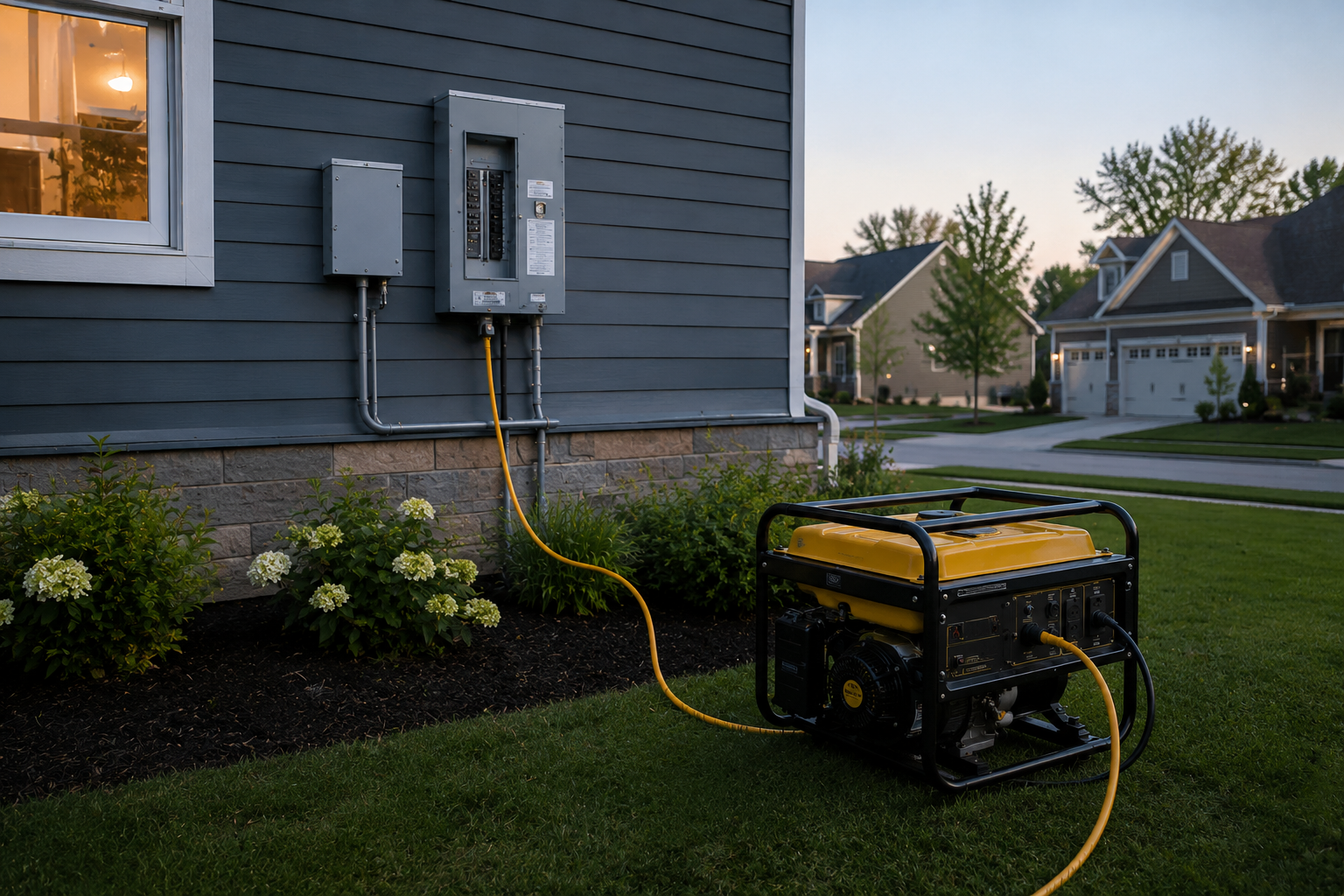
A transfer switch provides a controlled way to supply selected household circuits from a generator while keeping generator power isolated from utility power.
That isolation is the most important job of the switch. Without approved transfer equipment, an improperly connected generator can backfeed electricity onto utility lines, creating a potentially deadly hazard for utility workers and others.
With a typical manual transfer switch, selected circuits can be switched between utility power and generator power. The exact controls and operating sequence vary by model, so the manufacturer’s instructions should always be followed.
Depending on the transfer switch, generator, and electrical system, the setup may support both 120V and 240V loads. That can make it possible to operate equipment such as:
- Refrigerators and freezers
- Lighting and selected outlets
- Furnace controls and blowers
- Sump pumps
- Compatible well pumps
- Other essential circuits within the generator’s capacity
Large motor-driven equipment deserves special attention. A well pump, furnace blower, refrigerator compressor, or similar load may require considerably more power during startup than it uses while running.
Neutral and Grounding Configuration Matters
Generator and transfer-switch installations do not all use the same neutral and grounding arrangement. Some portable generators have a bonded neutral, while others use a floating neutral, and transfer equipment can be designed differently as well.
Use the requirements for your specific generator and transfer equipment rather than assuming one wiring configuration applies to every installation.
Interlock vs. Transfer Switch: Which Is Right for You?
A manual transfer switch and an approved panel interlock can both provide a safe method of preventing utility power and generator power from supplying the home’s electrical system at the same time when the equipment is properly matched and installed.
The better choice depends on your electrical panel, generator, essential loads, budget, and how you want to manage circuits during an outage.
Interlock Kit
An interlock kit is a mechanical device installed on a compatible breaker panel. It prevents the generator breaker and main utility breaker from being switched on at the same time.
Unlike a small transfer panel with a predetermined group of circuits, an interlock can give you access to circuits in the main panel. That provides flexibility, but it also means you are responsible for managing the load so the generator isn’t overloaded.
Advantages:
- Uses the home’s existing breaker panel
- Provides flexibility in choosing which circuits receive generator power
- Usually requires less additional wall-mounted equipment
- Can be a cost-effective permanent solution when approved for the specific panel
Considerations:
- The interlock must be compatible with the exact electrical panel
- You must actively manage the circuits being powered
- The generator still limits how much equipment can operate at once
- Installation and approval requirements vary by panel and jurisdiction
Manual Transfer Switch
A manual transfer switch typically supplies a predetermined group of essential circuits. Depending on the model, individual circuits may be switched between utility and generator power from the transfer panel.
This approach can make emergency operation straightforward because the important circuits are selected when the system is installed.
Advantages:
- Creates a clearly defined group of essential circuits
- Makes load management straightforward
- Some models include watt meters or other load-monitoring features
- Can make the system easier for other household members to operate
Considerations:
- Generator power may be limited to the circuits included in the transfer system
- Usually requires additional equipment beside the main panel
- Capacity and installation cost vary considerably by system
Which One Is Better?
Neither system automatically wins for every home.
An approved panel-specific interlock can be a good choice when you want flexibility in selecting circuits and are comfortable managing generator loads from the main panel.
A manual transfer switch can be a better fit when you want a predetermined group of essential circuits and a straightforward way to manage them during an outage.
Whichever approach you choose, the critical requirement is the same: utility power and generator power must remain safely isolated from one another.
Transfer Switch Options for Portable Generators
Transfer switches are not one-size-fits-all. The right model depends on your generator’s outlet configuration and output, the circuits you need to power, whether you have 120V or 240V loads, and the electrical system where the switch will be installed.
The three options below represent different approaches to generator backup. Before purchasing, verify the current manufacturer’s specifications and compatibility with your generator and electrical system.
Quick Comparison
| Model | Type | Key Consideration | Best Fit |
|---|---|---|---|
| Reliance Controls 31406CRK | Manual transfer-switch kit | 30A class system for selected essential circuits | Smaller essential-circuit backup systems |
| Champion Transfer Equipment | Generator transfer equipment | Verify exact generator, switch, inlet, and panel compatibility | Champion-based backup systems |
| Generac HomeLink 9854 | Manual transfer switch | 50A system with expandable circuit capacity | Larger portable-generator backup systems |
1. Reliance Controls 31406CRK
The Reliance Controls 31406CRK is a manual transfer-switch kit designed around selected essential circuits rather than attempting to supply every circuit in the home.
This type of setup makes sense when your outage priorities are equipment such as refrigeration, lighting, furnace controls, a sump pump, or other essential loads that fit within the generator and transfer-switch capacity.
The 31406CRK is an older Reliance Pro/Tran model. Reliance now cross-references it to the newer Pro/Tran 2 306CRK, so check the exact model being sold and its current specifications before purchasing.
Best for: Homeowners who want a straightforward essential-circuit backup system instead of whole-panel generator access.

2. Champion Transfer Equipment
Champion offers generator and transfer-equipment combinations for home backup applications. If you’re already using a Champion generator, matching compatible equipment from the same manufacturer can simplify planning, but compatibility still needs to be verified for the exact generator and transfer equipment.
Pay particular attention to generator voltage, outlet configuration, amperage, required inlet, and whether the equipment you intend to power includes 240V loads.
Best for: Homeowners building a backup system around compatible Champion generator equipment.

3. Generac HomeLink 9854
The Generac HomeLink 9854 is a 50A manual transfer switch intended for portable-generator backup. Generac lists the 9854 as a prewired indoor HomeLink model that provides 10 circuits and can accommodate additional circuits up to the model’s specified maximum.
One advantage of the HomeLink platform is expandability. Generac states that compatible HomeLink switches can also be upgraded for use with certain Generac home standby generators, which can be useful if you eventually move beyond portable-generator backup.
Best for: Larger essential-load systems where a 50A transfer setup and additional circuit capacity are useful.

Check Compatibility Before You Buy
Don’t choose a transfer switch from generator wattage alone. Verify the generator’s voltage, outlet configuration, amperage, transfer-switch rating, required inlet, number of circuits, and any 120V or 240V loads you intend to operate.
Product specifications and model availability can change, so check the current manufacturer documentation for the exact model before purchasing or installing transfer equipment.
Planning a Transfer Switch Installation
Installing a transfer switch means making permanent changes to your home’s electrical system. The exact installation depends on the transfer equipment, electrical panel, generator, circuits being powered, and local electrical requirements.
Instead of treating every installation the same, start by planning the complete backup-power system.
Before Installation
- Choose your essential circuits: Decide which circuits you actually need during an outage, such as refrigeration, heating equipment, a sump pump, well pump, lighting, or selected outlets.
- Calculate the electrical loads: Account for both normal running wattage and the higher startup demand of motor-driven equipment.
- Identify 120V and 240V loads: Well pumps, HVAC equipment, and other larger appliances may require 240V and must be supported by the generator and transfer equipment.
- Match the equipment: The generator, cord, inlet, transfer switch, breakers, conductors, and connectors all need compatible voltage and amperage ratings.
- Verify neutral and grounding requirements: The correct configuration depends on the generator and transfer equipment being used.
- Check permit and inspection requirements: Requirements vary by location, so verify them with the local authority before beginning permanent electrical work.
Don’t Use Universal Installation Measurements
There is no single mounting height, panel spacing, conductor size, conduit arrangement, or generator-cord configuration that applies to every transfer-switch installation.
Follow the instructions supplied with the specific equipment and the electrical requirements that apply to your installation.
Professional Installation vs. DIY
Load planning, generator sizing, circuit selection, and equipment research are useful things for a homeowner to understand. Permanent panel wiring is different.
If you’re not qualified to work inside electrical panels, have the transfer equipment installed or verified by a qualified electrician. Mistakes involving source isolation, neutral configuration, grounding, breaker sizing, or conductor sizing can create shock, fire, equipment-damage, and backfeed hazards.
Permits, Electrical Requirements, and Safety
Permit and inspection requirements for generator transfer equipment vary by jurisdiction. Because a transfer switch or interlock changes how an alternate power source connects to household wiring, check the requirements that apply where you live before installation.
Depending on the system and jurisdiction, an installation may need to address:
- Approved transfer or interlock equipment
- Correct breaker and conductor sizing
- Generator and inlet ratings
- Neutral and grounding configuration
- Outdoor equipment and weather protection
- Working clearances around electrical equipment
- Required labeling
- Permitting and inspection where applicable
Insurance requirements can also vary by company and policy. Don’t assume that one specific transfer switch automatically guarantees coverage or that a particular permitting issue automatically voids a claim. If you’re concerned about coverage, verify the requirements with your insurer.
Never Backfeed Through a Household Receptacle
Never attempt to power household wiring by connecting a portable generator to a dryer receptacle, range receptacle, or ordinary household outlet.
If a generator will supply household circuits, use approved transfer equipment designed for that purpose.
Generator Placement and Carbon Monoxide Safety
A correctly installed transfer switch does not eliminate the carbon-monoxide hazard created by a fuel-burning generator.
Operate portable generators outdoors and follow the generator manufacturer’s placement instructions and current carbon-monoxide safety guidance. Keep generator exhaust away from doors, windows, vents, crawlspaces, and other openings where fumes could enter the home.
Keep working carbon-monoxide alarms inside the home, particularly near sleeping areas, and test them regularly according to the manufacturer’s instructions.
Keep an Operating Guide With the System
Once the system is installed, keep the generator and transfer-switch instructions somewhere easy to find. A simple household operating guide can also list the startup and shutdown sequence, essential circuits, and any high-demand loads that should not operate simultaneously.
That preparation matters during an outage because you don’t want to learn how your backup-power system works for the first time in the dark.
Integrating a Transfer Switch With Your Generator
Once transfer equipment is installed, the next step is making sure the generator, fuel supply, inlet, transfer equipment, and essential loads work together as one backup-power system.
For many households, a dual-fuel portable generator can add useful flexibility. Gasoline is widely available and may provide the generator’s highest rated output, while propane is easier to store for long periods and avoids some of the storage problems associated with gasoline.
The transfer switch itself doesn’t determine which fuel you use. Its job is to manage the electrical connection. As long as the generator is operating within the electrical requirements of the system, you can use the fuel supported by that generator according to the manufacturer’s instructions.
Plan Your Backup System Around the Loads
- List your essential circuits: Start with refrigeration, water, heating equipment, communications, medical equipment, lighting, and other loads you consider necessary during an outage.
- Calculate running demand: Record the running wattage of the equipment you expect to operate.
- Account for startup demand: Refrigerators, freezers, well pumps, sump pumps, furnace blowers, and other motor-driven equipment can require substantially more power when starting. Use equipment specifications when available rather than applying one universal multiplier.
- Identify 120V and 240V equipment: If essential equipment requires 240V, both the generator and transfer system must support it.
- Match the electrical connection: Generator output, receptacle configuration, inlet rating, transfer-equipment rating, breakers, and conductors all need to be compatible.
- Plan which loads can operate together: You may not need enough generator capacity to run every essential appliance simultaneously. Staggering high-demand loads can substantially reduce the generator capacity required.
- Plan for future expansion: If you eventually want battery storage or solar charging, consider that goal before investing heavily in equipment so future upgrades can be planned around the existing backup system.
Generator Size Isn’t Just a Wattage Number
A generator must handle both the continuous demand of your operating equipment and the temporary startup demand of motors and compressors.
A smaller generator with a good load-management plan may support your essential circuits better than a larger generator that is routinely overloaded by poorly managed startup loads.
Using Gasoline and Propane
If you own a dual-fuel generator, understand how its specifications change between fuels. Many models have different running and starting output ratings on gasoline and propane.
Fuel consumption also depends on generator size, electrical load, engine design, operating conditions, and the fuel being used. Don’t assume a propane cylinder or gasoline tank will provide a particular runtime without checking your generator’s specifications and testing your actual setup.
For compatible generator options, see our Dual-Fuel Generator Buyer’s Guide.
Know Your Runtime Before the Outage
Don’t wait until the power is out to find out how quickly your generator consumes fuel. Estimate your expected load and fuel requirements beforehand, then compare those estimates with real-world fuel use during a test run.
That gives you a much better basis for deciding how much gasoline or propane you actually need to keep available for a multi-day outage.
Use our Generator Runtime & Fuel Calculator to estimate runtime and fuel needs based on your generator, load, and fuel supply.
Useful Upgrades for a Generator Backup System
Once the basic generator and transfer system is working correctly, several upgrades can make load management easier and provide additional protection. Not every household needs all of them.
Power Monitoring
Knowing how much electricity your backup loads are using makes it easier to stay within the generator’s capacity.
Some transfer equipment includes built-in watt meters. Other systems may use compatible energy-monitoring equipment to track electrical demand.
The important information is the actual load on the generator. If adding another appliance pushes the system too close to its continuous capacity, you can shut off a lower-priority circuit before an overload occurs.
Whole-Home Surge Protection
A properly selected surge protective device can provide another layer of protection for equipment connected to the home’s electrical system.
Surge protection should be selected for the electrical service and installed according to the device manufacturer’s requirements. It should not be treated as a substitute for correct generator voltage, grounding, transfer equipment, or proper wiring.
Load Management
Load management becomes especially useful when your generator cannot operate every desired circuit simultaneously.
Depending on the electrical system, loads may be managed manually by switching lower-priority circuits off, or automatically with compatible load-management equipment.
For example, you might temporarily avoid operating an electric water heater or another large load while a well pump or other high-demand appliance is running.
This approach can allow a properly sized generator to support more household functions without attempting to run everything at once.
Battery and Solar Expansion
A generator does not have to be the only source of emergency electricity. Battery storage can handle smaller loads quietly between generator runs, while solar charging can replenish some of that stored energy when conditions allow.
A hybrid system can be particularly useful during extended outages because the generator can be reserved for high-demand loads and battery charging instead of operating continuously.
If you’re considering battery backup, use our Battery & Power Station Runtime Calculator to estimate how long a battery system could run your refrigerator, freezer, lights, communications, and other essential loads between generator charging cycles.
If solar will be part of the system, use our Solar Panel Charging Calculator to estimate how much solar capacity you’ll need and how long it may take to recharge your battery bank or power station.
However, adding battery or solar equipment is not simply a matter of connecting it to any existing manual transfer switch. Compatibility and system design depend on the inverter, transfer equipment, electrical panel, battery system, and how the different power sources are intended to interact.
If hybrid backup is part of your long-term plan, design for it intentionally rather than assuming any transfer switch can be converted later without additional equipment or wiring changes.
Build in Layers
A practical backup-power system doesn’t have to be built all at once.
Start with safe generator connections and essential-load management. Then consider monitoring, surge protection, battery storage, or solar charging if those upgrades solve a real problem for your household.
The goal is dependable emergency power, not adding equipment simply because it is available.
Testing and Maintaining Your Generator Transfer System
A backup-power system should be tested before you actually need it. The goal isn’t simply to confirm that the generator starts. You want to know that the generator, inlet, transfer equipment, and essential circuits work together correctly under a realistic load.
Follow the Generator’s Maintenance Schedule
Maintenance intervals vary by generator. Follow the manufacturer’s recommendations for oil changes, filters, spark plugs, starter batteries, fuel-system maintenance, and other service items rather than relying on one maintenance schedule for every model.
If you own a dual-fuel generator, periodically verify operation on both fuels according to the manufacturer’s instructions. Finding a fuel-system problem during a test is much better than discovering it during a multi-day outage.
Test the Complete Backup-Power System
Periodically test the system using the circuits and appliances you actually expect to operate during an outage.
During a test:
- Follow the generator and transfer-equipment startup procedure
- Verify that your designated essential circuits receive power
- Bring larger loads online according to your planned load-management strategy
- Watch for generator overloads, abnormal operation, or unexpected breaker trips
- Inspect accessible cords, plugs, and inlet connections for damage or abnormal heating
- Confirm that household members understand which loads should not operate simultaneously
- Record approximate runtime and fuel consumption
A real load test gives you information that simply starting the generator for a few minutes cannot. It can reveal whether your load plan is realistic and how quickly your fuel supply may be consumed.
Maintain Stored Fuel Correctly
Fuel-storage requirements depend on the fuel and the generator manufacturer’s recommendations.
Gasoline requires more attention because it degrades during storage. Use approved containers and follow appropriate storage, stabilization, and rotation practices for the fuel you’re keeping.
Propane is generally better suited to long-term storage, but cylinders, regulators, hoses, and connections still need to remain in good condition. Inspect accessible components for damage and follow the manufacturer’s procedures for checking the fuel system.
Inspect Accessible Equipment
Look over generator cords, plugs, inlet connections, exterior equipment, and other accessible components for:
- Cracked or damaged insulation
- Loose or damaged connectors
- Corrosion
- Moisture intrusion
- Discoloration or evidence of overheating
- Physical damage to outdoor equipment
Do not remove electrical-panel or transfer-switch covers simply to perform a routine homeowner inspection. Internal electrical connections, torque requirements, signs of arcing, and other conditions inside this equipment should be evaluated according to the manufacturer’s instructions and by a qualified electrician when appropriate.
Keep Instructions and Records With the System
Keep the generator and transfer-equipment instructions somewhere easy to access. A simple maintenance log can also record test dates, generator hours, fuel use, maintenance performed, and any problems you notice.
Clearly label the circuits supplied by the backup system and keep a simple startup and shutdown procedure where household members can find it.
Backup Power Test Checklist
- Generator starts and operates normally
- Transfer equipment operates correctly
- Essential circuits are clearly labeled
- Planned loads operate without overloading the generator
- Cords, plugs, and inlet connections show no damage or abnormal heating
- Fuel system is ready for use
- Both fuels have been tested if using a dual-fuel generator
- Carbon-monoxide alarms are operational
- Startup and shutdown instructions are accessible
- Household members understand the basic backup-power plan
A tested system is far more useful than equipment that has been sitting untouched for years. Periodic operation under realistic loads helps confirm that your generator and transfer equipment are ready before the next outage.
Final Takeaway: Build Your Backup System Around Essential Loads
A portable generator is only one part of a reliable home backup-power system. If you want to supply household circuits, you also need a safe method of keeping generator power isolated from utility power.
Depending on your electrical panel and backup plan, that may mean a properly matched manual transfer switch or an approved panel-specific interlock system.
The best system starts with your household’s actual needs. Identify the circuits that matter most, determine their running and startup requirements, account for any 240V equipment, and then match the generator and connection equipment to those loads.
You may not need to power everything at once. Good load management can keep refrigeration, water systems, heating equipment, communications, lighting, and other essential loads operating without requiring a generator large enough to run the entire house simultaneously.
Before the Next Outage
- Know which circuits are essential
- Know your generator’s running and starting capacity
- Understand which large loads should not operate together
- Keep adequate fuel for your expected outage plan
- Test the generator and transfer system under realistic loads
- Keep startup and shutdown instructions accessible
- Make sure other household members understand the backup-power plan
The goal isn’t simply to own a generator. It’s to have a backup-power system that has been properly planned, safely connected, and tested before you actually need it.
Further Reading