This survival skills guide organizes the core disciplines required to stay alive when gear fails and help is hours away.
Looking for a complete survival system—not just individual skills? Start with our
Emergency Preparedness Guide
to connect fire, water, power, and communication into a full strategy.
Owning equipment does not equal readiness. Tools increase efficiency, but skill determines outcome. A trained survivalist can compensate when tools fail, adapt when conditions change, and conserve energy through deliberate action. Competence reduces panic and prevents escalation.
Effective survival training is incremental. Practice firecraft in damp conditions. Test navigation without electronics. Build a shelter before weather forces urgency. Purify water from unfamiliar sources. Repetition under controlled stress develops reliability that cannot be improvised in crisis.
Gear supports you — skill sustains you. Batteries fail, tools break, and equipment gets lost. When that happens, the only reliable asset you control is competence.
Core survival disciplines follow a deliberate order: fire, water, navigation, shelter, and environmental awareness. When mastered in that order, they stabilize body temperature, hydration, direction, and physical resilience.
This guide organizes those disciplines into structured pathways. Each section links to deeper breakdowns so you can build real-world capability, not just theoretical knowledge.
Survival situations are rarely dramatic at first. They escalate gradually — a wrong turn, a soaked jacket, a delayed return time. Skill prevents small setbacks from compounding.
Practice turns uncertainty into control. Test your firecraft in wet conditions. Navigate short distances without GPS. Build a shelter before you need one. Controlled repetition builds confidence long before emergencies arise.
Preparedness is not paranoia. It is disciplined competence.
Survival skills are not random tricks. They follow a predictable hierarchy that stabilizes the human body and restores control in escalating conditions. Fire regulates temperature. Water preserves cognition. Navigation prevents compounding error. Shelter protects core stability. Environmental health prevents minor issues from becoming fatal.
Mastering these in order creates layered resilience. Each discipline reinforces the next. Competence is built through repetition, not theory.
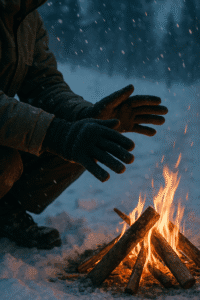
Fire provides heat, signaling, water purification, and morale stabilization. True firecraft extends beyond ignition — it includes fuel selection, moisture management, airflow control, and redundancy planning. Practicing in wet conditions and variable environments builds reliability when comfort disappears.
Master the fundamentals first in our Fire Starters Guide, then build reliability in wet and extreme conditions.
Fire alone isn’t enough—pair it with water purification skills to ensure safe hydration in any environment.
Dehydration reduces cognitive function before physical weakness is obvious. Water discipline includes safe sourcing, filtration, contamination awareness, and energy-efficient collection methods. A trained survivalist plans water before thirst becomes a liability.
Navigation errors multiply survival problems. Terrain reading, sun orientation, shadow tracking, and map interpretation preserve directional control. The goal is not speed — it is deliberate movement with reduced uncertainty.
Exposure accelerates physical decline. Shelter construction reduces wind exposure, manages radiant heat loss, and stabilizes the body’s core temperature. Efficient shelter building balances insulation, location, and resource conservation.
Heat exhaustion, hypothermia, dehydration, and minor injuries escalate quickly when untreated. Environmental awareness and early response prevent survivable conditions from becoming fatal. Discipline in monitoring your body is as important as any tool.
Survival skill is cumulative. Each discipline strengthens the next. Fire practice improves shelter efficiency. Navigation reduces energy waste. Water discipline preserves clarity under stress. Small repetitions build layered competence long before crisis conditions arise.
The objective is not intensity — it is consistency. Train deliberately. Rotate skills seasonally. Practice in imperfect conditions. Competence is built quietly long before it is needed.
Skills sharpen with practice. Continue building capability with the latest hands-on survival guides.