

Best Survival Knives and Multitools: 8 Practical Picks
Choosing the best survival knives and multitools comes down to what you actually need to accomplish. A dependable fixed-blade knife can help with shelter construction, wood processing, food preparation, and other camp chores. A multitool adds pliers, screwdrivers, scissors, and other useful functions for equipment repairs.
This post contains affiliate links. I may earn a small commission at no extra cost to you. Learn more.
Whether you’re building a bug-out bag, assembling an emergency vehicle kit, or preparing for a backcountry trip, carrying the right cutting and repair tools can make difficult tasks more manageable.
However, not every knife is designed for heavy outdoor work, and a multitool cannot replace every dedicated tool. Blade construction, steel type, handle design, weight, and maintenance requirements all affect performance.
This guide compares four survival knives and four multitools across different price categories. We’ll examine their practical advantages, limitations, and intended uses so you can choose equipment that fits your preparedness plan.
Quick Answer: Which Survival Knife and Multitool Should You Choose?
For general camping and everyday outdoor tasks, the Morakniv Companion is a practical budget-friendly fixed blade. The Morakniv Garberg offers a more substantial full-tang construction for demanding camp work. For repairs and everyday utility, the Gerber Suspension-NXT is a budget-oriented multitool, while the Leatherman Wave+ offers a broader premium tool configuration. Your ideal combination depends on the tasks you expect to perform, your budget, and how much weight you can comfortably carry.
Survival Knife vs. Multitool: What’s the Difference?
A survival knife and a multitool overlap in some functions, but they are designed around different priorities.
A fixed-blade knife is primarily a cutting tool. Its blade does not fold into the handle, eliminating the folding joint found on pocketknives. Depending on its construction, a fixed blade may be suitable for carving, preparing kindling, processing food, and other outdoor tasks.
A multitool combines several smaller implements into one portable package. Many include pliers, wire cutters, screwdrivers, scissors, files, and a folding blade.
For general preparedness, these tools often complement each other rather than compete.
When a Fixed-Blade Knife Makes Sense
- Carving wooden stakes and notches.
- Preparing feather sticks and small kindling.
- Cutting cordage and other materials.
- Handling routine camp food preparation.
- Performing controlled outdoor cutting tasks.
A fixed blade is generally easier to clean than a complex multitool and does not rely on a folding blade lock. However, it still requires appropriate handling, maintenance, and a secure sheath.
When a Multitool Is More Useful
- Tightening loose screws and fasteners.
- Gripping small components with pliers.
- Cutting wire within the tool’s rated capability.
- Repairing straps and camping equipment.
- Handling small mechanical adjustments.
Multitools are especially useful when you cannot justify carrying a complete toolbox.
For a broader emergency equipment strategy, see our Emergency Preparedness Plan.
Best Survival Knives and Multitools Compared
The following table summarizes the eight options covered in this guide.
| Product | Type | Best For | Main Trade-Off |
|---|---|---|---|
| Morakniv Companion | Fixed-blade knife | Budget camping and carving | Not designed for heavy prying |
| Morakniv Garberg | Full-tang fixed blade | Demanding outdoor tasks | More weight and cost |
| BPS Knives Adventurer | Fixed-blade knife | Value-focused bushcraft | Carbon steel needs rust prevention |
| Fällkniven S1 | Premium fixed blade | Dedicated outdoor use | Higher price |
| Gerber Suspension-NXT | Pliers-based multitool | Budget everyday repairs | Limited heavy-duty capability |
| Siupro Multitool | Budget multitool | Occasional backup use | Specifications and fit may vary |
| WETOLS 21-in-1 | Multi-function tool | Vehicle and equipment kits | Potential bulk |
| Leatherman Wave+ | Premium multitool | Frequent repairs and everyday carry | Higher cost and weight |
Best Survival Knives for Camping and Emergency Preparedness
These four fixed-blade knives cover different budgets and intended uses. None is automatically the right choice for every user.
1. Morakniv Companion: Best Budget Survival Knife
The Morakniv Companion is a popular entry-level outdoor knife because of its relatively simple design, manageable size, and accessible price category.
Its fixed blade is well suited to controlled cutting tasks such as carving, making feather sticks, cutting cordage, and preparing food at camp.
The Companion’s relatively lightweight construction also makes it appealing to hikers who want a practical knife without carrying an unnecessarily heavy blade.
Advantages:
- Affordable option for basic outdoor cutting tasks.
- Lightweight compared with many larger survival knives.
- Comfortable handle design for routine use.
- Practical blade geometry for carving and wood preparation.
Limitations:
- Not intended for prying or other abusive tasks.
- Does not offer the same construction as a full-tang heavy-duty knife.
- Blade and sheath should be maintained and inspected regularly.
Best for: Beginners, casual campers, and preparedness kits where affordability and everyday utility matter most.
Bottom line: The Companion is a sensible first outdoor knife when you primarily need dependable cutting performance rather than a large, heavy-duty survival blade.

2. Morakniv Garberg: Best Full-Tang Outdoor Knife
The Morakniv Garberg is positioned as a more robust outdoor knife than the Companion.
Its full-tang construction extends the blade steel through the handle, providing a different structural design for users who expect more demanding camp work.
The Garberg is commonly associated with bushcraft tasks such as carving, preparing wood, and general outdoor utility.
Some versions feature carbon steel, while others use stainless steel. Material and sheath configurations depend on the exact product.
Advantages:
- Full-tang construction.
- Designed for outdoor and bushcraft applications.
- Useful blade geometry for controlled wood carving.
- Multiple configurations may suit different preferences.
Limitations:
- More expensive and heavier than the Companion.
- Carbon-steel versions require attention to corrosion prevention.
- Sheath and accessory configurations should be checked before purchasing.
Best for: Campers who want a more substantial fixed blade for frequent outdoor use.
Bottom line: The Garberg is worth considering when full-tang construction and regular bushcraft use are higher priorities than minimum weight or price.

For additional outdoor cutting and construction tasks, see our guide to essential shelter-building tools.
3. BPS Knives Adventurer: Best Value Bushcraft Knife
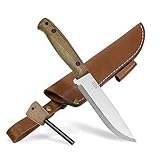
The BPS Knives Adventurer is a full-tang bushcraft knife designed for camping, carving, and general outdoor cutting tasks. It features a 1066 carbon steel blade, Scandinavian-style grind, and walnut wood handle.
The knife also comes with a leather sheath and ferro rod, making it an appealing option for campers who want a traditional bushcraft setup without moving into premium pricing.
Advantages:
- Full-tang construction for outdoor cutting tasks.
- 1066 carbon steel blade with a Scandi grind.
- Walnut wood handle with traditional styling.
- Leather sheath and ferro rod included.
- Useful for carving, feather sticks, and camp chores.
Limitations:
- Carbon steel requires regular cleaning and drying to prevent rust.
- Wood handles and leather sheaths require maintenance.
- Longer blade may be less convenient for detailed carving.
Best for: Campers and bushcraft enthusiasts seeking a full-tang carbon steel knife with traditional materials.
Bottom line: The BPS Adventurer offers a practical combination of full-tang construction, bushcraft-oriented blade geometry, and included accessories at a value-focused price point.
4. Fällkniven S1: Best Premium Survival Knife
The Fällkniven S1 is a premium outdoor knife associated with robust construction and a convex blade profile.
Its design appeals to users who prioritize a substantial fixed blade for camping, field work, and general outdoor preparedness.
The S1’s convex edge differs from the Scandi-style geometry found on several other knives in this comparison.
That difference can affect cutting behavior and the sharpening technique required to maintain the blade.
Advantages:
- Premium outdoor knife design.
- Convex edge geometry.
- Substantial construction for demanding cutting applications.
- Suitable for users who prioritize a dedicated fixed blade.
Limitations:
- Significantly higher price than entry-level knives.
- Convex sharpening may require additional practice.
- More knife than many casual campers need.
Best for: Experienced outdoor users who want a premium fixed-blade knife and are comfortable maintaining its edge.
Bottom line: The S1 is a serious option for buyers willing to pay more for a dedicated outdoor knife, but the extra cost is not necessary for every preparedness kit.

Best Survival Multitools for Repairs and Emergency Kits
Unlike a fixed-blade knife, a multitool is intended to provide several functions in one compact package.
For emergency preparedness, pliers, screwdrivers, cutters, and scissors may be just as valuable as a blade.
5. Gerber Suspension-NXT: Best Budget Multitool
The Gerber Suspension-NXT is a pliers-based multitool designed for general-purpose cutting, gripping, and small repairs.
Its tool selection makes it relevant to everyday carry, camping equipment, and vehicle emergency kits.
The Suspension-NXT is especially appealing to buyers who want several common tools without moving into a premium price category.
Advantages:
- Multiple functions in one portable tool.
- Useful for small equipment adjustments.
- Budget-oriented alternative to premium multitools.
- Practical for occasional camping and household tasks.
Limitations:
- Not a substitute for full-size pliers or screwdrivers.
- Compact implements have limited leverage.
- Not intended for heavy prying or excessive torque.
Best for: Budget-conscious readers who want a general-purpose multitool for occasional repairs.
Bottom line: The Suspension-NXT is a practical starting point for an emergency repair kit when affordability matters more than premium materials or specialized features.


6. Siupro Multitool: Best for Occasional Backup Use
The Siupro multitool represents the lower-cost end of the multi-function tool market.
Budget multitools can be useful for occasional tasks, especially when you want a spare tool for a secondary kit.
However, low price alone should not determine whether a tool belongs in your primary emergency equipment.
Inspect moving parts, locking mechanisms, handles, and cutting edges before use.
Advantages:
- Budget-friendly category.
- Combines several functions in one device.
- Potential option for light, occasional repairs.
- Can serve as secondary equipment.
Limitations:
- Build quality and specifications may vary.
- May not tolerate repeated heavy use.
- Tool fit and locking performance deserve careful inspection.
Best for: Occasional tasks and backup kits where the tool is not expected to replace dedicated equipment.
Bottom line: A budget multitool can be useful, but dependable construction and safe operation should take priority over the number of advertised functions.

7. WETOLS 21-in-1 Multitool: Best for a General Emergency Kit
The WETOLS 21-in-1 is marketed as a multi-function tool with a broad selection of implements.
A tool with numerous functions can be convenient when assembling a vehicle kit or general emergency bag.
However, a higher tool count does not automatically mean greater usefulness.
What matters is whether the included implements match the repairs you are likely to encounter and whether they can be operated safely.
Advantages:
- Wide range of advertised functions.
- Convenient for organizing several small tools together.
- Potential option for vehicle or equipment kits.
- Useful for buyers prioritizing versatility.
Limitations:
- May be bulkier than minimalist multitools.
- Some functions may see little practical use.
- Compact tools cannot replace full-size equipment for demanding repairs.
Best for: Readers assembling general-purpose emergency kits where versatility matters more than minimum size.
Bottom line: The WETOLS may appeal to buyers who want multiple functions in one package, but the quality and usefulness of each implement matter more than the advertised count.

8. Leatherman Wave+: Best Premium Multitool
The Leatherman Wave+ is a well-known pliers-based multitool designed for a wide range of everyday and outdoor repair tasks.
Its configuration includes multiple implements for gripping, cutting, and working with small fasteners.
One notable design feature is its replaceable wire-cutter components, which can be useful for maintenance over the tool’s service life.
For users who regularly work with camping equipment, household hardware, and emergency supplies, the Wave+ offers a more substantial multitool option.
Advantages:
- Broad selection of practical implements.
- Replaceable wire-cutter components.
- Designed for repeated everyday utility.
- Useful combination of pliers, blades, and repair tools.
Limitations:
- Higher purchase price.
- Heavier than minimalist pocket tools.
- Optional accessories may increase the total cost.
Best for: Readers who frequently use pliers, screwdrivers, and other small repair tools.
Bottom line: The Wave+ is a strong candidate for a primary multitool when you expect regular use and want a broad selection of repair functions.

How to Choose the Best Survival Knife
Before buying a knife, think about the tasks you expect to perform and how frequently you will carry it.
Fixed Blade or Folding Blade?
A fixed-blade knife has no folding joint and is generally easier to clean and inspect.
A folding knife is often more compact, but its pivot and locking mechanism introduce additional maintenance and handling considerations.
For frequent wood preparation and general bushcraft, a fixed blade may be the more practical choice.
For lighter everyday cutting, a folding knife may be sufficient.
Full Tang or Partial Tang?
A full-tang knife extends its blade steel through the handle.
This construction can be advantageous for demanding tasks, although overall durability also depends on steel, heat treatment, blade geometry, and manufacturing quality.
A partial-tang knife is not automatically unsuitable for outdoor use. Many perform well when used within their intended limits.
Blade Length
Many campers find a blade around four to five inches manageable for routine cutting and carving.
Shorter blades can offer precision and portability, while longer blades may be useful for some larger tasks at the cost of additional weight and reduced maneuverability.
There is no universal blade length that suits every survival situation.
Handle Comfort
A secure grip is essential when working with sharp tools.
Look for a handle that fits your hand, allows controlled cutting, and does not create uncomfortable pressure points during normal use.
Wet hands and cold conditions may change how secure a handle feels.
Sheath Quality
A sheath should protect the blade and help prevent accidental contact with the cutting edge.
Inspect retention, attachment points, and accessibility before carrying a fixed-blade knife.
Understanding Knife Steel and Blade Grinds
Steel type and edge geometry influence sharpening, corrosion resistance, toughness, and cutting behavior.
However, steel labels alone do not determine quality. Heat treatment and overall blade design are also important.
| Feature | Typical Advantage | Consideration |
|---|---|---|
| Carbon steel | Can offer useful toughness and straightforward sharpening, depending on the alloy. | Generally requires more corrosion prevention. |
| Stainless steel | Usually offers improved corrosion resistance. | Performance varies significantly by alloy and heat treatment. |
| Scandi grind | Popular for controlled wood carving. | Edge geometry may be less suitable for some other cutting tasks. |
| Convex grind | Can provide a supportive edge profile. | Maintaining the original shape takes practice. |
| Flat grind | Versatile cutting geometry. | Actual performance depends on blade thickness and edge design. |
What to Look for in a Survival Multitool
When choosing a multitool, focus on the functions you will actually use.
Pliers and Wire Cutters
Pliers are useful for gripping small components and making minor adjustments.
Check whether the tool’s cutters are suitable for the materials you expect to encounter.
Screwdrivers
Different equipment requires different fastener types.
A multitool with the wrong driver may be less useful than a simpler model that matches your gear.
Scissors and Cutting Tools
Scissors can be useful for trimming tape, packaging, and lightweight materials.
Folding blades should open and lock as designed, without excessive looseness.
Weight and Carry Options
A heavy multitool may be useful in a vehicle kit but less convenient during a long hike.
Consider whether the tool will be carried in a pocket, belt sheath, backpack, or emergency container.
Maintenance and Replacement Parts
Check whether the manufacturer offers replacement components, repair services, or warranty support.
These factors may matter more over time than the initial tool count.
Knife and Multitool Safety
Survival equipment should make tasks safer and more manageable, not introduce unnecessary injuries.
- Cut away from your body and keep your supporting hand outside the blade’s path.
- Use a stable working position and adequate lighting.
- Do not use a knife as a pry bar, screwdriver, or substitute for a specialized tool.
- Inspect folding locks and multitool mechanisms before use.
- Keep blades properly sharpened and protected.
- Return tools to their sheath or storage position when not in use.
- Keep sharp tools away from unsupervised children.
Do not attempt heavy chopping, splitting, or impact tasks with equipment not designed for them.
For shelter construction and related outdoor tasks, choose equipment specifically appropriate for the job.
How to Maintain Survival Knives and Multitools
Routine maintenance can extend the useful life of outdoor cutting and repair equipment.
Clean After Use
Remove dirt, moisture, food residue, and other debris.
Follow manufacturer cleaning instructions, especially for multitools with multiple moving components.
Dry Thoroughly
Moisture trapped around pivots, handles, or blade surfaces can contribute to corrosion.
Allow equipment to dry before long-term storage.
Maintain the Cutting Edge
Use a sharpening method appropriate for the blade’s edge geometry.
A Scandi grind and a convex grind may require different techniques to maintain their original profiles.
Lubricate When Appropriate
Some knives and multitools benefit from small amounts of suitable lubricant on moving parts or exposed steel.
Use food-contact-appropriate products for equipment intended for food preparation, and follow manufacturer guidance.
Inspect Before Storage
Check for loose components, damaged handles, corrosion, and worn sheaths.
Do not depend on damaged equipment during an emergency.
Building a Practical Knife and Multitool Kit
For many households, a simple combination of tools is more useful than carrying several large knives.
A practical emergency setup might include:
- One fixed-blade knife suited to your expected outdoor tasks.
- One multitool with pliers and useful drivers.
- A suitable sharpening tool.
- A secure sheath or protective storage system.
- A small maintenance cloth.
- Any manufacturer-recommended lubricant or maintenance supplies.
Choose equipment based on the environment and intended activities rather than carrying unnecessary weight.
For additional preparedness equipment ideas, see our guide to forgotten survival items.
Knife Carry Laws and Travel Considerations
Knife laws vary by state, locality, and location type.
Restrictions may concern blade length, concealed carry, opening mechanisms, or possession in certain buildings and facilities.
Schools, government buildings, airports, and other controlled locations may have additional rules.
Before traveling with a knife or multitool, check the applicable laws and transportation requirements.
Airline carry-on restrictions are particularly important: knives and many multitools containing blades are not permitted in carry-on baggage.
Never assume that a knife legal to possess at home is legal to carry everywhere.
Frequently Asked Questions
What is the best survival knife for beginners?
The Morakniv Companion is a practical beginner option for routine outdoor cutting and carving. Its relatively simple design and accessible price make it worth considering for basic camping tasks.
Is a fixed-blade knife better than a multitool?
Neither is universally better. A fixed blade is generally more suitable for dedicated cutting and wood preparation, while a multitool provides additional repair functions.
Do I need a full-tang survival knife?
Not necessarily. Full-tang construction may be beneficial for demanding use, but a properly designed partial-tang knife can handle many ordinary camp tasks.
What blade length is best for survival?
A blade around four to five inches is a useful starting point for many general outdoor tasks. The best length depends on your activities, experience, and local laws.
What is the best multitool for a bug-out bag?
The Gerber Suspension-NXT is worth considering for a budget kit, while the Leatherman Wave+ offers a more substantial premium option. Choose based on weight, expected repairs, and cost.
Are expensive survival knives worth buying?
Premium knives may offer advantages in construction, materials, finishing, and manufacturer support. However, many routine camping tasks can be completed with less expensive knives used correctly.
What is the difference between carbon steel and stainless steel?
Carbon steels generally require more attention to corrosion prevention, while stainless steels typically offer improved corrosion resistance. Toughness, edge retention, and sharpening behavior depend on the specific alloy and heat treatment.
Can a multitool replace a survival knife?
A multitool can handle many light cutting tasks, but its folding blade may be less convenient than a dedicated fixed blade for extended carving or wood preparation.
How often should I sharpen a survival knife?
Sharpening frequency depends on how often the knife is used, what materials it cuts, and the blade steel. Inspect the edge regularly and maintain it before cutting performance becomes poor.
Should I keep a knife and multitool in my emergency vehicle kit?
Both can be useful for equipment repairs and emergency tasks, provided they are stored securely and legally. Protect them from moisture, damage, and unauthorized access.
Final Thoughts: Choosing the Best Survival Knives and Multitools
The best survival knives and multitools are the ones that match your actual needs and that you know how to use safely.
A fixed-blade knife can simplify outdoor cutting tasks, while a multitool adds useful repair capabilities without requiring a full toolbox.
For budget-conscious campers, the Morakniv Companion and Gerber Suspension-NXT offer practical starting points. Readers looking for more substantial equipment may prefer the Morakniv Garberg or Leatherman Wave+.
Whatever you choose, prioritize dependable construction, appropriate maintenance, safe handling, and familiarity with your equipment.
Practice routine tasks before relying on any tool during an emergency.
Related Survival and Camping Guides
- Shelter Building Tools for Survival
- What Happens in the First 72 Hours After a Disaster?
- The Ultimate Camping Guide
- Best Survival Kits for Beginners
As an Amazon Associate, The Savvy Survivalist earns from qualifying purchases.


