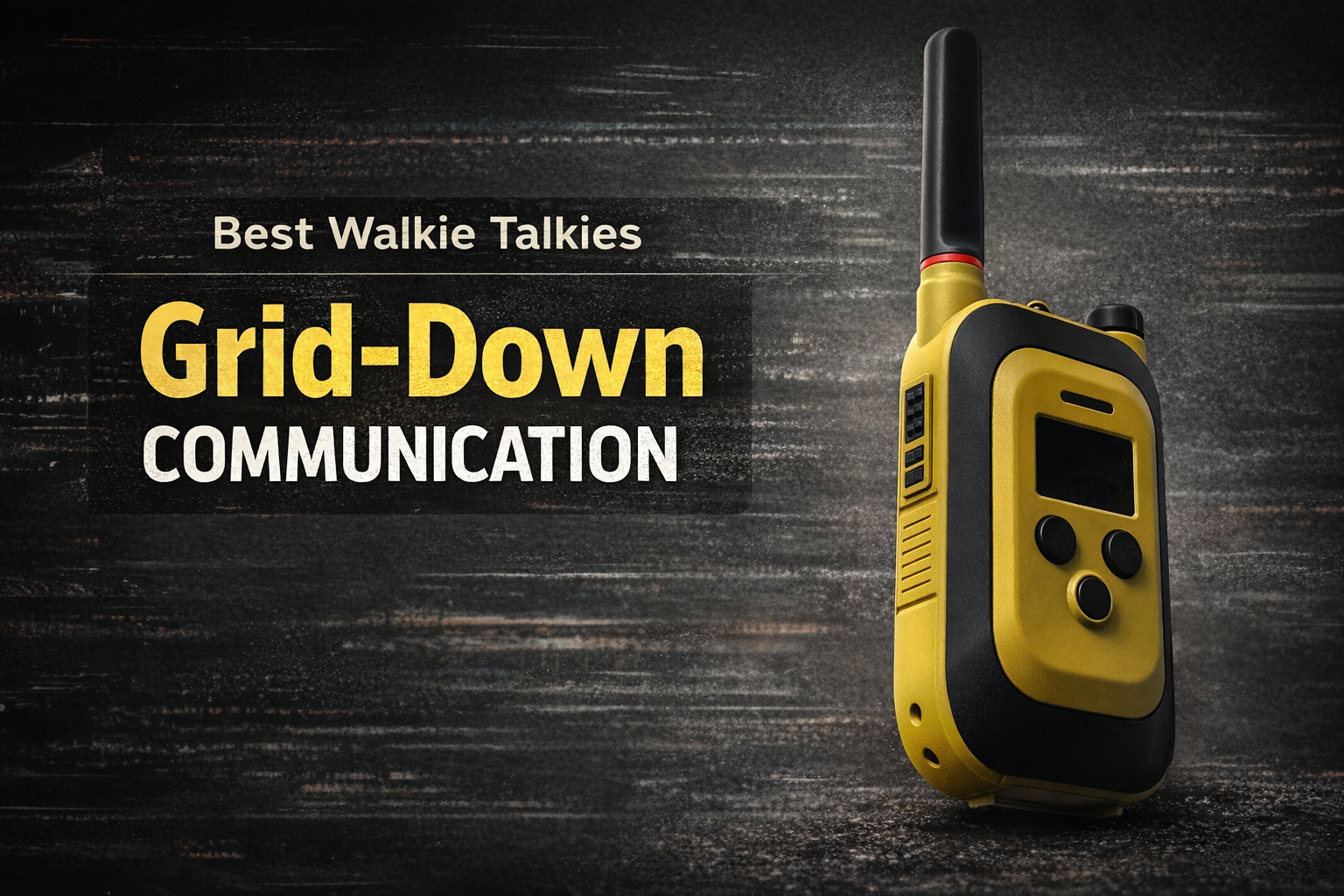
Best Long-Range Emergency Walkie Talkies for Blackouts (2026)
When the grid goes down, your phone becomes a brick within hours.
This post contains affiliate links. I may earn a small commission at no extra cost to you. Learn more.
No signal. No updates. No way to coordinate with family or neighbors.
And that’s where most people realize too late—they have no backup communication plan.
The best two-way radios for emergencies are the ones that work without cell towers, Wi-Fi, or infrastructure.
Walkie talkies (two-way radios) are one of the simplest, most reliable ways to stay connected when everything else fails. They don’t rely on cell towers, Wi-Fi, or infrastructure. They just work.
But here’s the problem:
Most people buy the wrong ones.
The best long-range emergency walkie talkies give you communication that still works when phones, internet, and infrastructure fail.
They fall for inflated “36-mile range” claims, cheap plastic builds, or radios that die after a few hours.
In a real emergency, those mistakes matter.
Who Needs Emergency Walkie Talkies?
Emergency walkie talkies are useful for far more than extreme survival scenarios.
They can help families stay connected during blackouts, severe weather events, evacuations, camping trips, hiking emergencies, neighborhood coordination, and communication failures caused by overloaded networks.
Even short-term outages can quickly expose how dependent most people have become on phones and internet-based communication.
This guide covers the best walkie talkies for grid-down communication—what actually works when cell service fails and how to avoid costly mistakes.
You’ll learn:
- Which radios actually work when the grid is down
- What features matter (and what’s marketing fluff)
- The best options for families, bug-out situations, and off-grid use
For a complete system beyond radios, see how to build a Complete Off-Grid Communication System (No Phone, No Internet)—because radios are just one part of a reliable plan.
Communication systems fail without power. Build a reliable backup with our off-grid power guide.
For a full preparedness system, see our emergency preparedness plan.
Recommended Gear: See our complete Emergency Communication Gear List for recommended radios, walkie talkies, backup power, and off-grid communication tools.
What to Look for in a Survival Walkie Talkie
Not all radios are built for emergencies.
Here’s what actually matters when your life depends on it:
Most emergency radios look similar on the surface, but real-world performance differences become obvious very quickly once communication conditions start getting difficult.
Battery flexibility, terrain performance, signal strength, durability, charging options, and realistic range matter far more than flashy packaging claims or inflated mileage numbers printed on the box.
If you’re building a full emergency setup, this is just one piece—see our complete preparedness plan.
Real Range (Not the Box Lie)
Most radios advertise “20–36 miles.”
Those advertised distances only happen under ideal line-of-sight conditions with elevated terrain, minimal interference, and almost no physical obstacles blocking the signal.
In real-world emergencies filled with buildings, trees, vehicles, weather interference, and terrain obstacles, actual range becomes much shorter than the packaging suggests.
Actual communication range varies heavily depending on terrain, interference, elevation, weather conditions, and surrounding structures.
In dense urban environments filled with buildings, electrical interference, and signal obstruction, most emergency walkie talkies realistically reach about 0.5–2 miles.
In suburban areas with fewer obstructions, communication range often improves to roughly 1–3 miles depending on terrain and radio quality.
Open rural terrain with elevated visibility can sometimes extend communication distances to 3–10 miles under favorable conditions.
Battery Type (Critical)
Avoid radios that only use built-in batteries.
The most reliable emergency radios use multiple backup power options instead of depending entirely on sealed internal batteries.
The best emergency radios use flexible power options including AA or AAA backup batteries, rechargeable battery packs, and USB charging support.
That flexibility becomes critical during extended blackouts when traditional charging methods may no longer be available.
Reliable backup power becomes critical during long-term emergencies because communication systems fail quickly once batteries can no longer be recharged.
Durability
Durability matters far more during emergencies than most people expect because radios are often exposed to rough storage conditions, moisture, drops, travel, and extended daily use during stressful situations.
Emergency radios should be durable enough to survive drops, rain exposure, dust, rough storage conditions, and long-term use during stressful situations.
Look for radios with water resistance, reinforced casing, and strong battery compartment construction instead of cheap plastic builds that crack under pressure.
Low-quality radios often fail quickly once they are exposed to rough handling, moisture, repeated charging cycles, harsh weather, or extended emergency use.
FRS vs GMRS (IMPORTANT)
FRS radios are easier for beginners because they do not require a license, but they usually operate with lower power and shorter communication range.
GMRS radios typically provide stronger transmission power, better signal penetration, and longer real-world communication distances, making them a better option for serious preparedness planning.
VOX (voice-activated transmission) allows radios to transmit automatically without pressing the talk button manually.
This becomes extremely useful during emergencies when your hands may already be occupied carrying supplies, moving through terrain, assisting family members, or handling equipment.
Radios are just one piece of a bigger system—here’s a complete off-grid communication system using multiple backup methods.
Will Walkie Talkies Work if the Grid Goes Down?
Yes — most walkie talkies will still work during a blackout because they do not rely on cell towers, internet, or Wi-Fi.
FRS and GMRS radios communicate directly from radio to radio using local frequencies. As long as both radios have power and remain within range, they can continue working even during major infrastructure failures.
However, terrain, buildings, battery life, and repeater availability can still affect performance.
This is why realistic range expectations and backup power matter so much during emergencies.
Why Communication Systems Fail So Fast During Blackouts
Most people assume communication systems will continue working for days after the power grid fails.
In reality, communication infrastructure often starts degrading much faster than expected.
Cell towers rely on backup batteries, generators, internet routing systems, fuel deliveries, and maintenance crews to stay online. During large-scale outages, those systems become overloaded or begin shutting down one layer at a time.
Even when towers remain operational, network congestion can make phones nearly useless as thousands of people attempt to call, text, or access emergency information simultaneously.
This is why independent communication tools like walkie talkies, GMRS radios, HAM radio systems, and emergency weather radios become so important during long-term emergencies.
What Most People Get Wrong About Emergency Walkie Talkies
Most people buy emergency radios based entirely on the advertised range printed on the box.
That is usually a mistake.
Real-world communication range depends heavily on terrain, elevation, interference, weather conditions, buildings, battery strength, antenna quality, and signal congestion.
A cheap radio claiming 36 miles of range may struggle to communicate even one mile inside a city during a major blackout.
This is why realistic testing matters far more than marketing claims.
The best emergency communication systems are built around realistic expectations, layered backups, spare batteries, and radios that have already been tested under real conditions before an emergency ever begins.
| Radio | Best For | Real Range | Battery Type |
|---|---|---|---|
| Midland GXT1000 | Best Overall | 3–5 miles | Rechargeable + AA |
| Motorola T470 | Budget Option | 1–3 miles | Rechargeable + AA |
| Retevis RB48 | Rugged Use | 2–5 miles | Rechargeable |
| Motorola T210 | Backup Radio | 0.5–2 miles | AAA Batteries |
Best Long-Range Emergency Walkie Talkies
Best Overall: Midland GXT1000VP4 GMRS Radios
🟡 Check Price on Amazon

Why This One Stands Out
If you want serious grid-down communication, this is one of the most reliable options.
The Midland GXT1000 stands out because it operates on GMRS frequencies, allowing it to transmit with more power and achieve better real-world communication range than many basic consumer radios.
That extra signal strength becomes especially valuable during blackouts, severe weather events, neighborhood emergencies, and off-grid situations where terrain and interference can weaken weaker radios quickly.
✅ Pros
- Strong real-world range (3–5+ miles typical)
- NOAA weather alerts built-in
- Rechargeable + battery backup
- Durable and widely trusted
❌ Cons
- Requires GMRS license (simple to get)
- Bulkier than cheap radios
This radio works especially well for family blackout communication, neighborhood coordination, bug-out groups, and emergency preparedness situations where reliable range and durability matter more than compact size.
Best Budget Option: Motorola T470 Talkabout
🟡 Check Price on Amazon


Why It’s a Better Budget Choice
If you want something affordable that still performs in real conditions, the T470 is a solid pick.
It’s not a high-power GMRS radio, but it gives you dependable short-to-mid range communication without overcomplicating things.
✅ Pros
- Good real-world range for price (1–3 miles typical)
- NOAA weather alerts built-in
- Rechargeable + battery backup options
- Simple, reliable design
❌ Cons
- Not ideal for long-distance communication
- Struggles in dense urban environments
This radio is a good fit for families, beginners, short-range blackout communication, camping trips, and backup emergency kits where simplicity and affordability matter more than maximum range.
Most Durable Option: Retevis RB48
🟡 Check Price on Amazon

Why It Stands Out
If you want something that can take abuse, this is one of the toughest radios in this category.
✅ Pros
- IP67 waterproof + dustproof
- Drop-resistant (built for rough environments)
- Long battery life (20+ hours)
- Loud audio (important in chaos situations)
❌ Cons
- Bulkier design
- Not as beginner-friendly
This radio makes the most sense for harsh environments, outdoor work, storm cleanup, prepper groups, construction-style settings, and emergency situations where durability, waterproofing, and long battery life matter most.
Best Compact Option: Motorola T210
🟡 Check Price on Amazon

Why It Works
Not everyone needs a heavy-duty radio.
The T210 is simple, lightweight, and easy to throw into a bag or emergency kit.
✅ Pros
- Lightweight and compact
- Very easy to use
- Affordable
- Good for short-range communication
❌ Cons
- Limited range
- Not built for extreme conditions
This radio works best as a lightweight backup option for kids, family members, close-range communication, camping trips, car kits, and emergency bags where compact size and ease of use are the priority.
How Walkie Talkies Are Actually Used in a Grid-Down Scenario
Buying emergency radios is only the first step. Real preparedness depends on knowing how to use them effectively under stressful conditions where normal communication systems may already be failing.
Bug-Out Situations
Communication becomes significantly harder during bug-out situations because movement, stress, changing terrain, and overloaded networks create confusion very quickly.
Once phones lose signal or towers become overloaded, families and groups often struggle to coordinate movement, relay information, or stay together during evacuations.
Reliable walkie talkies allow groups to communicate instantly without relying on outside infrastructure, making route adjustments, danger alerts, and coordination far easier during fast-moving emergencies.
Reliable walkie talkies help groups stay in contact, avoid separation, adjust evacuation routes, and coordinate movement in real time without relying on overloaded communication infrastructure.
Family Communication During Blackouts
One of the biggest problems during blackouts is family separation.
Children may be at school, spouses may be commuting home, and overloaded phone systems can make communication unreliable within hours.
Simple emergency radios provide direct communication that allows families to coordinate movement, share updates, and reduce confusion without relying on cellular infrastructure.
Emergency radios provide immediate direct communication without relying on cellular towers, internet access, or overloaded emergency networks.
Neighborhood Coordination
During large-scale emergencies, neighborhoods often begin sharing information, resources, security updates, and local conditions long before official systems stabilize.
Walkie talkies can help small groups coordinate supplies, monitor changing situations, communicate across properties, and maintain local awareness even when internet and phone systems become unreliable.
Radios Become a Local Communication Network
During prolonged emergencies, small neighborhood radio groups can effectively become localized communication networks that continue functioning even after larger systems begin failing.
Wilderness and Hiking Emergencies
Off-grid hiking and wilderness travel create an entirely different communication challenge because there may be little or no cellular coverage available even under normal conditions.
Reliable radios allow groups to coordinate movement, respond to injuries, avoid separation, and maintain communication in areas where phones may never work at all.
Reliable radios allow hiking groups and off-grid travelers to coordinate movement, respond to emergencies, avoid separation, and maintain communication in areas where phones may never work at all.
How to Build a Real Grid-Down Communication Setup
Simply owning emergency radios does not automatically create a reliable communication system during a disaster.
Many people assume emergency radios work automatically the moment disaster strikes, but real-world communication failures are often caused by poor planning rather than bad equipment.
Without assigned channels, backup batteries, charging systems, and range testing, even expensive radios can become unreliable during large-scale emergencies.
Reliable emergency communication depends on building a layered system instead of assuming radios alone will solve every communication problem during a disaster.
Step 1: Assign Channels Ahead of Time
Communication channels should always be planned before an emergency begins instead of being improvised during stressful situations.
Every emergency communication plan should include a designated primary channel, backup channel, and emergency fallback channel so everyone understands where to communicate if conditions change suddenly.
Establishing those channels ahead of time prevents confusion during stressful situations where quick coordination becomes critical.
Everyone in your group should know these in advance.
Step 2: Plan for Power Failure
Emergency radios become far more reliable when they are supported by layered backup power systems capable of operating during prolonged outages.
A reliable communication setup should always include multiple backup power methods including spare batteries, rechargeable battery packs, USB charging options, power banks, and solar charging systems.
Communication systems fail quickly once battery reserves disappear, which is why power redundancy matters just as much as the radios themselves.
Once batteries become depleted, even high-quality communication equipment quickly becomes ineffective during long-term emergencies.
Most communication failures aren’t caused by bad radios—they’re caused by lack of power. Learn how to build a reliable system in our grid-down power guide.
Not sure what size backup power you actually need? Use this solar generator sizing guide to avoid running out of power.
Step 3: Define Roles
Communication roles become extremely important during larger emergencies where multiple people may be attempting to share information at the same time.
Larger groups should also establish basic communication roles ahead of time.
Family members may use one channel for direct communication while group leaders, scouts, or neighborhood coordinators operate on separate frequencies to reduce overlap and confusion during emergencies.
Step 4: Set Range Expectations
One of the biggest mistakes people make is assuming advertised radio ranges reflect realistic emergency communication performance.
Emergency radios should always be tested under realistic conditions before relying on them during a disaster.
Testing communication inside your home, across neighborhoods, through wooded terrain, and during poor weather conditions provides a far more accurate understanding of real-world performance than marketing claims printed on product packaging.
Understanding realistic communication limitations before an emergency happens is far more valuable than relying on unrealistic manufacturer expectations during a disaster.
Radios are only one part of a full system—here’s how to communicate when the grid goes down using layered backup methods.
Walkie Talkie vs Other Emergency Communication Methods
Walkie Talkie
Walkie talkies remain one of the simplest and most reliable emergency communication tools available, but they work best as part of a larger layered communication strategy.
Walkie talkies provide fast direct communication without relying on internet access, cellular towers, or outside infrastructure.
However, they also have realistic range limitations that depend heavily on terrain, weather conditions, interference, and radio quality.
Ham Radio
HAM radio systems provide some of the most powerful long-distance emergency communication capabilities available to civilians during large-scale disasters and infrastructure failures.
Unlike standard walkie talkies, HAM radio operators can often communicate across counties, states, and even internationally depending on equipment, antenna setup, atmospheric conditions, and radio frequency bands.
HAM radio systems become especially valuable during major blackouts, hurricanes, wildfires, and large regional emergencies where normal communication infrastructure begins collapsing or becoming overloaded.
However, HAM radio also requires significantly more training, licensing, setup knowledge, and operational practice compared to standard FRS or GMRS radios.
For serious long-term preparedness, many survivalists use HAM radio as part of a layered communication system rather than relying on a single communication method alone.
Emergency Radios
Emergency weather radios serve a completely different role than two-way communication radios.
Instead of allowing direct communication between people, emergency radios are designed primarily for receiving critical information during disasters including weather alerts, evacuation notices, emergency broadcasts, and infrastructure updates.
NOAA weather radios become especially important during hurricanes, tornado outbreaks, severe storms, wildfires, and prolonged blackout situations where internet access and television broadcasts may no longer be reliable.
Many modern emergency radios also include solar charging, hand-crank charging, flashlight functions, USB charging ports, and backup battery systems, making them useful as part of broader emergency preparedness kits.
While emergency radios cannot replace direct communication tools like walkie talkies or HAM systems, they remain one of the most important ways to continue receiving outside information when traditional communication systems begin failing.
Emergency radios can keep you informed during outages — see our guide to the best emergency solar radios for blackouts.
Phones (Reality Check)
Most people assume their phones will continue working during emergencies because modern communication infrastructure feels permanent and reliable during normal conditions.
But phones depend entirely on outside systems including cell towers, backup generators, internet routing infrastructure, maintenance crews, fuel deliveries, and operational power grids.
During large-scale blackouts or regional disasters, those systems can begin failing much faster than most people expect.
Even when towers remain operational temporarily, communication networks often become overloaded as thousands of people attempt to call family members, access emergency updates, use navigation apps, or contact emergency services simultaneously.
This is why phones should never be treated as a standalone emergency communication plan.
Reliable preparedness depends on layered communication systems that continue functioning even after cellular infrastructure becomes unreliable or unavailable.
The most reliable emergency communication plans use multiple overlapping systems instead of relying entirely on a single device or technology.
Radios alone aren’t enough—build a layered system using multiple tools in our complete off-grid communication system
Why Phones Fail Faster Than Most People Expect
Most people assume their phones will keep working during emergencies because cell towers have backup batteries.
But those backup systems are often limited.
During large-scale blackouts, towers can lose power, fuel deliveries fail, networks become overloaded, and communication systems start collapsing faster than most people realize.
This is why independent radio communication becomes so important during infrastructure failures.
Urban Areas
Dense urban environments create some of the worst conditions for emergency radio communication because buildings, electrical systems, steel structures, vehicles, and heavy interference constantly weaken radio signals.
In real-world city conditions during emergencies, most walkie talkies realistically achieve roughly 0.5–1 mile of reliable communication range.
Suburban Areas
Suburban environments usually provide better communication performance because there are fewer large structures blocking radio signals and less concentrated interference overall.
Most emergency radios can often maintain reliable communication across roughly 1–3 miles in suburban conditions depending on terrain and radio quality.
Rural and Open Terrain
Open farmland, elevated terrain, and low-interference rural environments generally provide the best communication distances for emergency radios.
Under favorable conditions, some higher-quality GMRS radios may achieve realistic communication distances of 3–10 miles across open terrain.
How Terrain Changes Radio Performance
Terrain has a massive impact on emergency radio communication.
Dense cities filled with concrete, steel, electrical interference, and buildings can dramatically reduce signal range even with expensive radios.
Forested terrain, hills, valleys, and storm conditions can also weaken communication strength far faster than most people expect.
Open farmland and elevated terrain usually provide the best communication distances because there are fewer obstacles blocking the signal.
This is why testing radios in your actual environment matters more than advertised packaging claims.
Mistakes That Will Get You in Trouble
Believing Manufacturer Range Claims
Most manufacturer range claims are based on ideal testing conditions that rarely exist during real emergencies.
Buildings, terrain, interference, weather conditions, and signal congestion can dramatically reduce communication distance in the real world.
Buying Cheap Radios Only
Cheap radios often suffer from weak signal strength, unreliable battery life, poor audio clarity, and fragile construction that fails under stress.
Emergency communication equipment should be dependable enough to function during the worst conditions—not just casual recreational use.
Ignoring Backup Power
Even the best radio becomes useless once batteries die.
Every emergency communication setup should include spare batteries, power banks, solar charging options, or alternative charging systems capable of operating during extended outages.
Never Testing Equipment
Many people buy emergency radios, place them in storage, and never test them under realistic conditions.
Without practice, assigned channels, charging plans, and real-world range testing, communication systems often fail long before the equipment itself does.
What Happens When You Buy the Wrong Radio
Many emergency communication failures happen because people purchase radios based on unrealistic expectations instead of real-world performance.
Cheap Radios Fail Under Stress
Low-quality radios often struggle with weak transmission power, unreliable batteries, poor durability, and inconsistent audio performance once conditions become difficult.
During emergencies, those weaknesses become much more obvious very quickly.
People Overestimate Range
Many families assume they will be able to communicate across entire cities or large evacuation zones because of exaggerated packaging claims.
In reality, terrain, buildings, interference, and weather conditions usually reduce communication distance dramatically.
No Backup Power Means No Communication
Without backup batteries or charging systems, even reliable radios can become useless during extended outages.
This is why communication planning should always include layered backup power systems instead of relying entirely on rechargeable batteries alone.
Urban vs Wilderness Communication Strategy
Emergency communication works very differently in cities compared to wilderness environments.
Urban areas create heavy signal interference due to buildings, electrical infrastructure, congestion, and dense construction materials that block or weaken radio transmission.
In major cities during blackouts or disasters, communication also becomes more chaotic as more people compete for information and coordination.
Wilderness environments often allow longer communication distances because there are fewer structures and less interference blocking the signal.
However, wilderness communication places greater importance on battery life, durability, weather resistance, and backup charging systems because outside support may be limited or unavailable.
Best Overall
👉 Midland GXT1000 (serious use)
Best Budget
👉 Motorola T470 (reliable + simple)
Most Durable
👉 Retevis RB48 (rugged environments)
Best Backup
👉 Motorola T210 (lightweight + cheap)
Need a reliable backup communication setup? See our recommended emergency communication gear here.
Emergency Walkie Talkie FAQ
Do walkie talkies work without cell towers?
Yes. Most walkie talkies communicate directly using radio frequencies and do not rely on cell towers, internet, or Wi-Fi.
Will walkie talkies work during blackouts?
Yes. As long as the radios have power and remain within range, they can continue working during blackouts and infrastructure failures.
How far do emergency walkie talkies actually reach?
Most radios achieve far less than advertised box ranges. In real-world conditions, expect roughly 0.5–5 miles depending on terrain and interference.
Are GMRS radios better than FRS?
GMRS radios usually provide stronger signals and better range, but they require a license in the United States.
What radios work best during emergencies?
Reliable emergency radios should have strong battery life, NOAA alerts, durable construction, and backup charging options.
If the grid goes down tomorrow, communication quickly becomes one of the most important survival systems you have.
Most people assume their phones will continue working until they suddenly realize how dependent modern communication systems really are on outside infrastructure.
Reliable emergency radios provide a communication method that continues functioning even after networks become overloaded, towers lose power, or internet systems begin failing.
But radios alone are not enough.
Real preparedness depends on building layered communication systems, backup power plans, realistic range expectations, and equipment that has already been tested before an emergency ever begins.
The people who communicate effectively during emergencies are usually the people who prepared before everyone else realized communication systems were failing.
Start building your full communication system now:
👉 Build your complete off-grid communication system