Best Emergency Solar Radios for Blackouts (2026 Guide)
📡 Why Every Go-Bag Needs an Emergency Solar Radio
This post contains affiliate links. I may earn a small commission at no extra cost to you. Learn more.
During extended blackouts, reliable information becomes just as important as food, water, or backup power.
NOAA weather alerts warn you of on-rushing flash floods, lightning outbreaks, wildfires, or hurricane landfalls long before the chaos reaches your campsite or driveway.
If communication towers fail during a disaster, you need more than just a radio — here’s how to communicate when the grid goes down using multiple backup methods.
Unlike standard battery radios, the models below use solar charging, hand cranks, and backup battery systems to continue operating during extended power outages.
Reliable communication is only one part of blackout preparedness. For the full backup power system, see our guide to the best survival and off-grid generators of 2025.
What Actually Happens to Communication During a Blackout
Most people assume cell phones will keep working indefinitely during a power outage. In reality, communication systems begin degrading far faster than most households expect once backup batteries at local towers start draining and network congestion spikes.
During regional outages, emergency alerts, evacuation orders, severe weather warnings, and road closure information become difficult to access once overloaded mobile networks begin failing intermittently. Even short outages can create communication bottlenecks if thousands of households attempt to access the same towers simultaneously.
In many disasters, communication failures occur gradually rather than instantly, creating dangerous periods where inaccurate information spreads faster than reliable emergency updates.
This is where emergency solar radios become critical.
Unlike cellular networks, NOAA weather radio systems continue broadcasting emergency alerts independently of overloaded public communication infrastructure. A properly configured emergency radio gives households direct access to weather alerts, evacuation updates, and regional emergency information even when phones become unreliable.
For a full breakdown of how communication systems begin failing during extended outages, read our guide on how to communicate when the grid goes down.
Recommended Gear: See our complete Emergency Communication Gear List for recommended radios, walkie talkies, backup power, and off-grid communication tools.
Quick Gear List (Jump Links)
- Midland ER310 👉 Best Overall
- Kaito KA500 Voyager Pro 👉 Best for Shortwave
- RunningSnail MD-090P 👉 Best Budget Option
- Sangean MMR-88 👉 Advanced Features
- Eton FRX3+ 👉 Red-Cross Approved
- FosPower A1 👉 Compact Emergency Option
- Raynic 5000 👉 Longest Runtime
- Mesqool CR12000 👉 Multi-Purpose Emergency Radio
How We Picked
Non-negotiables: NOAA SAME alerts, integrated solar panel, hand-crank dynamo, USB power-bank output, at least one LED light, and IPX3 splash resistance. Radios also had to maintain a 4-star average across 1,000+ verified reviews and be readily available at the time of our latest update in early 2026. We cross-referenced multiple expert roundups and industry guides to ensure we weren’t overlooking high-performing or newly updated models.
Test protocol: Each unit endured a 36-hour simulated grid-down scenario with four scheduled crank sessions, continuous NOAA monitoring, two smartphone top-offs, and a midnight flashlight drill. We logged reception clarity, signal drop-off, charging efficiency, and real-world runtime across AM, FM, and NOAA weather bands from Dallas, TX.
Best Emergency Solar Radios at a Glance
| Model | Best For | Battery Capacity | Charging Methods | Weight |
|---|---|---|---|---|
| Midland ER310 | Best Overall Reliability | 2600mAh | Solar / Crank / USB | 1.2 lb |
| Kaito KA500 | Shortwave & Global Broadcasts | 600mAh NiMH | 6-Way Power | 1.3 lb |
| RunningSnail MD-090P | Budget Preparedness Kits | 4000mAh | Solar / Crank / USB | 1 lb |
| Sangean MMR-88 | Premium Features | Li-ion Pack | Solar / Crank / USB | 1.4 lb |
| Eton FRX3+ | Emergency Alert Monitoring | 2000mAh | Solar / Crank / USB | 1 lb |
| FosPower A1 | Compact Go-Bags | 2000mAh | Solar / Crank / USB | 0.7 lb |
| Raynic 5000 | Long Runtime | 5000mAh | 5-Way Power | 1.3 lb |
| Mesqool CR12000 | Camping & Multi-Use | 5000mAh | 5-Way Power | 1.5 lb |
1. Midland ER310 — Best Overall Reliability
Midland’s ER310 nails the survival trifecta: rock-solid reception, intuitive controls, and marathon stamina. Its replaceable 2,600 mAh Li-ion battery powered NOAA alerts for 32 hours straight before the first crank. The built-in ultrasonic locator adds an additional emergency signaling layer during search-and-rescue situations.
- ✅ Three-Way Power: solar, hand crank, or micro-USB
- ✅ Flashlight: 140-lumen CREE LED + SOS strobe
- ✅ Charging: 5 V USB-A port tops off a typical smartphone to ~60%
- ✅ Weight: 1.2 lb—packable yet reassuringly sturdy
- ✅ Reception: NOAA, AM/FM with telescopic antenna

What Stood Out
The ER310 pulled in weather alerts a good 5–7 minutes sooner than cheaper sets. The crank dynamo delivered two full minutes of broadcast after just 30 seconds of winding—best efficiency in our lineup. Rubberized end caps shrugged off two 4-foot drops onto gravel.
Trade-Offs
No Bluetooth or SD slot for music playback. If you want entertainment features, look to the Sangean MMR-99 below.
2. Kaito KA500 Voyager Pro — Best for Shortwave Reception
Kaito’s long-running Voyager Pro has survived hurricanes, Himalayan treks, and three redesigns without losing its versatile feature set . Alongside NOAA and AM/FM, the KA500 tunes shortwave bands 3–18 MHz, letting you snag global news when local communication infrastructure becomes unreliable.
- ✅ Six Power Modes: solar, crank, NiMH pack, AA batteries, USB-in, or 5 V DC adapter
- ✅ Reading Lamp: four-LED panel swivels up for map checks
- ✅ Antenna: 14-inch telescopic for distant SW stations
- ✅ Extras: built-in compass, red LED beacon
What Stood Out
Shortwave reception punched above its $60 price tag—we logged BBC World Service (6,155 kHz) at dusk from 4,800 miles away.
Trade-Offs
The NiMH pack is only 600 mAh. Pack spare AAs or plan on more cranking for phone charges.
3. RunningSnail MD-090P — Best Budget Emergency Radio
For households building a preparedness kit on a tighter budge, RunningSnail’s upgraded 4,000 mAh MD-090P obliterates the cheap-radio stereotype. It costs half of our top pick yet beats some mid-range units on battery capacity and lighting options.
- ✅ Battery: 4,000 mAh Li-ion (removable)
- ✅ Lighting: 3-mode flashlight + motion-sensor reading lamp
- ✅ Power Bank: 5 V/1 A USB-A
- ✅ Alert LED: flashes when NOAA issues warnings
What Stood Out
We ran a Bluetooth speaker from its USB port for three hours after topping off an iPhone 15 Pro—impressive for $35.
Trade-Offs
Plastic feels thin and the tuning knob overshoots easily. Keep it padded in your pack.
4.Sangean MMR-88 — Best Advanced Feature Set
Sangean’s proven emergency unit costs more than the budget radios, but you’re paying for Public Alert certification, rugged shock protection, 19 presets, and multi-source charging. If family morale matters during multi-day outages, the MMR-88’s toughness and dependable reception justify the splurge.
- ✅ Power: rechargeable Li-ion pack with solar, hand-crank, or USB recharge
- ✅ Charging: micro-USB input + USB-A output (5V/0.3A) for topping up a phone
- ✅ Flashlight: triple-LED with Low/High/Blinking/SOS, plus emergency buzzer
- ✅ Presets: AM/FM + all 7 NOAA channels with 19 station memories
Public Alert certification and the rugged, rubber-reinforced body make it a radio you can toss in the truck and actually trust when the grid goes dark.
What Stood Out
Reliable reception and fast top-offs: one minute of cranking yields several minutes of listening, and micro-USB recharges the pack without drama.
Trade-Offs
No Bluetooth and only a modest phone-charge output (5V/0.3A). Heavier than ultra-compact radios and usually priced around the mid-$70s.
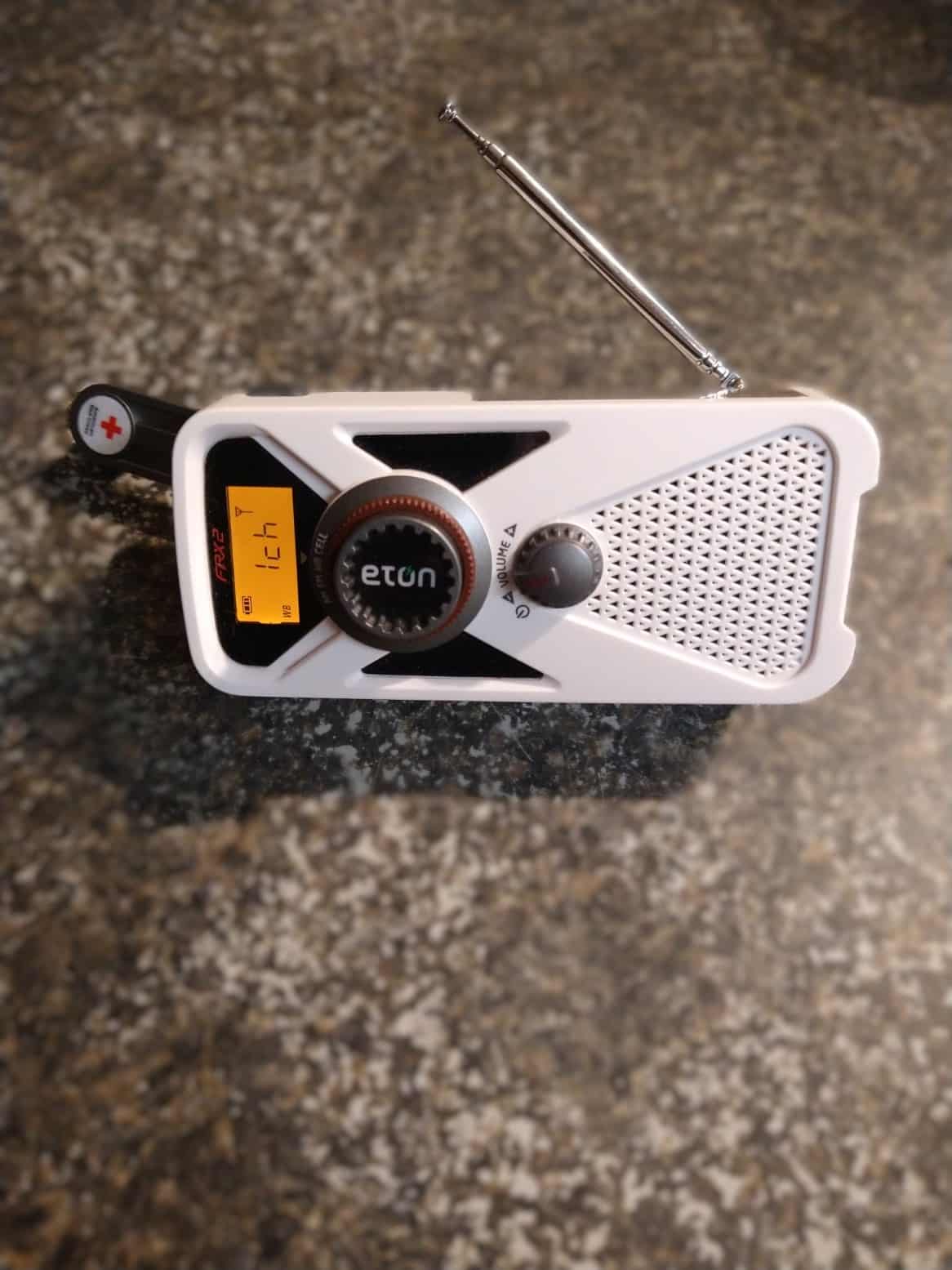
5. Eton FRX3+ — Red-Cross Approved Choice
Co-branded with the American Red Cross, the FRX3+ adds automatic SAME alerts—it sits silently until NOAA pushes urgent bulletins, then springs to life. Great for light sleepers.
- ✅ Power: solar, crank, or built-in 2,000 mAh pack
- ✅ Glow-in-the-Dark Trim: easy to locate at 2 a.m.
- ✅ Turbine Efficiency: one minute cranking = 15 min radio
- ✅ Phone Charging: emergency top-ups only (0.7 A)
What Stood Out
SAME alerts triggered six seconds after the Midland—virtually real-time.
Trade-Offs
Solar panel is small; expect full-day charging for a half-charge.
6. FosPower A1 — Compact Emergency Option
FosPower’s palm-size A1 slips into a school backpack yet packs the essentials: 2,000 mAh battery, flashlight, SOS buzzer, and triple power options.
- ✅ Weight: 0.7 lb
- ✅ Flashlight + Reading Lamp: keep homework going in outages
- ✅ Gasketed Ports: IPX3 splash-proof
Small hands can crank it without wobble. SOS siren hits 90 dB—attention-grabbing for search teams.
Trade-Offs
Battery drains fast on speaker music; keep volume low.
7. Raynic 5000 — Best Long Runtime
With a massive 5,000 mAh cell and five-way power redundancy, the Raynic 5000 survived a three-day grid-down drill while topping off two phones nightly.
- ✅ Power: Li-ion, AAA backup, solar, crank, or AC
- ✅ Flashlight + Lamp: both dimmable
- ✅ Weight: 1.3 lb (worth it for capacity)
What Stood Out
Crank felt smoother than average; one minute yielded ~5% phone juice—handy when you’re phoning in evacuation logistics.
Trade-Offs
Bulky shape hogs pack real estate; store it in the car kit instead of your ultralight go-bag.
8. Mesqool CR12000 — Multi-Purpose Emergency Radio
The CR1009 balances price, features, and campsite usability—combining lantern lighting, backup charging, and portable radio functionality in a single unit, and 5,000 mAh power bank in one.
- ✅ 5-Way Power: USB-C, AAA, solar, crank, or AC
- ✅ Lantern Mode: diffused panel for tent ambiance
- ✅ Headphone Jack: catch late-night ballgames without waking the crew
What Stood Out
Solar panel is angled, so you can set the radio flat on a picnic table and still sip sun while cooking dinner.
Trade-Offs
NOAA tuning slightly less sensitive in canyons—extend antenna fully for best results.
Reliable communication becomes one of the most valuable survival advantages during prolonged blackouts, especially once mobile networks become overloaded or regional emergency information becomes difficult to access.
Emergency radios work best as part of a larger layered preparedness system that includes backup lighting, battery storage, water purification, and emergency power redundancy. For the complete backup power framework, see our guide to the best survival and off-grid generators of 2025.
Which Emergency Radio Is Right for Your Situation?
Best for Home Blackout Preparedness
Households preparing for multi-day outages should prioritize long battery runtime, reliable NOAA alerts, and strong phone-charging capability. Models like the Midland ER310 and Raynic 5000 perform best for keeping communication devices powered during prolonged grid failures.
Best for Vehicle Emergency Kits
Compact radios with strong durability work best inside evacuation vehicles and roadside kits. The FosPower A1 and RunningSnail MD-090P are small enough for glove boxes while still providing NOAA alerts and backup lighting.
Best for Off-Grid Camping & Remote Areas
If you spend significant time outside cellular coverage, shortwave capability becomes far more valuable. The Kaito KA500 allows users to monitor international and long-range broadcasts when local infrastructure becomes unreliable.
Best for Family Emergency Kits
Families should prioritize radios with simple controls, bright lighting, and dependable alert systems that function well under stress. The Midland ER310 and Eton FRX3+ both perform exceptionally well during fast-moving severe weather events.
Best for Long-Term Grid Failure Scenarios
Long-duration outages require layered charging redundancy. Radios with larger battery systems, multiple charging methods, and reliable crank efficiency become critical once replacement batteries and fuel supplies become limited.
Households planning for longer outages should also review our complete grid-down survival power guide to build layered backup systems beyond small emergency radios.
How Long Will Cell Towers Work During a Blackout?
One of the biggest misconceptions during a power outage is that cell phones will continue working normally as long as the phone itself remains charged. In reality, mobile networks depend on thousands of local cell towers that require electricity to operate.
Most cell towers have backup battery systems designed to keep equipment running during short-term outages. Depending on the provider, location, and network configuration, those batteries may last anywhere from a few hours to roughly a day before performance begins degrading. Some critical towers have backup generators that can extend operations significantly longer, but fuel availability becomes a major factor during widespread emergencies.
Even when towers remain online, network congestion often becomes the larger problem. During major storms, blackouts, and disasters, thousands of people attempt to call family members, access news updates, stream video, and check emergency information at the same time. This surge in demand can overwhelm available capacity long before towers completely lose power.
Text messages often continue working longer than voice calls because they require far less bandwidth. However, delays can still occur as networks become overloaded.
This is one reason emergency radios remain such a valuable preparedness tool. NOAA weather broadcasts continue operating independently of overloaded cellular systems and provide direct access to weather alerts, evacuation notices, and emergency information when phone service becomes unreliable.
For a deeper look at how communication systems begin failing during prolonged outages, see our guide on Communication Failure Timeline (0–72 Hours): When Phones and Networks Go Down.
You should also review How to Communicate When the Grid Goes Down to build a layered communication plan that does not rely entirely on cellular infrastructure.
Common Emergency Radio Mistakes
Relying Entirely on Solar Charging
Small integrated solar panels recharge slowly and should be viewed as supplemental charging systems rather than primary power sources.
Forgetting to Program SAME Codes
Many households never configure county-specific NOAA alerts, reducing the effectiveness of emergency weather notifications during fast-moving disasters.
Assuming Cell Networks Will Stay Operational
Mobile towers often experience heavy congestion or backup battery depletion during extended outages.
Never Testing the Radio
Emergency radios should be tested regularly for NOAA reception, battery runtime, crank charging, and flashlight operation.
Waiting Until an Emergency to Learn How the Radio Works
Many households buy an emergency radio, place it in a closet, and never use it again until a disaster occurs. Unfortunately, stressful situations are the worst time to learn how to tune NOAA channels, activate weather alerts, adjust antennas, or recharge backup batteries. Spend a few minutes each month testing your radio so you know exactly how it operates before you need it.
Buying Tips & Survival Extras
Key Specs to Compare
- Battery Capacity (mAh): determines phone-charge potential.
- NOAA SAME vs. Standard Alerts: SAME codes cut false alarms by locking to your county.
- Band Coverage: Shortwave can deliver vital intel when domestic towers fail.
- Lighting Modes: Lantern + flashlight beats flashlight-only designs during shelter-in-place scenarios.
- Crank Efficiency: Aim for at least 10 min radio per 1 min cranking.
Communication planning becomes critical during long grid failures. Our guide on how to prepare for a two-week power outage explains how radios, lighting, water storage, and backup power work together.
Many preppers combine radios with other solar powered survival gear to maintain communication and lighting when the grid fails.
Need a reliable backup communication setup? See our recommended emergency communication gear here.
Communication planning should never rely on a single device. Radios, backup power, emergency lighting, water storage, and family communication plans all work together to create a more resilient preparedness system.
Stay Powered Beyond the Storm
If you’re prepping for longer outages, pair your radio with a solar generator hybrid system — no noise, no fuel, just reliable backup energy.
Final Thoughts
Emergency radios provide something many households lose quickly during large-scale outages: reliable information. If you’re trying to keep refrigerated food from spoiling during outages, see our guide explaining whether a solar generator can run a refrigerator during a blackout. Pick the model that matches your lifestyle: Midland for balanced reliability, Sangean for advanced features, or RunningSnail for tight budgets. Then practice: store SAME codes in advance, test crank output monthly, and log battery runtimes in your preparedness journal. When the next derecho or polar vortex hits, you’ll be informed, connected, and one step ahead.
Emergency communication is only one part of a complete blackout plan.
For the full system covering water storage, backup power, heating, and long-term outage readiness, read the
Emergency Preparedness Master Plan.
This post contains Amazon affiliate links. If you buy through them, we may earn a small commission at no extra cost to you—helping support our preparedness research and testing.