
Grid-Down Survival Playbook: Backup Power and Emergency Essentials
When the electrical grid fails, everyday routines can become difficult surprisingly quickly. Refrigerators begin warming, phones eventually lose their charge, electric well pumps stop operating, and heating or cooling equipment may become unavailable. A reliable grid-down survival plan addresses these problems before an outage occurs.
This post contains affiliate links. I may earn a small commission at no extra cost to you. Learn more.
Preparing for a blackout does not necessarily mean installing an expensive solar system or purchasing a large generator. Many households can improve their readiness with stored water, dependable lighting, a charged power bank, and a practical plan for keeping essential equipment operating.
For longer outages, however, the requirements change. Refrigeration, medical devices, communications, seasonal temperatures, fuel availability, and battery recharging become increasingly important.
This guide explains how to build a layered backup system using generators, portable power stations, solar panels, and low-power emergency equipment. It also covers water, food, cooling, sanitation, and the calculations needed to estimate how long your supplies will last.
For a broader household preparedness framework, see our Emergency Preparedness Master Plan. You can also review our Two-Week Power Outage Guide for extended emergencies.
Recommended equipment: Browse our Emergency Power and Lighting Gear List for backup batteries, solar equipment, lanterns, and related supplies.
What Happens When the Power Grid Goes Down?
The effects of a power outage depend on its duration, location, weather, and the infrastructure serving your household. A brief outage may cause little more than inconvenience. A prolonged regional blackout can affect communications, water treatment, fuel distribution, grocery stores, and medical services.
Homes with electric well pumps may lose running water immediately. Households connected to municipal systems may retain pressure temporarily, although pumping or treatment disruptions can eventually affect service.
Refrigeration presents another challenge. Without electricity, perishable foods gradually warm into temperatures where harmful microorganisms can multiply.
Extreme temperatures can make the situation more serious. During summer, indoor heat can become dangerous. In winter, homes without alternative heating may lose safe indoor temperatures.
These possibilities make it important to identify essential needs before choosing backup equipment.
Establish Your Power Priorities
Start by separating critical equipment from convenience appliances.
- Critical: Medically necessary devices, essential communications, and equipment required for immediate household safety.
- Important: Refrigeration, lighting, water pumping, and temperature-management equipment.
- Optional: Entertainment systems, nonessential electronics, and appliances that can remain unused temporarily.
Not every household has the same priorities. A family using a private well may need substantial generator capacity, while an apartment resident may only need a power bank, portable fan, radio, and rechargeable lights.
Choosing Your Primary Backup Power Source
Two common approaches to residential emergency electricity are fuel-powered generators and rechargeable portable power stations. Neither is universally superior.
Generators produce electricity while fuel is available. Portable power stations store electricity in batteries and must be recharged after use. Solar panels can replenish compatible batteries, but production varies with available sunlight.
Option 1: Gasoline and Dual-Fuel Generators
Portable generators are particularly useful when a household must operate equipment with substantial power requirements.
Examples include certain well pumps, refrigerators, freezers, power tools, and selected household circuits when connected through an appropriate transfer system.
Dual-fuel generators can operate on gasoline or propane, providing flexibility when one fuel is unavailable. Actual output and runtime depend on the model, fuel type, and electrical load.
Advantages: Higher power output, compatibility with many appliances, and the ability to continue operating when sufficient fuel is available.
Disadvantages: Fuel consumption, noise, maintenance requirements, exhaust emissions, and the need for safe outdoor operation.
Choose a generator based on both running watts and starting watts. Motors and compressors may briefly require significantly more power when starting.
For model comparisons, visit our Best Survival and Off-Grid Generators Guide.
Option 2: Portable Solar Power Stations
A portable power station combines a rechargeable battery, charging electronics, and electrical outputs in one unit. Many models include USB connections, 12-volt DC outputs, and household-style AC outlets.
Unlike fuel-powered generators, battery power stations produce no combustion exhaust during operation. They can generally be used indoors when operated according to the manufacturer’s ventilation and temperature requirements.
They are useful for powering phones, radios, LED lighting, fans, laptops, and compatible appliances.
Advantages: Quiet operation, no combustion exhaust, relatively simple setup, and several recharging options.
Disadvantages: Limited stored energy, equipment cost, charging time, and output restrictions.
A power station advertised with a 1,000Wh battery does not provide unlimited electricity. Once its usable energy is depleted, it must be recharged.
Solar panels may extend operation, but only when their daily energy production is sufficient for the connected loads.
Our Solar Generator Sizing Guide explains how to match equipment capacity to household appliances.
Generator vs. Portable Power Station
| Feature | Fuel Generator | Power Station |
|---|---|---|
| Energy source | Gasoline or propane | Stored battery electricity |
| Indoor operation | Never | Generally suitable when used as directed |
| Noise | Engine noise | Quiet; cooling fans may operate |
| Runtime | Depends on fuel and load | Depends on battery capacity and load |
| Maintenance | Engine and fuel maintenance | Battery care and periodic checks |
| Best applications | Higher-wattage appliances and pumps | Electronics, lights, fans, selected appliances |
Should You Combine Both Systems?
For households preparing for extended outages, a hybrid arrangement can provide useful redundancy.
A generator can operate higher-wattage equipment and recharge a power station. The battery can then support quiet nighttime operation without running the generator continuously.
This arrangement may reduce fuel consumption, but the actual savings depend on generator efficiency, charging losses, and household demand.
Never connect charging equipment beyond the manufacturer’s input limits, and never improvise connections between generators, batteries, or household electrical circuits.
Building a Practical 72-Hour Grid-Down Survival Plan
The first three days of a blackout are a useful starting point for emergency planning. During this period, your household should be able to access safe water, prepare basic meals, maintain communication, and provide necessary lighting.
Power equipment should support these priorities rather than determine them.
What Should You Do When an Outage Begins?
- Confirm the situation. Check official alerts and determine whether the outage is local or widespread.
- Protect critical needs. Address medical devices, temperature hazards, and other immediate safety requirements.
- Preserve refrigeration. Keep refrigerator and freezer doors closed while determining whether backup power is available.
- Deploy lighting. Use LED lanterns and headlamps rather than relying on candles.
- Conserve electricity. Turn off unnecessary equipment and prioritize essential charging.
- Check water availability. Use stored water when supply safety is uncertain and follow official advisories.
- Communicate. Send essential status updates and establish the next family check-in.
Do not assume every blackout will last 72 hours. Monitor conditions and adjust your plan as reliable information becomes available.
Recommended Portable Power Equipment
Portable power stations come in different capacities and output ranges. Compare battery capacity, continuous AC output, charging options, and appliance compatibility before choosing a model.
Jackery Explorer Portable Power Station
A portable Jackery unit can support smaller emergency loads such as lighting, communication equipment, fans, and compatible electronics. Battery capacity and available output depend on the specific model.

EcoFlow DELTA Series Power Station
Higher-capacity portable power stations can support larger appliances when their continuous output, starting surge capability, and available energy are sufficient.

BLUETTI Portable Power Station
Expandable battery systems may be appropriate for households needing greater stored energy. Confirm expansion compatibility, supported charging inputs, and the exact battery capacity of the listed model.

Understanding Watts, Watt-Hours, and Battery Runtime
Before purchasing a power station, understand the difference between watts and watt-hours.
Watts (W) measure the rate at which a device consumes electricity. Watt-hours (Wh) measure energy consumed or stored over time.
A 10W fan operating for eight hours consumes approximately 80Wh.
Energy consumed (Wh) = Device watts × Operating hours
This calculation provides a starting point for determining battery requirements.
Estimating Battery Runtime
A simple runtime estimate divides usable battery energy by the connected load.
Runtime (hours) ≈ Usable battery energy (Wh) ÷ Device power (W)
For example, suppose a 1,000Wh power station provides approximately 850Wh of usable energy after applicable losses.
A 10W fan could theoretically operate for approximately 85 hours under those assumptions.
Actual runtime may be lower because of inverter consumption, temperature, battery condition, and other electrical losses.
Small DC-powered devices can sometimes operate more efficiently through suitable DC outputs than through an AC inverter.
Example Emergency Power Budget
| Equipment | Example Consumption | Daily Energy |
|---|---|---|
| LED lantern | 5W for 6 hours | 30Wh |
| USB fan | 10W for 8 hours | 80Wh |
| Phones and radio | Estimated charging needs | 60Wh |
| Refrigerator | Example measured daily use | 800Wh |
| Total | Before additional losses | 970Wh |
This example illustrates why refrigeration can dominate a small emergency power budget. Actual refrigerator consumption varies significantly with appliance efficiency, room temperature, door openings, and operating conditions.
Measure your own appliances when possible rather than relying exclusively on generalized estimates.
Use our Emergency Power Planner to develop a household-specific plan.
Solar Panels and Emergency Battery Recharging
Solar panels provide a way to recharge compatible power stations without consuming generator fuel. However, panel ratings represent output under standardized test conditions, not guaranteed production throughout the day.
Cloud cover, seasonal sunlight, temperature, shade, panel orientation, and charging limitations all influence actual output.
Calculating Daily Solar Production
A useful planning estimate is:
Daily solar energy (Wh) ≈ Panel watts × Peak sun hours × System efficiency factor
Suppose a 200W panel receives four equivalent peak-sun hours and the overall system delivers 70% of the theoretical output.
200 × 4 × 0.70 = 560Wh per day.
This is a planning estimate, not a guaranteed daily yield. The actual amount reaching the battery depends on the charging system and conditions.
How Long Does Solar Charging Take?
Consider a 1,000Wh battery requiring approximately 1,000Wh of replenishment. The table below uses four peak-sun hours per day and an illustrative 70% overall production factor.
| Panel Capacity | Estimated Daily Energy | Approximate Days |
|---|---|---|
| 100W | 280Wh | 3.6 |
| 200W | 560Wh | 1.8 |
| 400W | 1,120Wh | About 1 |
These figures assume no simultaneous appliance consumption and that the power station accepts the available solar input. Charging may take longer because of charging-stage behavior and weather variability.
Solar Panel Compatibility and Safety
Before connecting panels, verify the power station’s maximum solar input wattage, voltage range, current limits, connector requirements, and approved configurations.
MC4 connectors are common on solar equipment, but a matching connector does not automatically mean two components are electrically compatible.
Series connections increase voltage, while parallel connections increase available current. Incorrect configurations can damage equipment or create electrical hazards.
Use properly rated cables and compatible adapters. Never exceed the manufacturer’s electrical limits.
For additional information, see our Solar Generator Hybrid Backup Guide.
Keeping Your Home Cool During a Power Outage
Summer blackouts can become dangerous when indoor temperatures rise and air conditioning is unavailable. A practical cooling plan focuses on limiting heat gain, increasing safe airflow, and recognizing when conditions require relocation.
Reduce Heat Entering the Home
Close blinds or curtains on windows receiving direct sunlight. Exterior shading can be particularly effective when installed safely.
Reduce unnecessary indoor heat by postponing activities such as oven cooking and clothes drying.
If outdoor air is cooler than indoor air, ventilation may help remove accumulated heat. When outside temperatures are higher, keeping windows closed and shaded may be more effective.
Use Low-Power Fans
USB fans are useful because many operate on relatively little electricity. A 10W fan running eight hours consumes approximately 80Wh.
Fans improve comfort by moving air across the skin, but they do not necessarily lower room temperature.
During extreme heat, fans alone may be inadequate, especially in very hot indoor environments. Older adults, infants, people with medical conditions, and others vulnerable to heat require additional precautions.
Evaporative cooling methods generally work better in dry conditions than in humid climates.
Recognize Dangerous Heat
Heat exhaustion can cause heavy sweating, weakness, headache, dizziness, and nausea. Heat stroke is a medical emergency and may involve confusion, collapse, seizures, or other neurological symptoms.
If heat stroke is suspected, call emergency services and begin rapid cooling while waiting for help.
When a home cannot be kept at a safe temperature, consider an available cooling center or another safe, air-conditioned location.
For additional strategies, read How to Stay Cool Without Power.
Emergency Lighting: Build a Three-Layer System
Lighting is one of the easiest parts of blackout preparedness to improve. Modern LEDs provide useful illumination while consuming relatively little electricity.
A layered approach provides flexibility without depending on one device.
Layer One: Area Lighting
LED lanterns illuminate shared rooms, kitchens, and temporary workspaces. Models with adjustable brightness can conserve energy when full output is unnecessary.
Layer Two: Task Lighting
Headlamps provide hands-free lighting for repairs, cooking, carrying supplies, and first aid.
Keep a headlamp in a consistent location so it can be found quickly in darkness.
Layer Three: Independent Backup
Maintain a separate flashlight with fresh batteries or a reliable rechargeable battery.
Battery-operated lights are generally safer than candles during blackouts. Open flames introduce fire risks, particularly around children, pets, curtains, and combustible materials.
For product comparisons, see our Best Emergency Lights for Power Outages.
Amazon lighting options: Rechargeable LED lanterns and USB-C headlamps.
Emergency Communications When Networks Fail
Communication preparedness involves two separate needs: receiving reliable emergency information and contacting other people.
Cellular networks may remain operational during some outages, but congestion, backup-power limitations, or damaged infrastructure can interrupt service.
NOAA Weather Radios
A compatible NOAA Weather Radio receiver can provide weather warnings and emergency information where broadcasts are available.
Some models support SAME alerts, allowing users to configure alerts for specific geographic areas.
Check whether your radio provides automatic alert monitoring. Not every hand-crank or solar radio includes that capability.
See our Emergency Solar Radio Guide for additional features to consider.
FRS, GMRS, and Amateur Radio
FRS handheld radios can support short-range communication without an individual FCC license when operated under applicable FRS rules.
GMRS generally requires an FCC license, which can cover eligible family members. Amateur radio operation generally requires the appropriate amateur license.
Radio range varies substantially with terrain, buildings, antenna placement, and equipment. Do not assume advertised maximum ranges will be achievable in a neighborhood or during a disaster.
Most importantly, two-way radios are useful only when the people you intend to contact have compatible equipment and an agreed communication plan.
Create a Family Check-In Procedure
Write down important telephone numbers, select an out-of-area contact, and establish meeting locations.
Agree on reasonable check-in times and alternative communication methods.
Keep a paper copy of the plan with your emergency supplies.
For more detailed signaling methods, visit How to Signal for Help.
Water Preparedness During a Grid-Down Emergency
Reliable drinking water is more important than keeping every household appliance operating.
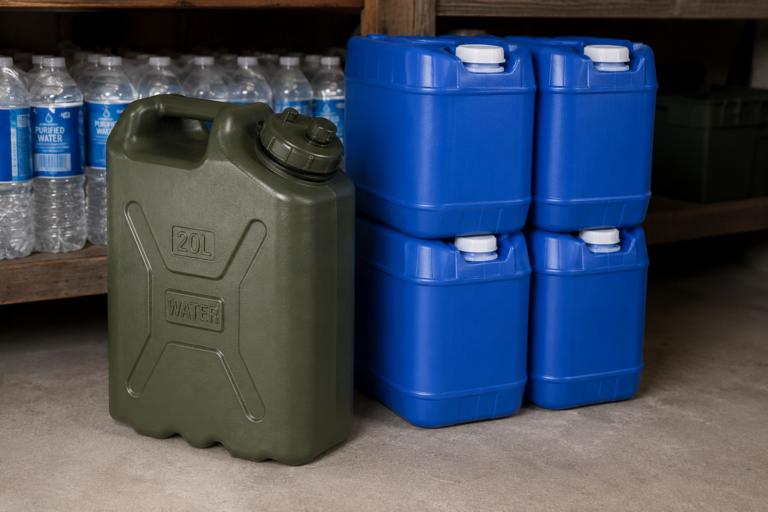
A common emergency planning minimum is one gallon per person per day for drinking and basic sanitation. Hot weather, medical requirements, pets, and other circumstances may increase that amount.
For four people, a three-day supply at this minimum equals 12 gallons.
Store additional water when space and resources allow, particularly if your household depends on an electric well pump.
Water Storage and Treatment
Use clean, food-grade containers intended for water storage. Keep them tightly closed and protected from excessive heat and contamination.
Do not routinely add arbitrary amounts of household bleach to stored drinking water. Follow recognized water storage and disinfection guidance appropriate to the water source and container.
If water becomes biologically unsafe, boiling or correctly applied disinfection may help, depending on the circumstances.
Bring water to a rolling boil for one minute, or three minutes at elevations above 6,500 feet, when boiling is the appropriate treatment.
Boiling does not remove fuel, pesticides, heavy metals, or many other chemical contaminants.
Portable filters also vary in their ability to remove bacteria, protozoa, viruses, and chemical substances.
When chemical contamination is suspected, use another safe water source rather than assuming an ordinary filter will make the water drinkable.
For a comprehensive explanation, read our Long-Term Water Storage Guide and Water Purification Survival Guide.
Food Storage and Refrigerator Safety
Power outages create two separate food problems: preparing meals without electricity and preventing refrigerated food from becoming unsafe.
For an initial three-day emergency, prioritize shelf-stable foods that your household already eats.
Examples include canned meats, beans, fruit, nut butter, crackers, and other ready-to-eat products.
Keep a manual can opener available. Remember that some dehydrated and freeze-dried emergency meals require additional water and cooking.
How Long Will Refrigerated Food Stay Safe?
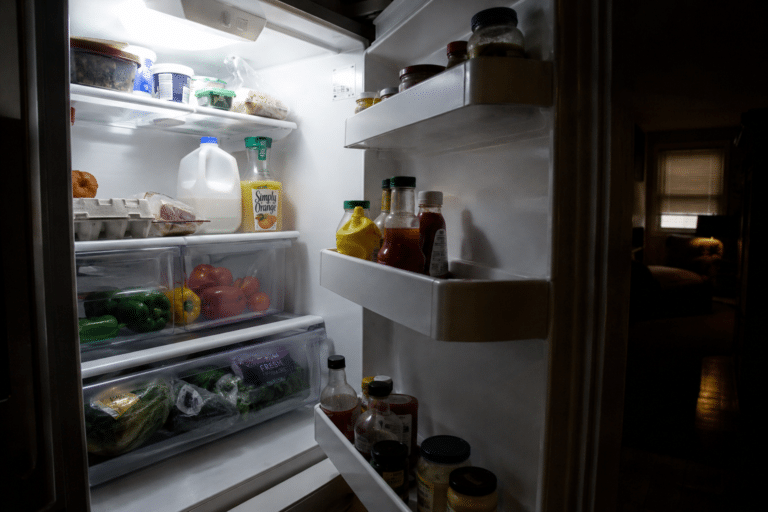
According to standard USDA and FDA emergency food-safety guidance, an unopened refrigerator generally keeps food cold for about four hours during a power outage.
A full freezer may maintain safe temperatures for approximately 48 hours, while a half-full freezer may last around 24 hours, provided the door remains closed.
These are general estimates, not guarantees. Use appliance thermometers to evaluate actual conditions.
Refrigerated perishable foods that have been above 40°F for more than two hours generally need to be discarded. Follow official food-safety guidance for specific items and circumstances.
Never taste food to determine whether it is safe.
Can a Power Station Keep a Refrigerator Running?
Yes, provided the power station supports the refrigerator’s starting surge and running power requirements.
However, there is no universally safe fixed schedule for switching a refrigerator on and off.
Use a refrigerator thermometer and maintain safe food temperatures rather than assuming that operating the compressor for a particular number of hours will preserve food.
For longer outages, measure refrigerator energy consumption and compare it with available battery storage, generator runtime, and solar production.
Hygiene and Sanitation Without Running Water
Maintaining basic hygiene becomes more difficult when electric water pumps, municipal pressure, or wastewater systems are unavailable.
Start with a reliable handwashing arrangement. A water container with a spigot, soap, and a catch basin can provide a simple low-power solution.
Rechargeable camping shower pumps and gravity-fed shower bags may be useful when sufficient water is available.
Water consumption is usually the greater limitation. A short shower can consume several gallons even when the pump requires very little electricity.
Emergency Toilet Planning
Determine whether your household toilets can continue operating during an outage. Homes with functioning gravity-fed water and sewer systems may retain normal flushing capability.
Other properties may depend on electric pumps or systems that become unavailable.
Keep an emergency sanitation kit with heavy-duty bags, suitable absorbent material, gloves, cleaning supplies, and a secure container.
Follow local public-health instructions for temporary waste storage and disposal. Avoid contaminating wells, surface water, and living areas.
Graywater Management
Used washing water may contain soap, grease, food particles, and microorganisms.
Biodegradable soap does not make graywater harmless or suitable for unrestricted disposal.
Keep wastewater away from drinking water sources, and follow local requirements for disposal. Do not automatically discharge household graywater onto vegetable gardens or near wells.
For equipment ideas, see our DIY Off-Grid Shower Guide.
What Emergency Equipment Should You Buy First?
Preparedness spending should follow your actual needs rather than an arbitrary equipment list.
A household without adequate drinking water should address that weakness before purchasing an expensive solar array.
Similarly, a family with critical electrically powered medical equipment may need a professionally planned backup solution before buying general-purpose camping equipment.
Tier One: Basic Blackout Essentials
Start with stored water, shelf-stable food, flashlights, a weather radio, first aid supplies, and a reliable phone-charging option.
These items address several common short-term outage problems without requiring a major investment.
Tier Two: Portable Emergency Electricity
Add a suitable portable power station, compatible solar panels if useful, and low-power devices such as USB fans and rechargeable lanterns.
Choose battery capacity based on measured daily energy requirements, not advertising claims about the number of appliances a unit can power.
Recommended power stations: Jackery power station, EcoFlow power station, and BLUETTI power station.
Tier Three: Extended Blackout Capability
For longer outages, consider higher-capacity battery storage, a properly sized generator, a compatible solar array, and safe fuel storage.
Homes with well pumps, electric heating systems, or other large loads may require a more comprehensive electrical design.
Professional installation is especially important when connecting backup equipment to household circuits.
Test Your Backup System Before an Emergency
Equipment that has never been tested may not perform as expected when electricity becomes unavailable.
A simple household blackout drill can reveal missing adapters, depleted batteries, insufficient lighting, and inaccurate assumptions about appliance consumption.
Choose a safe practice period and operate selected noncritical equipment using your emergency supplies.
Record how much electricity your devices consume, how quickly batteries discharge, and whether your recharging arrangement meets expectations.
Do not disconnect medical equipment, disable safety systems, or create unsafe indoor temperatures for the sake of a drill.
Review your results and correct the most important weaknesses.
Frequently Asked Questions About Grid-Down Survival
How long will a 1,000Wh power station last?
Runtime depends on the connected equipment and the battery’s usable energy. If approximately 850Wh is available after applicable losses, a constant 10W load could theoretically operate for about 85 hours. Higher-wattage equipment will discharge the battery much faster.
Can solar panels run a refrigerator during a blackout?
They can contribute enough electricity when the solar array, battery storage, inverter, and charging system are properly sized. Actual performance depends on refrigerator energy consumption and available sunlight. A battery is generally necessary to support operation when solar production is insufficient.
Are dual-fuel generators safe inside a house?
No. Gasoline and propane generators produce carbon monoxide and must never operate indoors, in garages, or near building openings. Follow the manufacturer’s instructions and established generator safety guidance.
How many solar panels do I need for a 1,000Wh battery?
Under an illustrative four peak-sun hours per day and 70% system efficiency, approximately 360W of panel capacity could theoretically produce 1,000Wh in one day. A 400W array provides a reasonable example, but actual charging depends on weather, equipment limits, and charging losses.
Should I buy a generator or a power station first?
Choose based on essential loads. A power station may be sufficient for lighting, phones, fans, and small electronics. A generator may be more appropriate for substantial motor loads, large appliances, or household circuits requiring higher output.
How much emergency water should I store?
At least one gallon per person per day is a common starting minimum for drinking and basic sanitation. Store more when possible, particularly for hot weather, pets, medical needs, and households relying on electric well pumps.
What is the best way to prepare for a two-week blackout?
Begin by calculating water, food, medication, and energy requirements for the entire period. Develop realistic fuel or battery recharging plans, account for seasonal temperatures, and identify alternative locations if conditions become unsafe.
Final Thoughts: Build a Reliable Grid-Down Survival System
Effective grid-down survival preparation is not about keeping every appliance running. It is about protecting the essential functions that make your home safe and manageable when normal services become unavailable.
Begin with water, food, lighting, communication, and a realistic household emergency plan. Then identify the equipment that genuinely requires electricity and calculate how much energy it consumes.
For some households, a charged power bank and dependable emergency lights provide an excellent starting point. Others may benefit from a portable power station, solar panels, or a properly installed generator system.
Whatever equipment you choose, test it before an emergency. Learn its limitations, maintain appropriate backups, and revisit your plan as household needs change.
The strongest preparedness systems are built around reliable supplies, practical skills, and decisions based on actual requirements rather than assumptions.
Related Preparedness Guides
- Emergency Preparedness Master Plan
- Two-Week Power Outage Preparedness
- What Size Solar Generator Do I Need?
- How to Stay Cool Without Power
- Emergency Solar Radio Guide
- Water Purification Survival Guide
As an Amazon Associate, The Savvy Survivalist earns from qualifying purchases.