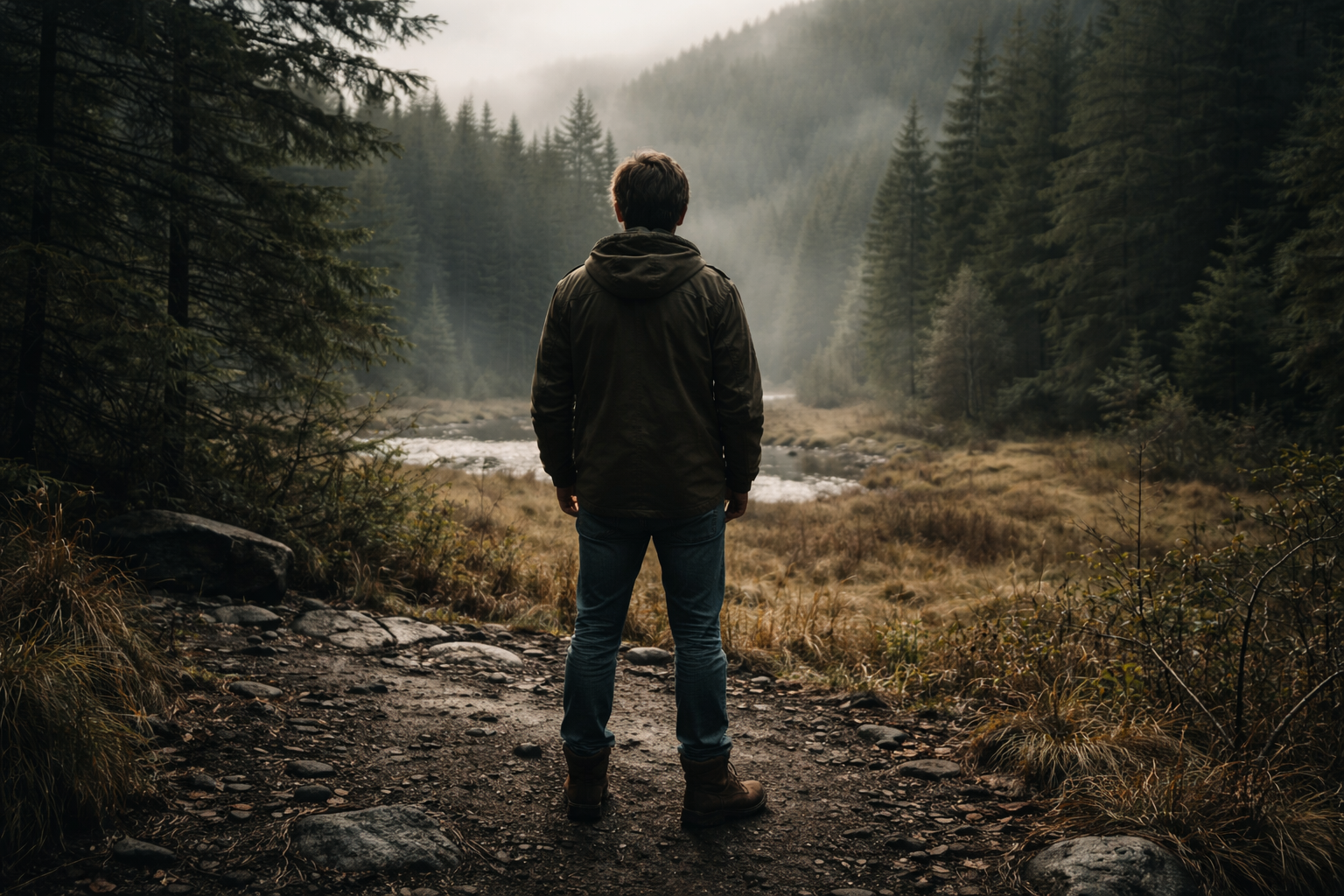
How to Survive in the Wilderness Without Supplies (No Gear Survival Guide)
Surviving in the wilderness without supplies doesn’t mean thriving, camping comfortably, or living off the land the way movies portray. It means staying alive long enough to be rescued when you have no food, no tools, no shelter, and no plan.
This post contains affiliate links. I may earn a small commission at no extra cost to you. Learn more.
Most people imagine wilderness survival as a test of toughness or ingenuity. In reality, it’s a test of discipline and restraint. The majority of fatal survival situations don’t happen because someone lacked skills — they happen because someone made the wrong decision early.
“Without supplies” usually means:
- No backpack or survival kit
- No knife, fire starter, or shelter materials
- No stored food or water
- Possibly no phone signal or navigation tools
This situation happens more often than people think. Day hikers take wrong turns. Hunters get separated from gear. Vehicles break down on remote roads. Weather shifts faster than expected.
The good news is this:
The human body can survive days — even weeks — with nothing, if exposure and dehydration are controlled.
The bad news:
Most people don’t fail because of starvation. They fail because of exposure, panic, or exhaustion.
This guide focuses on what actually matters when you have nothing:
- Staying warm or cool enough to function
- Finding drinkable water
- Conserving energy
- Making decisions that increase rescue odds
There are no gimmicks here. No fantasy bushcraft. Just the realities of survival when the only tool you have is your judgment.
For a complete breakdown of survival priorities beyond gear, see the master Wilderness Survival Guide (2026).
If You Have 60 Seconds, Read This
Bullet list:
- Stop moving unless you know exactly where safety is
- Shelter beats food and fire
- Water search must be low-risk
- Energy conservation keeps you alive
- Being found matters more than walking out
This guide is for people caught without gear — not for bushcraft practice or long-term wilderness living.
The same priorities that keep you alive in the wild—shelter, water, energy conservation—also apply during long grid failures. Learn how to prepare for a two-week power outage at home.
The First 24 Hours: Stabilize, Don’t Panic
The first 24 hours after realizing you’re stranded in the wilderness without supplies are the most dangerous — not because of hunger or thirst, but because of panic-driven decisions.
Most survival fatalities happen early, when people:
- Wander aimlessly trying to “walk out”
- Burn energy chasing food
- Ignore shelter until it’s too late
- Make reckless terrain choices
Your single objective during the first day is stabilization.
That means stopping the downward spiral before it starts.
The same principles apply whether you’re lost outdoors or managing a long-term power outage at home.
Step One: Stop Moving and Assess
As soon as you recognize you’re lost or stranded, stop. Sit down. Breathe. The urge to “do something” is natural, but uncontrolled movement burns calories, dehydrates you faster, and increases injury risk.
Ask yourself four questions:
- Am I injured?
- Am I exposed to immediate danger (cold, heat, storms)?
- Do I hear or see signs of people or roads?
- Can I retrace my steps safely?
If the answer to #4 is not an immediate, confident “yes,” then staying put is usually the correct decision.
Search-and-rescue teams are trained to look near last-known locations, not miles away.
Step Two: Control Exposure First
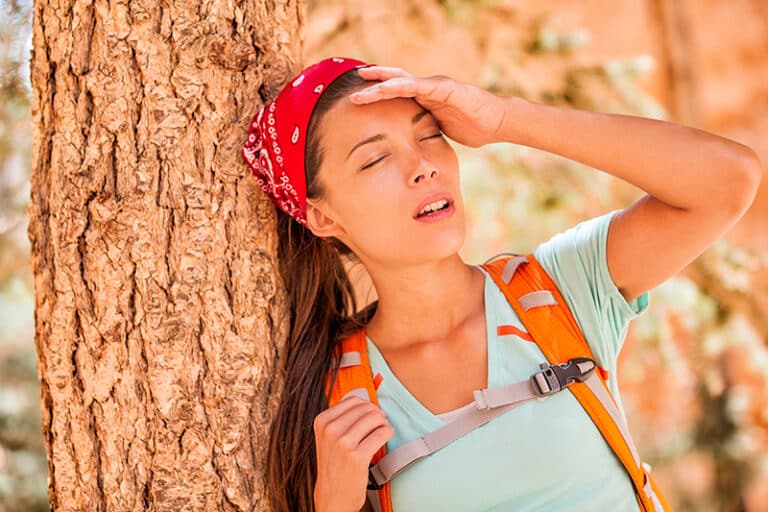
Exposure kills faster than dehydration. Hypothermia can set in even in mild temperatures if you’re wet, windy, or exhausted. Heat exhaustion can cripple you just as fast in hot environments.
In the first few hours:
- Get out of wind
- Get out of rain
- Get off bare ground
- Reduce sun exposure if overheated
You don’t need a shelter yet — you need temporary protection. Even standing on the leeward side of a rock, tree line, or slope can dramatically reduce heat loss or sun stress.
Step Three: Do Less, Not More
Survival without supplies is a game of energy economics.
Every unnecessary step costs calories.
Every panic sprint raises dehydration.
Every mistake compounds.
The goal is not comfort. The goal is to slow time.
Sit.
Observe.
Listen.
Wildlife noises, distant traffic, aircraft, rivers, or wind patterns can provide clues — but only if you’re still enough to notice them.
Step Four: Make Yourself Easier to Find
If rescue is likely, your job is to be visible and stationary.
Simple actions help:
- Stay near clearings or edges of terrain
- Avoid dense brush unless needed for shelter
- Use contrast (lighter clothing in dark areas, darker in snow)
- Avoid moving at night unless absolutely necessary
People who survive without supplies usually don’t “escape” the wilderness.
They outlast it.
The Mental Rule of the First Day
If you remember nothing else, remember this:
The first 24 hours are about not making things worse.
No shelter building marathons.
No forced marches.
No desperate food hunts.
Stabilize first. Everything else comes later.
Shelter Before Everything: Why Exposure Is the Real Killer
If you take nothing else from wilderness survival doctrine, take this:
Exposure kills faster than hunger, thirst, or predators.
People obsess over food. They picture starving slowly. In reality, most unprepared people die from hypothermia, heat exhaustion, or dehydration accelerated by exposure — often within the first 24–72 hours.
You can survive:
- Weeks without food
- Several days without water
But you may not survive one night of cold, wind, rain, or extreme heat without protection.
That’s why shelter comes before water and food when you have no supplies.
Why Shelter Is Priority #1
Shelter controls three critical survival variables at once:
- Body temperature
- Energy expenditure
- Hydration loss
Without shelter:
- Cold strips heat faster than your body can produce it
- Wind multiplies heat loss (wind chill kills quietly)
- Sun exposure accelerates dehydration and heat stroke
- Rain destroys insulation and morale simultaneously
A bad shelter is better than none.
An ugly shelter that keeps you alive is a success.
What Shelter Actually Needs to Do (Minimal Standard)
Forget cabins, huts, or Instagram-worthy bushcraft builds.
A survival shelter only needs to:
- Block wind
- Reduce heat loss to the ground
- Shed rain or snow
- Create shade if overheating
That’s it.
If your shelter does one of those well, it’s already helping. If it does two or more, you’re winning.
Use the Environment Before You Build Anything
Before you touch a single branch, look around.
Nature already provides partial shelter if you know how to use it:
- Rock faces or outcroppings – excellent wind blocks
- Fallen trees – instant frame for a lean-to
- Dense evergreen trees – natural wind and snow shields
- Depressions in terrain – reduce wind exposure
- Tree lines on slopes – block prevailing winds
Your job is not to fight the landscape.
Your job is to borrow from it.
If you can combine natural cover with minimal construction, you conserve energy and time.
Ground Insulation Matters More Than Roofs
Most people focus on overhead cover. That’s a mistake.
The ground steals body heat faster than air.
If you lie directly on dirt, rock, or snow:
- Your core temperature drops rapidly
- Shivering increases calorie burn
- Sleep becomes impossible
- Hypothermia risk skyrockets
Always insulate underneath first.
Use:
- Dry leaves
- Pine needles
- Bark
- Grass
- Moss (dry only)
- Extra clothing under your torso
You want thickness, not perfection. A sloppy pile of debris 6–12 inches thick is better than a neat but thin layer.
The Simplest Shelters That Actually Work
You’re not trying to impress anyone. You’re trying to survive the night.
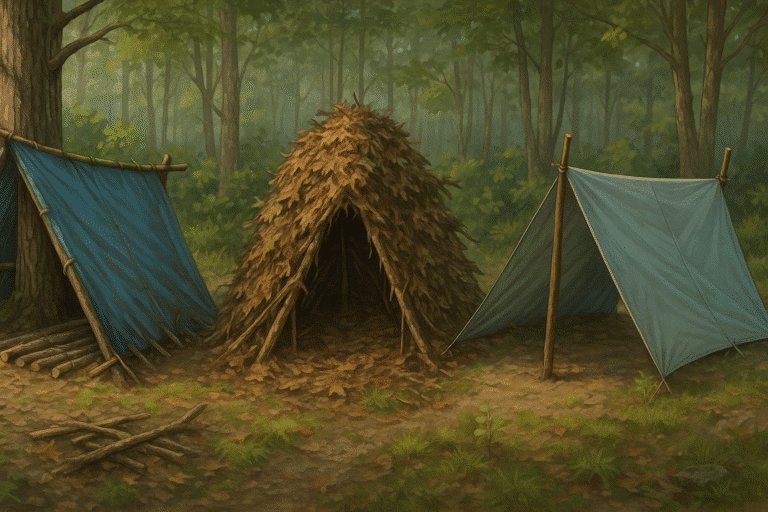
Lean-To Shelter
- One side closed, one side open
- Back faces wind
- Uses fallen logs or a slanted branch
- Fast, efficient, effective
Debris Shelter
- Small, cocoon-like structure
- Packed with leaves and insulation
- Excellent heat retention
- Ideal in cold environments
Natural Overhang Shelter
- Rock ledge + ground insulation
- Minimal effort
- High effectiveness
Avoid large shelters.
Small shelters trap heat better and cost less energy.
Shelter Size Rule (Critical)
Your shelter should be:
- Just big enough to lie down
- Just tall enough to turn over
- Just wide enough to curl slightly
Anything larger wastes heat.
Think sleeping bag, not cabin.
Shelter Timing: Build Before You’re Tired
This is where many people fail.
They delay shelter because:
- “It’s not cold yet”
- “I’ll do it later”
- “I want to find water first”
Then:
- Light fades
- Temperature drops
- Energy crashes
- Mistakes multiply
If you think you might need shelter tonight, start at least two hours before dark.
Cold decision-making is bad decision-making.
Shelter Is Psychological Survival Too
Shelter isn’t just physical protection — it’s mental armor.
Once you have shelter:
- Panic decreases
- Focus improves
- Sleep becomes possible
- Decision-making stabilizes
A person with shelter thinks clearly.
A person without shelter spirals.
The Rule to Remember
If you’re exposed, you’re dying on a schedule.
Shelter slows that clock.
Finding Water Without Gear: Smart Methods That Don’t Get You Killed
Water is essential — but how you look for it matters just as much as finding it.
Many people die in survival situations not because water was unavailable, but because they:
- Burned too much energy searching
- Took dangerous terrain risks
- Drank contaminated water
- Prioritized water at the wrong time
When you have no supplies, water procurement must be low-risk, low-effort, and sustainable.
The Hard Truth About Water Without Supplies
You can survive:
- 3–5 days without water (sometimes longer in cool conditions)
- Only hours to a day if you overexert yourself looking for it
That means reckless searching can kill you faster than dehydration.
If you already have shelter and are not overheating, you have time.
Rule #1: Don’t Chase Water — Let Gravity Do the Work
Water follows predictable patterns.
Instead of wandering randomly:
- Move downhill
- Follow natural drainage paths
- Look for green vegetation
- Observe animal trails (they often lead to water)
Water almost never sits on ridges or peaks.
Low ground is your ally.
Signs Water Is Nearby (Without Seeing It)
Look for:
- Dense green plant growth
- Willows, cottonwoods, reeds
- Insects hovering in clouds
- Birds flying low in the morning or evening
- Animal tracks converging
If you notice multiple signs together, slow down — water may be close.
The Safest Natural Water Sources (Ranked)
1. Flowing Streams or Rivers
Best option. Moving water is generally safer than stagnant water.
2. Springs or Seeps
Often found on hillsides or at rock transitions. Clear trickles from the ground are excellent.
3. Rainwater
Collect from leaves, rock faces, or natural depressions during rainfall.
4. Dew Collection
Use cloth, grass, or leaves in early morning. Low yield but low risk.
Avoid stagnant pools unless absolutely necessary.
What Not to Do (This Kills People)
❌ Don’t dig random holes hoping for water
❌ Don’t climb dangerous slopes chasing sounds
❌ Don’t drink water that smells foul or looks oily
❌ Don’t drink saltwater or cactus juice
❌ Don’t assume clear water is safe
Without purification gear, risk management matters more than volume.
Can You Drink Untreated Water?
This is where advice gets uncomfortable but honest.
Yes — sometimes you may have to.
But understand the tradeoff:
- Dehydration kills faster than most waterborne illnesses
- Giardia, cryptosporidium, and bacteria usually take days to debilitate you
- Severe dehydration can kill you now
If untreated water is your only option:
- Prefer clear, moving water
- Avoid areas near animal carcasses
- Take small sips, not large gulps
- Stop if stomach pain or vomiting starts
Survival is about choosing the least bad option, not the perfect one.
Solar Still Reality Check
Solar stills are often recommended — and widely misunderstood.
They:
- Require digging (high energy)
- Produce very little water
- Take hours or days to work
- Fail in many environments
They are last-resort tools, not primary strategies.
If you’re exhausted, injured, or overheating, building a solar still may cost more water than it provides.
Water Timing Matters
Search for water:
- Early morning
- Late afternoon
- When temperatures are lower
Avoid peak heat movement unless absolutely necessary.
If you already have shelter and shade, rest during heat and move when it’s safer.
The Water Survival Rule
Water is critical — but exposure and exhaustion kill first.
Shelter buys you time.
Time makes smart water decisions possible.
Fire Without Tools: When It’s Worth Trying — and When It’s Not
Fire is powerful. It provides warmth, light, protection, signaling, water purification, and psychological comfort. But here’s the truth most survival guides won’t tell you:
Trying to make fire without tools is one of the fastest ways to waste energy and fail.
Fire can save your life — or quietly kill you through exhaustion.
Knowing when to attempt fire matters more than knowing how.
The Brutal Reality of Fire-by-Friction
Hand drills, bow drills, fire plows — they can work.
But they require:
- Dry conditions
- The right wood species
- Technique
- Practice
- Calories
- Time
Most people attempting fire-by-friction for the first time fail repeatedly, blister their hands, sweat, and dehydrate themselves — especially under stress.
In a true “no supplies” scenario, fire is optional, not mandatory.
When Fire Is Actually Worth the Effort
Attempt fire only if at least one of the following is true:
✅ You are in cold or wet conditions where hypothermia is a real risk
✅ You have already secured shelter and water
✅ You have dry materials readily available
✅ You need smoke for signaling and rescue is likely
✅ You must boil questionable water and have no safer alternative
If none of these apply, delay fire.
Survival favors patience, not heroics.
When Fire Is NOT Worth It (Be Honest)
Do not prioritize fire if:
- You’re overheated or dehydrated
- You’re injured
- You’re already sheltered and warm
- You lack dry materials
- You’re burning daylight chasing embers
Fire is a force multiplier, not a starting point.
Low-Energy Fire Alternatives Most People Ignore
If warmth is your concern, consider:
- Ground insulation (leaf beds, pine boughs)
- Wind blocking
- Body positioning
- Rock heat retention
- Shared warmth (if not alone)
If signaling is your concern:
- Ground symbols (X, arrows, SOS)
- Reflective materials
- Staying visible in open terrain
Fire isn’t the only tool — it’s just the flashiest.
If You Do Attempt Fire: Smart, Low-Risk Strategy
If conditions are right and you decide to try:
1. Prepare before you start
- Gather tinder, kindling, and fuel first
- Protect materials from wind and moisture
- Build the fire structure before ignition
2. Choose friction wisely
- Hand drill works best in dry climates
- Bow drill requires cordage (often unavailable)
- Fire plow demands technique and strength
3. Stop before exhaustion
- If you’re failing repeatedly, stop
- Rest
- Reassess conditions later
Survival is not about winning — it’s about not losing.
Fire Myths That Get People Hurt
❌ “You must have fire on day one”
❌ “Fire keeps animals away” (often false)
❌ “You can just rub sticks together”
❌ “Fire equals survival”
Fire is useful — but it is not mandatory.
The Psychological Side of Fire
Fire feels like control.
That feeling can be dangerous.
People chase fire to feel productive — even when shelter, water, and rest matter more.
The wilderness rewards restraint.
The Fire Rule for No-Supplies Survival
If fire costs more energy than it gives back, it’s a liability.
Earn fire — don’t chase it.
Food Without Supplies: Why Most People Starve While Chasing Calories
Hunger is uncomfortable. Starvation is slow.
Bad decisions around food are fast.
In survival situations without supplies, people don’t die because there’s no food — they die because they burn more calories chasing food than food can give back.
This is one of the most dangerous mental traps in wilderness survival.
The Hard Truth About Food
You can survive:
- Weeks without food
- Days without water
- Hours without shelter in bad conditions
Food is not an early priority.
The body can function on stored energy far longer than most people realize — especially if you stay still, sheltered, and hydrated.
Hunting, trapping, or foraging too early often accelerates failure.
Why Food Chasing Kills People
Early food-seeking causes:
- Overexertion
- Increased dehydration
- Injury from falls or sharp tools
- Exposure due to movement
- Risky consumption of unknown plants
A single twisted ankle ends the situation fast.
Calories are only useful if they exceed the cost of obtaining them.
Without tools, that’s rare.
The Survival Calorie Math Nobody Teaches
Let’s be blunt:
- Walking burns ~300–400 calories per hour
- Digging burns ~400–600 calories per hour
- Chasing animals burns far more
- A handful of berries may provide 50–100 calories
- Insects provide calories — but take time and effort
That math almost never works in your favor early on.
When Food Becomes a Real Priority
Food becomes relevant only after:
- Shelter is secured
- Water access is reliable
- Weather is stable
- You are not injured
- Energy levels are preserved
This is typically day 3 or later, depending on conditions.
If rescue is likely, food may never matter at all.
The Safest Food Options Without Tools
If food becomes necessary, prioritize low-risk, low-effort sources.
1. Insects (Yes, Really)
- Ants, grasshoppers, beetle larvae
- High protein
- Minimal effort
- Avoid brightly colored or foul-smelling insects
2. Plant Foods (With Extreme Caution)
- Only eat what you can positively identify
- Berries are a common poison source
- Avoid white berries, milky sap, umbrella-shaped flowers
If unsure — don’t eat it.
3. Opportunistic Finds
- Carrion is dangerous — avoid unless desperate
- Eggs (if found intact and fresh) can help
- Shellfish in coastal areas (avoid red tide zones)
What NOT to Do for Food
❌ Don’t chase animals
❌ Don’t climb trees
❌ Don’t dig roots without identification
❌ Don’t eat unknown mushrooms
❌ Don’t gamble on “maybe edible” plants
Poisoning in the wilderness is often fatal due to dehydration and weakness.
The Psychological Trap of Hunger
Hunger makes people feel like they’re “running out of time.”
That’s false.
Your body is designed to conserve energy under calorie restriction — if you let it.
Stillness is strength.
The Food Survival Rule
If food costs you more energy to get than it gives back, it’s a trap.
Most people don’t starve.
They exhaust themselves trying not to.
Navigation Without Tools: Why Staying Put Often Saves Your Life
Getting lost triggers one overwhelming urge: move.
Your brain tells you that walking equals progress — that if you just keep going, you’ll eventually hit a road, a river, or civilization.
That instinct is responsible for countless survival deaths.
In a no-supplies wilderness situation, movement is the most dangerous decision you can make.
Why “Walking Out” Usually Fails
People who attempt to self-rescue without tools often:
- Walk in circles without realizing it
- Miss nearby trails or roads
- Cross terrain they can’t safely return from
- Burn calories and water rapidly
- Increase injury risk dramatically
Search-and-rescue statistics consistently show the same pattern:
Those who stay near their last known location are found faster.
When Staying Put Is the Smartest Move
You should strongly consider staying put if:
- You don’t know exactly where you are
- You can’t confidently retrace your steps
- You have shelter and water
- Weather conditions are worsening
- Rescue is likely (popular trails, parks, known routes)
Staying put preserves energy and makes you predictable to rescuers.
The One Exception: When Movement Makes Sense
There are situations where moving is the correct call — but they are specific.
Move only if:
- You know the exact direction and distance to safety
- Terrain is safe and familiar
- You are uninjured
- You can reach safety within a few hours
- You have daylight and stable weather
If even one of these is uncertain, movement becomes a gamble.
Why People Walk in Circles
Without a compass, humans naturally drift due to:
- Dominant leg strength
- Terrain slope
- Visual bias
- Wind and sun misjudgment
Even experienced hikers can unknowingly spiral.
Stopping breaks the loop.
If You Must Move: Do It Intelligently
If movement is unavoidable:
- Pick a fixed landmark and walk toward it
- Stop frequently and reassess
- Mark your path (bent branches, rock piles)
- Avoid dense brush and steep slopes
- Follow water downhill — cautiously
Never push through exhaustion.
Signaling Beats Traveling
If rescue is possible, focus on being seen, not moving.
Effective low-energy signals:
- Ground symbols (X, SOS, arrows)
- High-contrast positioning
- Staying near clearings
- Smoke (if fire is safe)
- Noise at regular intervals
Moving makes you harder to find.
The Navigation Survival Rule
Movement should solve a problem — not create new ones.
Stillness preserves life.
Mental Survival: How Calm Thinking Outlasts Strength
In survival situations without supplies, the mind fails before the body does.
People don’t quit because they’re starving.
They quit because they panic, catastrophize, and exhaust themselves emotionally.
Mental control is the real survival skill — and it’s the one no one trains.
Panic Is the Silent Killer
Panic causes:
- Poor decisions
- Wasted energy
- Tunnel vision
- Risk-taking
- Loss of time awareness
Once panic sets in, people stop thinking in systems and start reacting to fear.
Your job is to interrupt that spiral early.
The First Mental Reset Technique (Immediately)
Do this as soon as you realize you’re stranded:
- Sit down
- Take 10 slow breaths
- Name 5 things you can see
- Name 3 things you can hear
- Name 1 thing you can physically feel (ground, tree, clothing)
This sounds simple — but it forces your nervous system out of fight-or-flight and back into problem-solving mode.
Calm buys clarity.
Time Distortion Is Normal (Don’t Trust It)
In survival scenarios:
- Minutes feel like hours
- Hours feel like days
- Hunger feels urgent when it’s not
- Darkness feels final when it isn’t
People often think:
“If I don’t fix this now, I’m dead.”
That’s almost never true.
You have more time than your brain tells you.
Break Survival Into Small Wins
Thinking in days is overwhelming.
Thinking in hours is manageable.
Instead of:
❌ “How do I survive this?”
Ask:
✅ “What’s the next small problem?”
Examples:
- Get out of wind
- Improve insulation
- Locate water tomorrow
- Stay visible
- Rest until daylight
Small wins stabilize morale.
The “Next Useful Action” Rule
Whenever you feel panic rising, ask:
“What is the single most useful thing I can do right now?”
Not the biggest.
Not the hardest.
Not the bravest.
The most useful.
Often, the answer is:
- Rest
- Adjust shelter
- Stay put
- Wait
Action is not the same as progress.
Loneliness and Fear at Night
Night amplifies fear:
- Sounds feel closer
- Darkness feels threatening
- Imagination runs wild
This is normal.
Survivors manage it by:
- Staying still
- Keeping routine (wake/sleep cycles)
- Talking out loud (yes, really)
- Focusing on breathing rhythm
Fear doesn’t mean danger — it means uncertainty.
Hope Is a Skill
Hope isn’t pretending everything is fine.
Hope is believing tomorrow exists.
Most wilderness survivors report the same mindset shift:
“Once I stopped fighting the situation, it got easier.”
Acceptance is not surrender.
It’s control.
The Mental Survival Rule
Calm thinking preserves life longer than strength or skill.
If you can stay calm, you can survive mistakes.
If you panic, even perfect conditions can turn fatal.
The Big Picture: Why Most People Who Survive Do the Opposite of What Feels Right
When people imagine wilderness survival without supplies, they picture action:
- Building fires
- Hunting animals
- Marching toward civilization
- Constant movement
- Non-stop problem solving
That image is wrong — and dangerous.
In real survival situations, the people who live are usually the ones who slow down, do less, and resist instinct.
Instinct vs. Reality
Your instincts evolved for short bursts of danger — not prolonged uncertainty.
Instinct tells you to:
- Move when lost
- Eat when hungry
- Do something when afraid
- Solve everything immediately
Reality rewards:
- Stillness
- Energy conservation
- Patience
- Delayed action
Survival without supplies is not about conquering the wilderness.
It’s about coexisting with it long enough to be rescued or recover.
Why Doing Less Works
Every major survival priority we’ve covered points to the same truth:
- Shelter beats food
- Water beats movement
- Rest beats effort
- Calm beats strength
- Visibility beats distance
Doing less:
- Preserves calories
- Reduces injury risk
- Slows dehydration
- Keeps thinking clear
- Makes rescue easier
People don’t survive by doing everything right — they survive by avoiding catastrophic mistakes.
The Survival Order That Actually Works
When stripped of gear, the real order looks like this:
- Stabilize your mind
- Control exposure
- Preserve energy
- Secure low-risk water
- Make yourself easy to find
- Delay food until necessary
- Adapt as conditions change
Notice what’s missing:
- Fire on day one
- Food hunting
- Long-distance travel
Those come later — or not at all.
Why Movies Get It Wrong
Movies reward action because it looks heroic.
Real survival rewards:
- Boredom
- Waiting
- Repetition
- Discipline
Survivors often describe the experience as quiet, not dramatic.
The wilderness doesn’t need to be beaten — it just needs to be respected.
If You Remember One Thing
If this article leaves you with only one lesson, let it be this:
Survival without supplies is a patience test, not a strength test.
Those who rush fail.
Those who slow down live.
Final Thought
You don’t need to be tougher, stronger, or more skilled than the wilderness.
You just need to avoid letting fear and urgency make decisions for you.
Calm buys time.
Time buys options.
Options save lives.
Further Reading:
Surviving without supplies is about decision-making under stress. These guides expand on specific environments and risks where the same principles apply:
• How to Survive in the Desert With Little or No Supplies
• Emergency Heat Without Electricity
• Ultimate Water Purification Guide
• What to Do If You’re Lost in the Wilderness
• How to Prepare for a Two-Week Power Outage