How to Survive in the Woods Without Gear: 8 Essential Skills
Knowing how to survive in the woods without gear could save your life if you become lost on a hike, get separated from your group, or find yourself stranded outdoors without a backpack, survival kit, or reliable way to contact help.
This post contains affiliate links. I may earn a small commission at no extra cost to you. Learn more.
Surviving without equipment is possible in some situations, but it is never guaranteed. Your chances depend on the weather, terrain, injuries, available resources, and how quickly rescuers can locate you. The goal is not to prove you can live off the land. It is to make safe decisions, reduce exposure, and stay alive long enough to reach safety.
Many people imagine wilderness survival as building elaborate shelters, starting fires by rubbing sticks together, and searching for wild food. In a real emergency, those activities may waste valuable time and energy. Staying in one safe location, protecting yourself from the elements, and making yourself visible are often more important.
This guide explains eight essential wilderness survival skills you can use when you have little or no equipment. You’ll learn how to assess your situation, find shelter, locate safer drinking water, understand primitive fire-making, avoid dangerous plants and animals, navigate cautiously, and signal for rescue.
Quick Answer: How Do You Survive in the Woods Without Gear?
If you become lost in the woods without survival equipment, stop moving, remain calm, assess injuries and immediate hazards, and determine whether staying in place is safer than traveling. Protect yourself from rain, wind, heat, and cold. Make your location visible to rescuers, conserve energy, and avoid drinking untreated water or eating unidentified plants. Move only when remaining in place is dangerous or you have a clear, safer route to help.
Key Takeaways
- Stop and assess your situation before making decisions that could take you farther from safety.
- Staying in one safe location often improves your chances of being found.
- Exposure to cold, wet weather, or extreme heat may become dangerous before hunger does.
- Natural materials can provide temporary shelter, but choosing a safe location is essential.
- Sand, charcoal, and moss cannot reliably disinfect drinking water.
- Primitive fire-making requires skill, suitable materials, and favorable conditions.
- Avoid unidentified wild plants, mushrooms, and other potential food sources.
- Visible ground signals and repeated whistle-like sounds can help rescuers locate you.
1. Stop, Stay Calm, and Assess Your Situation
The first survival skill is knowing when to stop.
When you realize you’re lost, your instinct may be to keep walking until something looks familiar. Unfortunately, moving without a clear direction can take you farther from the trail, increase exhaustion, and make it more difficult for rescuers to find you.
Instead, use the STOP method.
Use the STOP Survival Method
- Stop: Stay where you are unless there is an immediate danger.
- Think: Consider where you last knew your location and what happened before you became disoriented.
- Observe: Examine the terrain, weather, daylight, injuries, and nearby hazards.
- Plan: Choose the safest next action instead of reacting impulsively.
Take several slow breaths and focus on immediate needs. Fear is a normal response to becoming lost, but rushing into unfamiliar terrain can create additional problems.
Check Yourself for Injuries
Before searching for a trail or building shelter, check for injuries that could affect your ability to move safely.
- Look for significant bleeding or other urgent injuries.
- Check for sprains, fractures, or difficulty walking.
- Notice symptoms of heat illness, hypothermia, or dehydration.
- Determine whether you can safely remain in your current location.
If you have a serious injury, avoid unnecessary movement and focus on attracting help. If you still have a phone, attempt an emergency call even if your normal cellular service appears unavailable. Emergency calling may sometimes work through another available network, but coverage is not guaranteed.
Decide Whether to Stay or Move
In many lost-person situations, remaining in one safe area is preferable to wandering. Search teams can have a better chance of locating someone who stays near their last known position.
However, remaining in place is not always safe. You may need to move away from an approaching wildfire, rising floodwater, falling trees, unstable terrain, or another immediate hazard.
Only attempt to travel toward safety when you have a reasonable understanding of the route and the risks involved.
Survival Priority
Do not spend hours searching for food or attempting complicated bushcraft projects while ignoring a nearby opportunity to signal rescuers. Getting found is usually the objective, not becoming self-sufficient in the wilderness.
2. Find or Build a Survival Shelter Without Tools
Exposure is one of the most immediate dangers in a wilderness emergency. Wind, rain, cold ground, and extreme temperatures can quickly reduce your ability to think clearly and function safely.
A basic shelter can help reduce environmental exposure, but the appropriate design depends on the weather.
In cold, wet conditions, prioritize staying dry, reducing wind exposure, and insulating yourself from the ground. In hot conditions, shade and ventilation may be more important than enclosing yourself in a small shelter.
Look for Natural Shelter First
Before constructing anything, examine the surrounding area for existing protection.
Possible options include:
- Dense vegetation that offers some protection from wind and light precipitation.
- Large fallen logs that provide a partial windbreak, provided they are stable.
- Natural terrain features that reduce exposure without creating falling-rock or flooding hazards.
- Healthy, dense evergreen branches that provide limited overhead cover.
Avoid unstable rock overhangs, caves with unknown hazards, dead trees, and locations beneath hanging branches. Natural shelter is useful only when the location itself is safe.
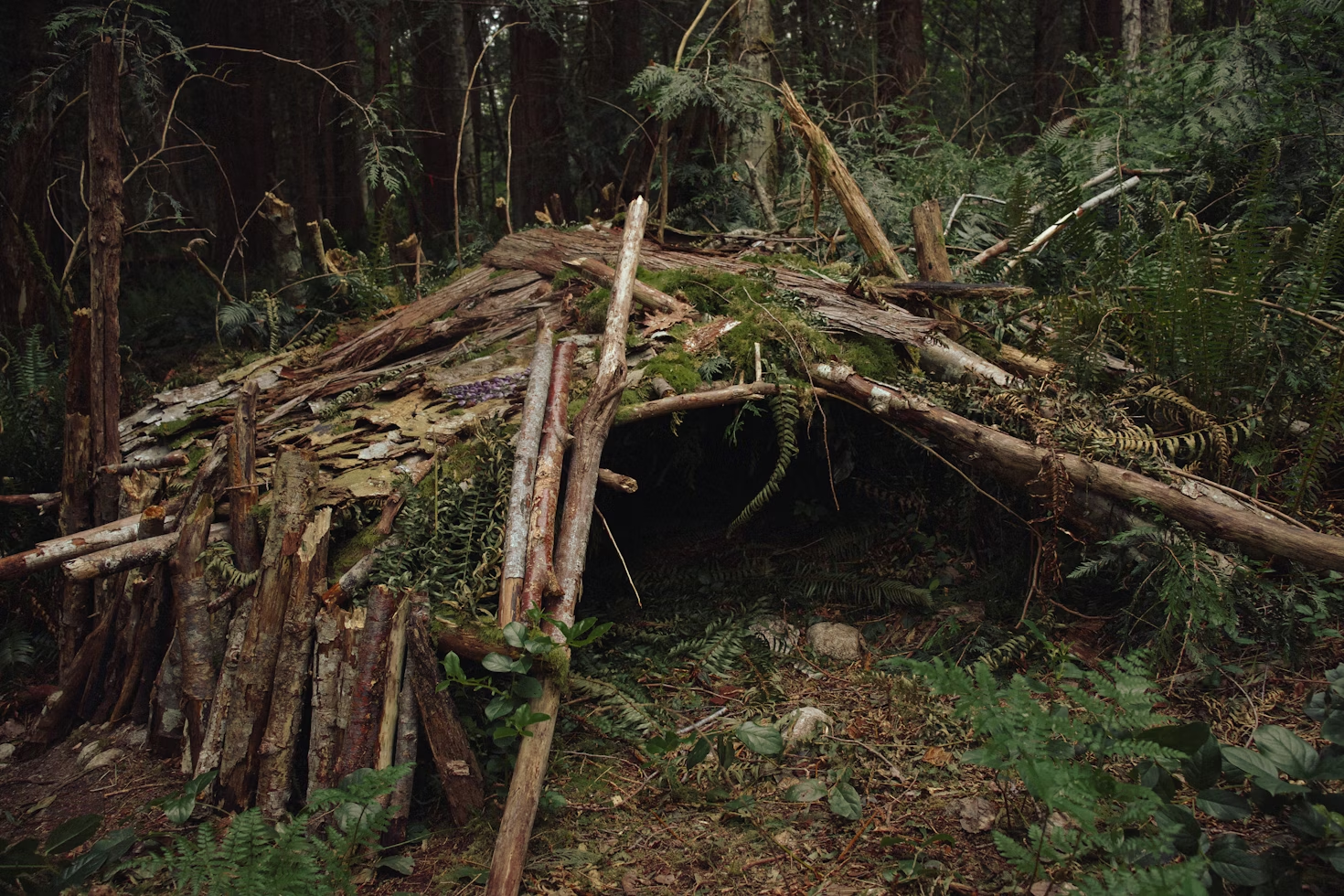
How to Build a Basic Debris Shelter
A debris shelter uses branches, leaves, and other natural materials to create a temporary insulating structure. It can be useful in some wooded environments, but it requires considerable time and effort to build properly.
- Choose a safe location. Find relatively level, well-drained ground away from flood channels, unstable trees, and falling branches.
- Locate a sturdy ridgepole. Use a suitable fallen branch and secure it against a stable support without creating a collapse hazard.
- Build the frame. Lean smaller branches along both sides to form a narrow structure.
- Add insulating material. Cover the frame with a substantial layer of dry leaves, pine needles, or other appropriate natural debris.
- Insulate the ground. Place a thick layer of dry material beneath your body to reduce contact with cold soil.
- Maintain an opening. Leave an accessible entrance and ensure you can exit quickly.
A debris shelter should be large enough to enter and move safely but not unnecessarily spacious in cold conditions. Avoid packing materials so tightly around yourself that movement or breathing becomes difficult.
Dry natural insulation can help reduce heat loss, but a debris shelter is not guaranteed to keep you warm or dry during severe weather. Construction may also be impractical when daylight is limited or you are already exhausted.
Protect Yourself From Cold Ground
Ground insulation is often overlooked. Even with overhead protection, direct contact with cold soil can accelerate heat loss.
If suitable dry materials are available, create a thick insulating layer beneath your body. Keep wet material away from clothing and bedding whenever possible.
Learn more about shelter equipment in our Shelter Building Tools for Survival guide.
3. Find Water and Understand What Makes It Safe
Water is essential for survival, but drinking contaminated water can cause serious illness. Finding water and making it safe to drink are two separate problems.
How urgently you need water depends on temperature, physical activity, health, and hydration status. In hot conditions, dehydration can become dangerous much faster than commonly repeated survival rules suggest.
Where to Look for Water in the Woods
Potential natural water sources include:
- Flowing streams and springs.
- Rainwater collected in a clean, suitable container if one is available.
- Surface water in low-lying areas, provided reaching it does not create additional danger.
- Snow or ice that can be safely melted when suitable equipment and heat are available.
Clear water is not necessarily safe. Streams and springs can contain bacteria, viruses, parasites, or chemical contaminants even when the water looks and smells clean.
Avoid water with obvious signs of chemical contamination, fuel, agricultural runoff, unusual discoloration, or harmful algal blooms. Boiling does not remove many chemical contaminants.
Can You Purify Water Without Gear?
Reliable water treatment is extremely difficult without a suitable container, heat source, disinfectant, or properly designed filter.
Improvised filters made from sand, gravel, charcoal, cloth, or moss may remove visible sediment, but they do not reliably remove or inactivate disease-causing microorganisms.
Passing water through natural materials should never be described as making it safe to drink.
Reliable Water Treatment Methods
When suitable equipment is available, established treatment options include:
- Boiling: Bring water to a rolling boil for one minute, or three minutes at elevations above 6,500 feet.
- Proper filtration: Use a filter rated for the relevant microorganisms and follow its instructions. Many backpacking filters do not remove viruses.
- Chemical disinfection: Use an appropriate water disinfectant according to its label and the water conditions.
- Combined treatment: Filtering followed by appropriate disinfection can provide broader protection when necessary.
If no reliable treatment method is available, there may be no completely safe option. The risks of dehydration and untreated water must be considered in context, especially when rescue may be delayed.
Do not assume that a solar still, improvised moss filter, or homemade charcoal filter will reliably produce safe drinking water.
For detailed guidance, see our Ultimate Water Purification Guide.
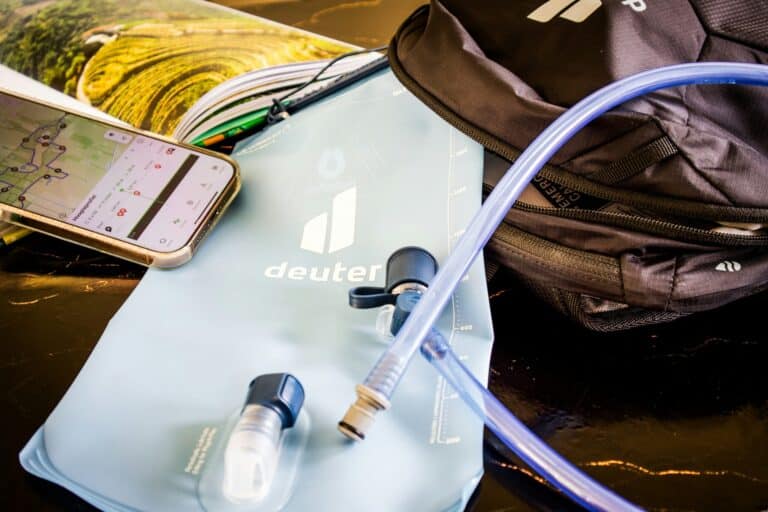
For future preparedness, a compact backpacking water filter can be a useful addition to an emergency kit.


4. Understand How to Start a Fire Without Matches
Fire can provide warmth, light, a means of heating water, and a visible signal in some conditions. However, building a fire without tools is substantially more difficult than many survival demonstrations suggest.
Primitive fire-making requires practice, suitable materials, and considerable effort. Wet weather, exhaustion, injuries, and a lack of dry tinder can make success unlikely.
Bow Drill Fire-Making
A bow drill uses friction between a wooden spindle and a fireboard to create hot wood dust that may develop into an ember.
The basic system requires a spindle, fireboard, bow, cordage, and a bearing block. Making suitable components without tools is challenging, especially when no cordage is available.
Successful bow-drill fire-making depends on the wood species, dryness, preparation, technique, and operator experience.
Hand Drill Fire-Making
A hand drill uses a straight wooden spindle rotated between the palms against a prepared fireboard.
This method requires substantial skill and favorable materials. It is not a dependable emergency fire-starting technique for someone who has never practiced it.
Fire Plow Method
A fire plow involves rubbing a wooden stick along a groove in another piece of wood to generate heat and fine wood dust.
Like other friction methods, it is physically demanding and highly dependent on suitable dry materials.
What About Striking Rocks Together?
Striking two random rocks together is not a reliable method of producing sparks capable of igniting tinder.
Traditional flint-and-steel fire-making uses suitable hard stone and carbon steel to produce sparks, typically captured by prepared tinder such as char cloth. That system requires materials you may not have in a true no-gear emergency.
Finding Suitable Tinder
If you have a dependable ignition method, dry tinder is essential.
Potential tinder materials include:
- Fine, dry inner bark from suitable dead material.
- Dry grasses and seed heads.
- Small wood shavings.
- Dry plant fibers.
- Resin-rich wood from appropriate fallen pine material.
Gather tinder and progressively larger fuel before attempting ignition. Follow local fire restrictions and avoid building fires when wildfire danger is high.
Fire Safety
Never start a fire inside a small debris shelter, cave, or poorly ventilated enclosure. Fire creates burn, smoke inhalation, and carbon monoxide hazards. In dry or windy conditions, an uncontrolled fire may become more dangerous than the original emergency.
If starting a fire would consume your remaining energy or create an unacceptable hazard, focus instead on shelter, insulation, and signaling.
5. Avoid Dangerous Foraging Mistakes
Finding food is usually less urgent than addressing exposure, injuries, dehydration, and rescue.
Many healthy adults can tolerate a short period without food better than they can tolerate severe cold, heat illness, or dehydration. Searching for unfamiliar wild foods may use more energy than it provides and can expose you to poisoning.
Why Wild Plant Identification Matters
Some woodland plants are edible, but many have toxic look-alikes. Identifying plants based on a single feature, such as leaf shape, smell, or color, is unreliable.
There is no universal visual test that distinguishes edible plants from poisonous ones.
For example, milky sap does not automatically mean a plant is poisonous, and a pleasant smell does not prove a plant is safe.
Commonly Studied Wild Edibles
Examples of plants discussed in North American foraging education include:
- Dandelion: Several parts are edible when the plant is positively identified and collected from a suitable location.
- Broadleaf plantain: A common edible green when correctly identified.
- Cattail: Certain parts are edible when properly identified, harvested from uncontaminated locations, and prepared appropriately.
- Wood sorrel: An identifiable wild green, although its oxalate content makes large consumption inappropriate for some people.
These examples are not a recommendation to experiment with unfamiliar plants during an emergency.
Avoid wild mushrooms unless you have expert-level identification skills. Some poisonous species closely resemble edible varieties, and cooking does not reliably eliminate all mushroom toxins.
Should You Eat Insects for Survival?
Insects are sometimes discussed as emergency food, but consuming wild insects carries risks involving parasites, allergens, pesticides, and misidentification.
Cooking may reduce some biological hazards, but it does not make every insect safe to eat.
For a short-term lost-person emergency, conserving energy and signaling for rescue is generally preferable to experimenting with unfamiliar foods.
Learn more about identifying edible species in our Wild Edible Plants Guide.
For planned outdoor trips, carrying a reputable edible plant field guide is more sensible than relying on memory. Explore an edible plant field guide on Amazon.
6. Navigate Without a Compass Without Getting More Lost
Natural navigation techniques can help you understand general directions, but they do not automatically tell you where the nearest trail, road, or safe exit is located.
Knowing which direction is north is useful only when you also understand your location and intended route.
Using the Sun for General Direction
In many locations, the sun generally rises toward the eastern part of the horizon and sets toward the western part. However, its exact position changes with season and latitude.
In the Northern Hemisphere outside the tropics, the sun is generally toward the south around local solar noon. This is a rough directional reference rather than a precise navigation method.
The Shadow Stick Method
A basic shadow-stick technique can help estimate an east-west direction when sunlight is available.
- Place a reasonably straight stick upright in level ground.
- Mark the tip of its shadow.
- Wait approximately 15 to 30 minutes.
- Mark the new shadow-tip position.
- Draw a line between the two marks to estimate an east-west axis.
The first mark generally indicates west and the second east. Accuracy depends on the time interval, terrain, sun position, and how carefully the marks are made.
Using the North Star
In the Northern Hemisphere, Polaris provides a useful reference for approximate true north.
The two outer stars of the Big Dipper’s bowl can help point toward Polaris when the constellation is visible.
However, cloud cover, trees, terrain, and light conditions may prevent reliable observation.
Do Not Rely on Moss
The belief that moss always grows on the north side of trees is a wilderness navigation myth.
Moss growth depends on moisture, shade, surface conditions, and local environmental factors. It is not a reliable directional indicator.
When Should You Attempt to Walk Out?
Consider traveling only when remaining in place is unsafe or you have a credible reason to believe a specific route leads to help.
Avoid blindly following streams, descending steep ravines, or crossing unfamiliar terrain. Watercourses can lead to cliffs, waterfalls, deep water, or difficult vegetation.
If you do move, use recognizable landmarks and avoid creating additional hazards.
7. Signal for Rescue and Protect Yourself From Wildlife
Being visible and audible to rescuers can be more important than constructing an elaborate campsite.
If you decide to remain in one area, choose a safe location where signals may be seen from trails, nearby terrain, or the air.
Make Large Ground Signals
Use available rocks, fallen branches, or other materials to create a large, high-contrast symbol in an open area.
Possible signals include:
- Large SOS letters.
- A prominent X or another clearly artificial shape.
- Repeated straight lines or geometric patterns that stand out from the surrounding terrain.
Make signals as large and visible as reasonably possible without exposing yourself to danger or unnecessarily damaging the environment.
Use Sound to Attract Attention
If you hear people, vehicles, or rescue activity nearby, call out or create repeated sounds by striking suitable objects together.
Three repeated sounds are widely recognized as a possible distress signal in outdoor settings, although no sound pattern guarantees recognition.
Pause between attempts so you can listen for a response.
Should You Build a Signal Fire?
A fire may attract attention in some circumstances, but it can also create serious wildfire risks.
Do not light signal fires during fire restrictions or when conditions make ignition unsafe. Never sacrifice personal safety to create smoke.
Avoid Unnecessary Wildlife Encounters
Most wildlife encounters can be avoided by giving animals space and not approaching, feeding, or cornering them.
Basic precautions include:
- Avoid animal dens, nests, and obvious feeding areas.
- Do not approach wildlife for photographs or food.
- Use caution when moving through dense vegetation.
- Keep any available food and scented items away from your sleeping area according to local wildlife guidance.
- Follow species-specific safety guidance for bears and other large animals in the region.
Do not bury food as a general wildlife-storage strategy. Animals may dig it up, and improper food storage can attract wildlife to campsites.
Protect Yourself From Ticks, Mosquitoes, and Snakes
Insects and snakes are practical concerns in many wooded environments.
To reduce exposure:
- Avoid unnecessary contact with tall grass and dense brush.
- Inspect your clothing and skin for ticks when possible.
- Keep clothing appropriately secured to reduce insect access.
- Use caution around rocks, logs, and concealed spaces where snakes may rest.
- Watch where you place your hands and feet.
Mud, ash, and crushed pine needles are not reliable substitutes for tested insect repellents and may irritate skin.
When stepping over a log, inspect the far side first rather than placing your foot where you cannot see.
8. Maintain Mental Focus and Conserve Energy
Wilderness emergencies create uncertainty, fear, fatigue, and frustration. These reactions are normal, but maintaining a simple routine can help you make better decisions.
Survival is not about ignoring fear. It is about recognizing the situation and choosing manageable actions.
Set Small, Achievable Goals
Instead of thinking about every possible danger, concentrate on the next useful task.
Examples include:
- Find a safer location away from immediate hazards.
- Improve protection from wind or rain.
- Create a visible rescue signal.
- Collect dry insulating material.
- Rest and reassess the weather.
Each task should serve a clear survival purpose.
Conserve Physical Energy
Unnecessary movement increases fatigue, water requirements, and injury risk.
Once immediate needs are addressed, rest when appropriate and avoid spending hours on projects that provide little practical benefit.
Establish a Simple Routine
If rescue is delayed, periodically check:
- Your physical condition and any injuries.
- Weather changes and shelter stability.
- Available daylight.
- Water needs and hydration concerns.
- Visibility of rescue signals.
- Signs of nearby people or rescue activity.
Reassess your plan when conditions change, but avoid changing locations repeatedly without a clear reason.
Gearless Wilderness Survival Checklist
Use this quick-reference checklist to focus on the most important decisions if you become lost outdoors without equipment.
5 Small Survival Tools Worth Carrying on Every Hike
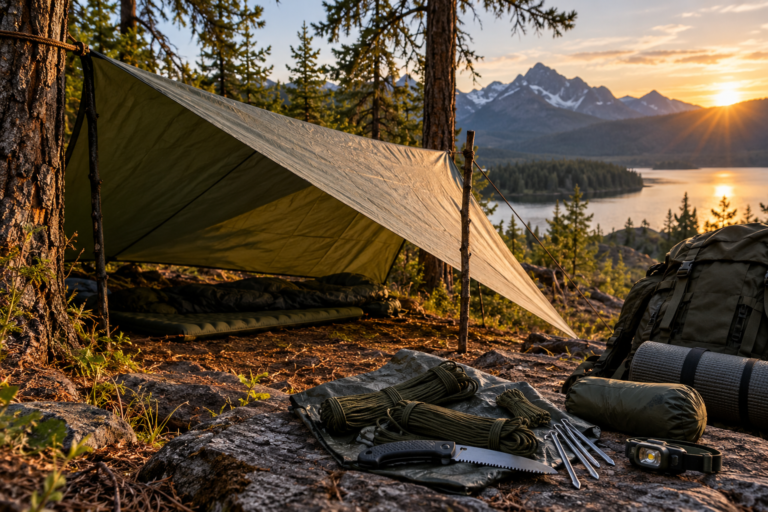
Although this guide focuses on surviving without equipment, a few lightweight items can greatly improve your options if an outdoor trip goes wrong.
Consider carrying the following supplies whenever you hike or travel into remote areas.
- Portable water filter: Helps treat water for certain microorganisms when used according to its specifications. View on Amazon.
- Ferrocerium fire starter: Provides a repeatable spark source when used with suitable tinder. View on Amazon.
- Emergency whistle: Makes repeated audible signaling easier. View on Amazon.
- Emergency bivy sack: Provides compact backup weather protection but does not replace adequate insulation. View on Amazon.
- Compact first-aid kit: Helps manage minor injuries and supports basic emergency care. View on Amazon.
Additional essentials include a charged phone, offline maps, appropriate clothing, water, a headlamp, and a way to communicate your planned route to someone you trust.
Frequently Asked Questions About Surviving in the Woods Without Gear
Can you survive in the woods with absolutely nothing?
Survival without equipment is possible in some circumstances, but it depends heavily on environmental conditions, injuries, available resources, and rescue access. Staying in a safe location, avoiding unnecessary risks, and signaling for help are often more important than advanced bushcraft skills.
What should you do first if you’re lost in the woods?
Stop moving, remain calm, check for injuries, and assess immediate hazards. Determine whether staying in place is safer than attempting to travel. If you have a working phone, try contacting emergency services.
How long can you survive in the woods without food?
Survival time without food varies considerably based on health, hydration, temperature, exertion, and other factors. In many short-term wilderness emergencies, exposure, injuries, and dehydration are more urgent concerns than food.
How do you make shelter without a knife or tarp?
Natural windbreaks and carefully constructed debris shelters can provide temporary protection. Use suitable fallen branches and dry insulating materials while avoiding unstable structures, flood-prone terrain, and falling branches.
Can you drink stream water if it looks clean?
Clear stream water can contain harmful microorganisms and contaminants. When possible, use a reliable treatment method such as boiling, an appropriate filter, or properly applied disinfection.
Can you start a fire by rubbing sticks together?
Yes, friction fire-making is possible with suitable wood and practiced techniques, but it is difficult and unreliable for beginners, especially in wet conditions. Do not assume you can produce fire without prior experience.
Should you follow a river if you’re lost?
Not automatically. Rivers and streams can lead into dangerous terrain, including cliffs, deep water, and steep ravines. Remaining in a safe location may be preferable unless you have a reliable route to help.
Is it safer to stay put or keep walking?
Staying put is often safer when you are lost and rescue is possible, provided your location is not dangerous. Move when there is an immediate threat or when you have a clear, safer route to assistance.
Final Thoughts: Survival Is About Making the Right Decisions
Learning how to survive in the woods without gear is about understanding priorities, recognizing hazards, and using practical wilderness skills when circumstances demand them.
You may be able to create a temporary shelter from natural materials, estimate direction using the sun, and attract rescuers with visible signals. But none of these techniques eliminates the risks of severe weather, dehydration, injuries, or unfamiliar terrain.
The most important survival decisions are often simple: stop before becoming more lost, protect yourself from exposure, avoid unnecessary risks, and make it easier for help to find you.
Practice basic wilderness skills before an emergency, carry appropriate equipment whenever possible, and tell someone where you plan to travel and when you expect to return.
For more outdoor survival knowledge, explore our 100 Forgotten Survival Skills That Could Save Your Life guide.
Further Reading
- Essential Bushcraft Skills for Preppers
- How to Use a Survival Knife
- How to Survive in the Woods With Just a Knife
- Shelter Building Tools for Survival
- 5 Wild Edible Plants You Can Forage Today
- Survival Camping: Essential Skills and Gear
As an Amazon Associate, The Savvy Survivalist earns from qualifying purchases.