Wilderness Survival Guide (2026): How to Stay Alive When You’re Truly On Your Own
When you’re beyond cell service, miles from pavement, and daylight is fading, wilderness survival stops being theory. It becomes biology.
This post contains affiliate links. I may earn a small commission at no extra cost to you. Learn more.
This wilderness survival guide connects every critical off-grid skill into one clear system — shelter, water, fire, food, navigation, signaling, and mindset — so you know exactly what to prioritize when you’re truly on your own.
If you ever lose your gear completely, the situation changes fast. Learn how to survive in the wilderness without supplies using the same priorities—shelter, water, and energy control.
Out there, mistakes compound quickly. Exposure doesn’t wait. Dehydration clouds judgment. Panic burns energy you can’t afford to lose.
Survival isn’t about heroics.
It’s about order.
And once you understand that order, your odds improve dramatically.
This guide connects directly to our fire, water, navigation, and emergency preparedness frameworks — so you can move from theory to execution fast.
The Wilderness Survival Rule of 3s
When you’re truly on your own, priorities are not emotional — they’re biological.
Survival instructors teach the Rule of 3s because it forces clarity under stress:
- You can survive 3 minutes without air
- About 3 hours without shelter in extreme exposure
- Roughly 3 days without water
- Around 3 weeks without food
Most people get this backwards.
They think about food first.
They think about hiking out immediately.
They think about gear.
But the body follows hard limits.
In freezing rain, shelter becomes urgent in less than three hours.
In desert heat, dehydration can impair decision-making within a single afternoon.
This master guide follows the Rule of 3s — which means your priorities must shift based on environment.
Survival is not random.
It is ordered.
And when you understand that order, you stop reacting — and start controlling outcomes.
1️⃣ Shelter: Survive the First Night
Exposure kills faster than hunger. Often faster than dehydration.
When people die in the wilderness, it’s usually because wind, rain, cold, or extreme heat stripped their body temperature beyond recovery.
Your first priority isn’t food.
It isn’t fire.
It’s shelter.
If you’re caught after dark or unsure of your location, start with our complete guide on how to survive lost in the woods to stabilize your situation and avoid panic-driven mistakes.
In hot environments, proper shade can prevent heat stroke before dehydration becomes critical. Understanding natural shade and shelter techniques can make the difference between exhaustion and endurance.
If you carry modern gear, your setup matters. Our breakdown of the best survival & basecamp tents 2025 explains which shelters actually hold up in real weather — not just campground conditions.
For a broader tactical framework, review the full survival camping guide to understand terrain positioning, wind management, and defensive camp layout.
And if you’re stripped down to the essentials, mastering how to survive with just a knife teaches you how to build protection from almost nothing.
Shelter first. Always.
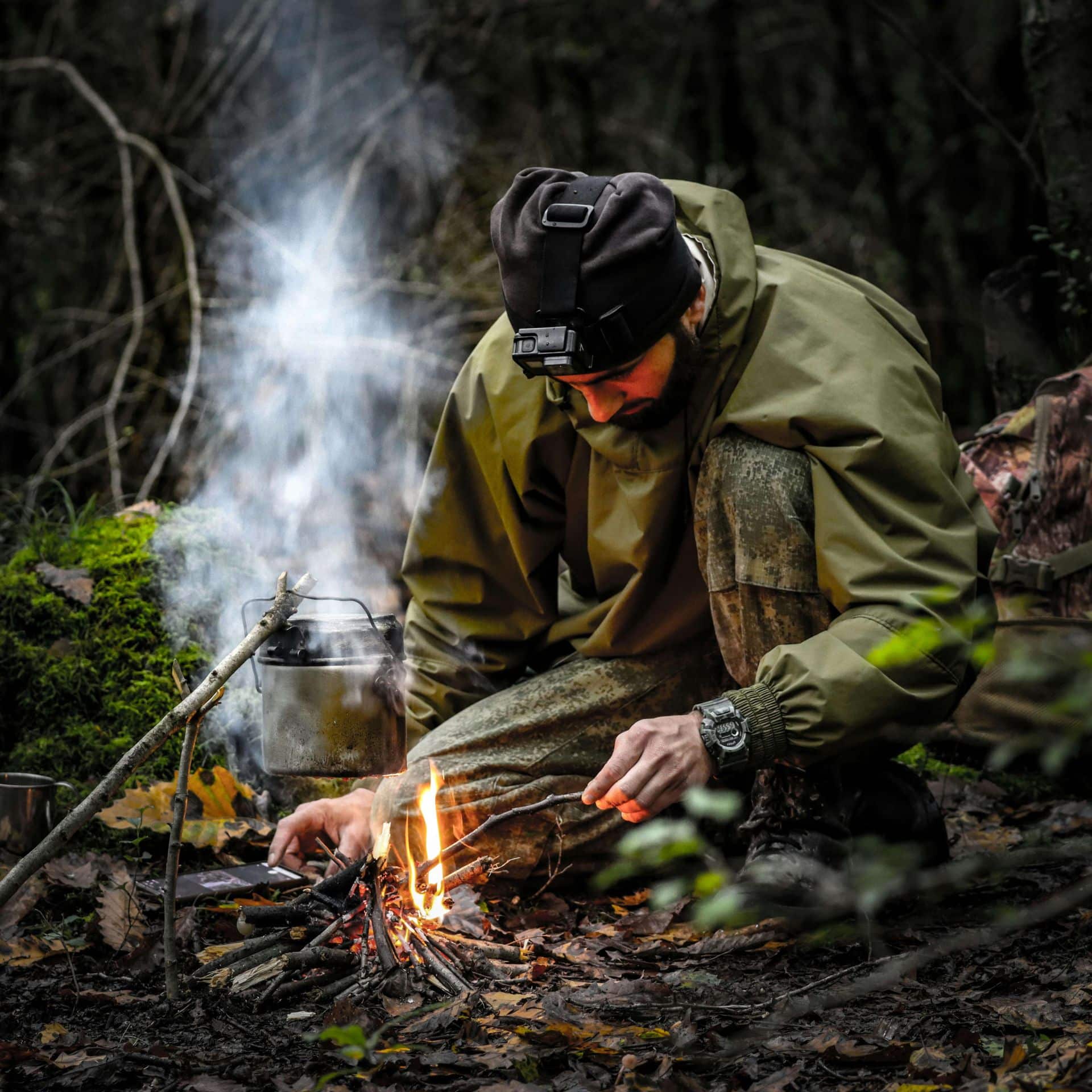
2️⃣ Fire: Heat, Water, and Morale
Fire is more than warmth. It’s survival leverage.
It raises core body temperature, purifies questionable water, dries soaked clothing, deters animals, and signals rescuers. In cold or wet conditions, it becomes the dividing line between stabilizing and spiraling.
But fire fails when technique fails.
For a complete ignition system and redundancy strategy, start with the Ultimate Survival Fire Starters Guide 2025 — your full breakdown of modern and traditional fire tools.
Rain changes everything. If your environment is soaked, study starting a fire in wet weather before you strike your first spark.
Primitive methods still matter. Mastering friction and ember transfer through our primitive fire-starting guide builds real resilience when gear fails.
In extreme heat environments, ignition techniques shift again — especially when natural tinder behaves differently. Review fire starters that work in extreme heat for desert or drought conditions.
And if you’re experimenting with improvised materials, understand the science behind combustion — including questions like does all wax burn? before relying on DIY fuel sources.
Fire builds stability.
Stability buys time.
Time keeps you alive.
3️⃣ Water: Hydration Before Anything Else
You can survive weeks without food.
You cannot survive long without water.
Dehydration impairs judgment within hours. Severe fluid loss can become life-threatening in as little as 72 hours — faster in heat, altitude, or high exertion.
Finding water is step one. Making it safe is step two.
Start with the complete Ultimate Water Purification Guide to understand filtration, boiling, chemical treatment, and field-ready systems.
If you’re relying on nature alone, learn proven natural purification methods that reduce risk when gear is limited.
No pot? No flame? Study how to purify water in the wild without boiling so you’re not dependent on fire to make water drinkable.
And if your situation shifts from short-term survival to extended isolation, understanding long-term water storage principles can turn a temporary crisis into a sustainable setup.
Hydration first.
Everything else depends on it.
4️⃣ Food: When You’re Out Longer Than Planned
Food is rarely your first emergency in the wild.
But it becomes critical if rescue stretches beyond a few days.
The key isn’t hunting immediately. It’s conserving calories while you assess your situation. Panic burns energy. Smart movement preserves it.
If you’re preparing ahead of time, review our breakdown of survival foods with long shelf life to understand what actually sustains you during extended isolation.
In true wilderness scenarios, knowledge replaces packaging. Learning how to identify wild edible plants can supplement calories when carried food runs low.
For protein, patience beats desperation. Study the fundamentals of tracking animals for food before wasting energy chasing blind signs.
And if you’re conserving fuel or can’t build a traditional fire, understanding campfire-free cooking expands your options without drawing attention or exhausting resources.
In short-term survival: conserve.
In long-term survival: adapt.
5️⃣ Navigation: Don’t Walk in Circles
Most lost hikers don’t stay put.
They wander.
Panic creates motion. Motion without direction burns calories, drains water, and increases your search radius beyond what rescuers expect.
Before you take a single step, understand orientation.
Start with the fundamentals in our navigate without a compass guide — your foundation for sun tracking, terrain reading, and directional discipline.
If you’re working with nothing but daylight and patience, the shadow stick method gives you a low-tech way to determine true direction.
And remember — movement isn’t always the answer. Sometimes signaling is smarter than hiking. Review how to signal for help in remote wilderness areas before committing to a long push through unknown terrain.
Direction first.
Distance second.
6️⃣ Signaling & Rescue
Survival is step one.
Getting found is step two.
Too many people focus only on sustaining themselves and forget that rescue depends on visibility. The goal isn’t just to stay alive — it’s to increase your chances of being located.
Visual signals, sound, reflective surfaces, ground-to-air markers, and controlled fires all improve your odds.
For a complete breakdown of proven rescue tactics, study how to signal for help in remote wilderness areas so you know what actually attracts attention from air and ground search teams.
If you carry communication equipment, redundancy matters. A proper emergency radio guide explains when radios work, when they fail, and how to use them effectively in off-grid conditions.
When modern systems fail completely, you still need a layered plan — here’s how to build a complete off-grid communication system using reliable methods.
Remember:
Search teams look where they expect you to be.
Stay visible. Stay predictable. Increase your signal footprint.
7️⃣ Mindset: The Survival Multiplier
Gear helps.
Skills matter.
Mindset decides outcomes.
Most wilderness emergencies don’t start as life-or-death events. They become life-or-death because of panic, poor decisions, and emotional spirals.
The survivors who make it through extended isolation share one trait: controlled thinking under stress.
If you want to deepen your core skill base, review 100 Forgotten Survival Skills That Could Save Your Life — because capability builds confidence, and confidence prevents panic.
Contrast wilderness survival with dense environments by studying urban survival skills. Different terrain, same mental discipline.
And for the big-picture architecture behind everything on this site, anchor yourself in the Emergency Preparedness Master Plan 2026 — the full framework that ties wilderness, grid-down, and urban survival together.
Calm thinking multiplies every other skill.
Control your breathing.
Control your decisions.
Control your outcome.
This wilderness survival guide is part of our larger Survival Skills framework, which includes fire, navigation, water purification, and emergency readiness systems.
Common Wilderness Survival Mistakes That Get People Killed
Most wilderness emergencies start manageable.
They become fatal because of compounding mistakes.
Here are the most common:
- Panic walking without direction
- Burning excessive calories the first day
- Drinking untreated water out of desperation
- Ignoring weather changes
- Failing to signal early
- Using all fire fuel the first night
- Underestimating nighttime temperature drops
The wilderness is rarely dramatic at first.
It’s small mistakes stacked on top of each other.
Avoid those — and your odds increase dramatically.
The Complete Wilderness Survival System
A true wilderness survival guide isn’t about one skill.
It’s a system built from:
- Shelter to control exposure
- Fire to stabilize temperature and purify water
- Water to preserve cognitive function
- Food to sustain long-term resilience
- Navigation to prevent energy waste
- Signaling to shorten isolation
- Mindset to hold everything together
Each element strengthens the others.
Weakness in one creates stress in all.
Understand the order — and your margin for error expands dramatically when things go wrong.
When you’re truly on your own, clarity beats courage every time.