Solar Survival Gear That Actually Works When the Grid Goes Down
Why Most “Solar Survival Gear” Fails When It Matters
This post contains affiliate links. I may earn a small commission at no extra cost to you. Learn more.
When people hear solar survival gear, they usually picture a small folding panel, a power bank, and maybe a solar radio tossed into a bug-out bag. It sounds responsible. It looks prepared. And in mild situations, it even works.
Until the grid stays down longer than expected.
Real blackouts don’t behave like weekend camping trips. Phones don’t need one recharge — they need power every day. Lights aren’t used for an hour — they’re relied on every night. Weather shifts. Smoke blocks sunlight. Batteries drain faster than planned. Suddenly, that “solar setup” that looked good on paper can’t keep up.
That’s where most people get burned — not because solar power is useless, but because they were sold gadgets instead of a system.
True solar survival gear isn’t about owning solar items. It’s about understanding how power is generated, stored, rationed, and replenished when there is no grid to lean on. Without that understanding, solar becomes frustrating fast — unreliable, slow, and sometimes completely ineffective.
The problem isn’t that solar doesn’t work.
The problem is that most solar survival advice skips the hard truths.
This guide exists to fix that.
We’re not listing the “top 10 coolest solar gadgets.” We’re breaking down what actually works during real grid-down scenarios — from short outages to multi-day blackouts — and where solar fits realistically into survival planning.
If you want hype, there are plenty of lists for that.
If you want solar survival gear that actually carries its weight when the lights stay off, keep reading.
If you’re building a solar setup, this guide explains the full system — use the pages below to go deeper into specific gear, kits, and use cases:
👉 Best Solar Powered Survival Tools – Individual gear and tools for real-world use
👉 Best Solar Survival Kits for Blackouts – Ready-made setups for different situations
👉 Best Solar Gear for Camping & Summer Use – Lightweight, portable solar for outdoor use
🔎 Quick Picks for Grid-Down Solar
Short on time? These are the most reliable solar options for real blackouts.
🔋 Best Overall Solar Power for Grid-Down Emergencies
BLUETTI AC200L Portable Power Station (2048Wh LiFePO₄)
Best for: Multi-day outages, medical devices, serious blackout prep
Why it works:
- High-capacity battery that lasts beyond day two
- Safe for indoor use
- Reliable for phones, radios, lights, and CPAPs
- If you only buy one solar item for outages, start here.

💰 Best Budget Solar Backup (Still Practical)
Jackery Explorer 500 (518Wh)
Best for: Apartments, short outages, budget setups
Why it works:
- Lightweight and easy to store
- Enough capacity for essentials
- Far better than power banks

🎒 Best Portable Solar Charging Panel
BigBlue 100W Foldable Solar Panel
Best for: Recharging batteries during outages
Why it works:
- Real output (not gimmicks)
- USB-C fast charging
- Folds flat for storage

📻 Best Emergency Communication Backup
Midland ER310 Emergency Crank Radio
Best for: Alerts and backup power
Why it works:
- NOAA weather alerts
- Hand-crank + solar backup
- Built-in flashlight

⬇️ Desktop readers can compare specs below. Mobile readers can continue scrolling for deeper explanations.
What “Solar Survival Gear” Really Means (and What It Doesn’t)
One of the biggest mistakes people make is assuming that anything labeled solar automatically qualifies as survival gear. In reality, solar products fall into very different categories — and only one of them consistently holds up when the grid goes down.
Solar survival gear is NOT camping convenience gear
Camping solar gear is designed for:
- Short use windows
- Fair weather
- Low daily demand
- Easy resupply
Survival solar gear has to function under:
- Extended outages
- Limited sunlight
- Repeated daily use
- No external backup
That’s a completely different standard.
A palm-sized solar panel that can slowly top off a phone is great on a trail where you’re conserving battery and hiking all day. In a blackout — where your phone becomes your flashlight, news feed, navigation tool, and emergency contact line — that same panel becomes painfully inadequate.
Solar survival gear is about energy flow, not gadgets
Real solar survival setups are built around four questions:
- How much power do I actually need per day?
- How am I storing that power?
- How fast can I realistically recharge it?
- What happens when conditions are bad?
If a piece of gear can’t answer those questions clearly, it’s not survival-grade — no matter how many five-star reviews it has.
This is why experienced preppers think in systems, not products. A solar panel without storage is a trickle. A battery without recharge is a countdown timer. A pile of mismatched devices becomes dead weight when conditions aren’t ideal.
Solar survival gear works best as part of a bigger plan
Solar excels at:
- Silent power
- Fuel independence
- Long-term sustainability
- Low-maintenance energy
But it struggles with:
- High-draw appliances
- Cloudy or smoky conditions
- Cold-weather efficiency
- Rapid recharging without storage
Understanding those strengths and weaknesses is the difference between being powered and being frustrated.
That’s why serious grid-down planning always places solar within a broader power strategy — not as a magic solution, but as a dependable component that keeps critical systems running when fuel, noise, or visibility become problems.
How Solar Survival Gear Fits Into a Complete System
Solar survival gear works best when it’s part of a layered system — not used on its own.
This guide explains the full strategy. The pages above break down specific gear, kits, and use cases so you can build a setup that actually works when the grid stays down.
If you’re looking for specific gear to build that system, see our breakdown of solar-powered survival tools that actually perform in outages.
Tier 1: Solar Survival Gear for 24–72 Hour Outages
Short-term outages are where solar survival gear performs best — but only when expectations are realistic.
In a 24–72 hour blackout, your goal isn’t comfort or convenience. It’s:
- Communication
- Situational awareness
- Basic functionality
You’re keeping phones alive, powering lights, monitoring weather alerts, and maintaining a small sense of normalcy while you wait for restoration or decide your next move.
This is where low-draw solar gear shines.
For reliable blackout alerts and emergency broadcasts, see our full guide to Emergency Solar Radios That Work When the Power Is Out.
What solar does well in short outages
During brief grid failures, solar works because:
- Energy demand is still relatively low
- Batteries haven’t been fully drained yet
- Sun exposure doesn’t need to be perfect
- You’re supplementing stored power, not replacing it
Small solar panels, power banks, and solar radios can stretch your existing battery life significantly during this window.
You’re not “running on solar.”
You’re slowing the bleed.
That distinction matters.
Core priorities for Tier 1 solar gear
At this stage, solar survival gear should focus on:
- Communication – keeping phones charged for emergency alerts and family contact
- Lighting – powering lanterns, headlamps, or flashlights after dark
- Information – maintaining access to weather, news, and emergency broadcasts
This is where solar or hand-crank radios, compact folding panels, and battery banks earn their place. They don’t need to be fast — they need to be reliable and repeatable.
Where people mess this up
The most common failure in short outages is assuming solar replaces storage.
A small solar panel without a battery does almost nothing in real time. Charging directly from sunlight is slow, inconsistent, and often impractical.
The correct mindset is simple:
Solar tops off batteries. Batteries power devices.
When people complain that “solar doesn’t work,” it’s usually because they skipped the storage step or expected too much output too quickly.
How Tier 1 solar fits into bigger planning
Short outages are your testing ground. This is where you learn:
- How fast your devices drain
- How long recharging actually takes
- What gear you rely on most
If solar feels barely adequate at 48 hours, it won’t magically improve at day five.
Tier 1 solar survival gear buys you time — and information.
Tier 2: Solar Survival Gear for Multi-Day Blackouts
Once an outage stretches past a couple of days, solar survival gear stops being a convenience and starts being make-or-break.
At this stage, stored power is no longer a buffer — it’s a finite resource that must be actively replenished. Phones need daily charging. Lights run every night. Radios stay on for updates. Medical devices and small electronics enter the equation.
Solar can absolutely support this phase — but only if it’s built around storage first.
For a full breakdown of long-term power planning, see Grid-Down Survival Power: The 2025 Off-Grid Energy Playbook.
Why batteries matter more than panels
A common mistake is focusing entirely on panel wattage. Bigger panels feel reassuring, but without adequate battery capacity, they’re just feeding a very small cup.
In real-world conditions:
- Sunlight is inconsistent
- Panels rarely hit rated output
- Recharge windows are shorter than expected
Batteries absorb those fluctuations. They turn unpredictable sunlight into usable, stored energy. Without them, solar becomes unreliable fast.
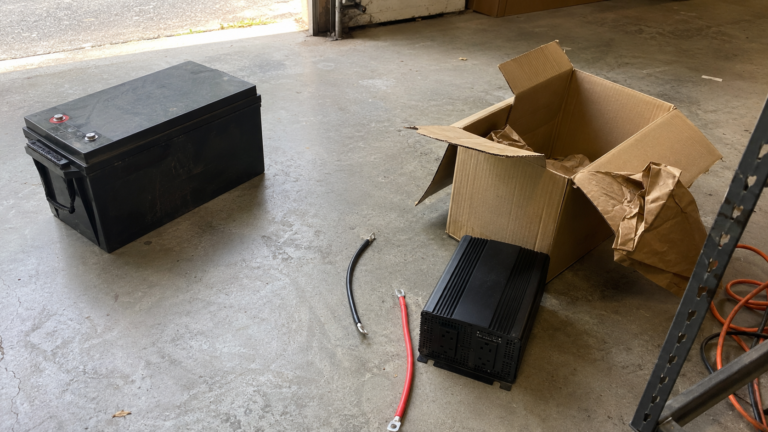
This is where power stations, battery banks, and proper charge control become the backbone of any solar survival setup.
What solar realistically supports at this stage
Multi-day solar survival gear is best suited for:
- Communications (phones, radios, small routers)
- Lighting (lanterns, LEDs, headlamps)
- Medical needs (CPAPs, monitors, small devices)
- Low-draw electronics (tablets, GPS units)
Trying to force solar into high-demand roles — space heaters, cooking appliances, or whole-home loads — is where disappointment sets in.
Solar isn’t about replacing everything.
It’s about keeping critical systems alive without fuel.
For product-level recommendations that fit this stage, see Best Solar Powered Survival Gear & Kits for 2025.
Solar Survival Gear as a System (Not Individual Products)
One of the biggest reasons people struggle with solar survival gear is that they buy pieces instead of building a system.
A panel here. A battery there. A cable added last minute.
It all looks prepared — but rarely works smoothly under stress.
Recommended Solar Survival Setup for Grid-Down Emergencies
When solar power actually matters — during multi-day outages with no reliable grid — energy storage becomes the backbone of any survival setup. Panels collect energy, but batteries decide whether that energy is usable when you need it.
This is where most solar setups fail.
Without sufficient storage, solar becomes a slow trickle that never quite catches up to daily demand. Phones drain faster than they recharge. Lights go dark before morning. Medical and communication devices become a gamble instead of a guarantee.
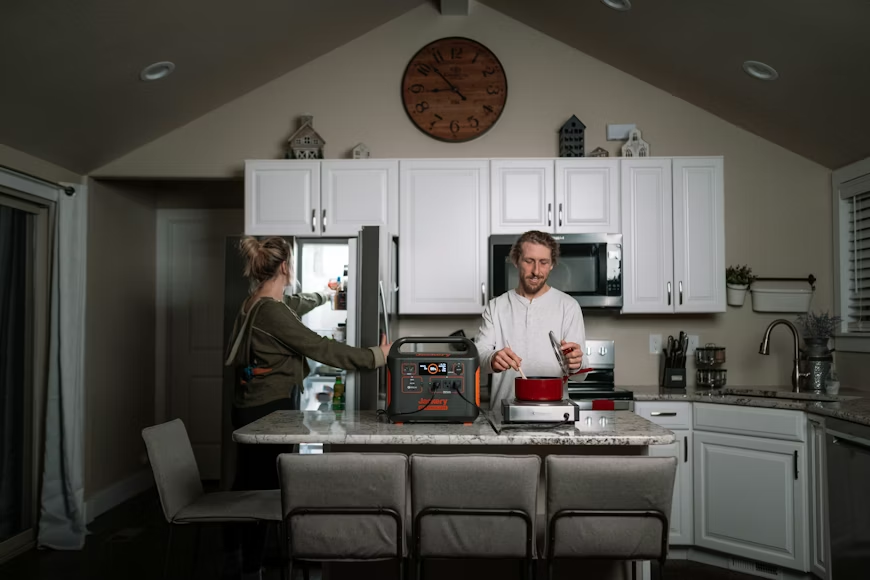
A properly sized power station solves that problem by turning unpredictable sunlight into usable, stored energy that can be drawn on day or night, rain or shine.
Portable power stations only work well when they’re sized for your real energy needs. See our guide on how to size a solar generator for blackout emergencies.
Portable Power Station (System Backbone)
A mid-to-high capacity power station forms the anchor point of any solar survival setup. This is what allows solar power to function as a system instead of a novelty.
Why this matters in real outages:
- Stores enough energy to cover daily device use
- Absorbs inconsistent solar input
- Provides stable, indoor-safe power
- Eliminates fuel dependence and generator noise
If you rely on communication, lighting, or medical devices during an outage, a power station like this becomes the difference between staying operational and constantly rationing power.
This capacity range is realistic for grid-down planning. It’s large enough to support phones, radios, lighting, and medical devices without pushing solar expectations beyond what physics allows.
Foldable Solar Panel (Closing the Loop)
A power station without a reliable way to recharge is just a countdown timer. A properly sized foldable solar panel closes the loop and turns stored energy into a renewable system.
What matters here isn’t portability — it’s output.
Small panels struggle to replace daily usage during real outages. A higher-output folding panel gives you a realistic chance to replenish batteries even when sunlight is inconsistent.

This output level represents a practical baseline for survival use — not overkill, but not wishful thinking either. It balances portability with recharge speed and works within the limits discussed earlier in this guide.
Together, these two components form a functional solar survival system:
- The battery handles reliability
- The panel handles sustainability
The four components every solar survival system needs
Every functional solar survival setup relies on the same loop:
- Power generation – solar panels that collect energy
- Energy storage – batteries that hold power for later use
- Power management – controllers and inverters that regulate flow
- Load discipline – deciding what gets powered and what doesn’t
If any one of these breaks down, the entire system becomes unreliable.
Why mismatched gear causes failure
Common imbalance problems include:
- Large panels feeding tiny batteries
- Oversized batteries paired with weak panels
- High-draw devices plugged into low-capacity systems
The result is constant power anxiety — batteries that never fully charge and systems that always feel behind demand.
Solar survival gear works best when it’s intentionally sized — even if that size is modest.
Load discipline is the invisible skill
Experienced solar users don’t just manage gear — they manage behavior.
They know:
- Which devices are essential
- When to charge during peak sun
- What gets shut off after dark
That discipline turns limited resources into sustainability.
For a foundational checklist of core components, see 10 Essential Solar Powered Survival Items You Need for Ultimate Preparedness.
Why Solar Alone Usually Fails (And What Actually Fixes It)
Solar survival gear is valuable — but on its own, it has limits. Those limits show up fast during bad weather, heavy use, or extended outages.
That’s why people walk away convinced solar “doesn’t work.”
It does. Expectations are the problem.
The hard limits of solar-only setups
Solar struggles when:
- Cloud cover blocks consistent sunlight
- Smoke, snow, or debris reduce efficiency
- Short winter days limit recharge time
- Power demand spikes unexpectedly
Even well-sized systems can fall behind for days at a time. Once storage is empty, recovery is slow.
That’s not a flaw — it’s physics.
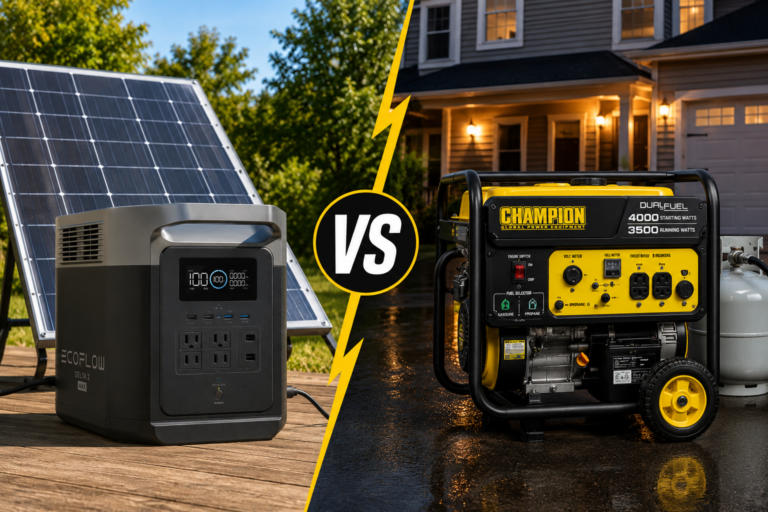
The fix: hybrid power
Pairing solar with a secondary charging source changes everything.
Hybrid systems allow you to:
- Use solar for silent, daily charging
- Recharge batteries quickly when sunlight fails
- Preserve fuel by running generators sparingly
- Maintain continuity instead of cycling between “on” and “dead”
Solar handles sustainability.
The backup handles recovery.
For a deeper breakdown, see Solar + Generator Hybrid Backup (2025).
Solar Survival Gear You Should NOT Waste Money On
Not all solar gear is bad — but a lot of it is badly marketed.
Avoid these traps
- Ultra-small “emergency” panels (5–10W phone trickle chargers)
- Solar gadgets with no storage
- Overpromised all-in-one kits with vague specs
- Novelty solar gear designed to look clever, not perform
If a product doesn’t clearly state battery capacity (Wh), realistic output, and recharge times, it’s not built for outages.
Filter rule:
What problem does this solve after two days without sun?
If there’s no clear answer — skip it.
Choosing the Right Solar Survival Setup for Your Situation
There is no single “best” solar setup — only setups appropriate for specific situations.
Apartment and urban setups
Priorities:
- Compact
- Quiet
- Low-visibility
- Storage-focused
Solar here supports phones, lights, radios, and medical devices.
See Apartment Prepping: How to Store Food, Water & Gear in Tight Spaces and How to Power a CPAP During an Outage.
Suburban and rural setups
Outdoor space adds flexibility. Solar works best when:
- Paired with a generator
- Used to offset fuel use
- Focused on essentials, not whole-home power
See Grid-Down Survival Power: The 2025 Off-Grid Energy Playbook.
Budget reality
A modest setup you understand beats an expensive system you don’t.
Start with:
- One battery
- One reliable panel
- Clear load priorities
Build from there.
For a complete solar setup, start with this guide, then use the recommended tools, kits, and supporting pages above to build a system that actually holds up in real outages.
Conclusion: Solar Survival Gear Works — When You Respect Its Limits
Solar survival gear isn’t magic. It doesn’t erase outages. What it offers is independence, silence, and sustainability when used intelligently.
The people who succeed don’t chase gadgets. They build systems. They understand storage. They manage loads. And they plan for days when the sun doesn’t cooperate.
Solar doesn’t fail people.
Unrealistic expectations do.
You now know the difference.
Further Reading:
- Grid-Down Survival Power – Complete blackout power planning
- Best Solar Powered Survival Gear & Kits – Field-tested recommendations
- Solar + Generator Hybrid Backup – Use solar without wasting fuel
- How to Power a CPAP During an Outage – Medical power planning
- Emergency Solar Radio – Alerts and communication
- Apartment Prepping – Urban blackout readiness