How to Run a Well Pump During a Power Outage: Generator, Solar & Manual Backup Options
How to run a well pump during a power outage is one of the most important things homeowners with private wells need to understand. When electricity fails, most electric well pumps stop working, leaving households without a reliable water supply. Fortunately, a properly sized generator, compatible solar battery system, or manual deep-well pump can help restore access to water. This guide explains the best backup options, electrical requirements, costs, and emergency water storage strategies to keep water available during an extended blackout.
This post contains affiliate links. I may earn a small commission at no extra cost to you. Learn more.
For families in rural areas, this can turn an ordinary power outage into a serious problem. Without a working well pump, daily tasks such as washing hands, preparing meals, flushing toilets, and watering animals become harder. An ice storm or severe thunderstorm that knocks out power for several days can leave a household dependent on whatever water it stored beforehand.
The good news is that a private well does not have to become useless during a blackout. Depending on the pump, a properly sized generator, a compatible battery-and-inverter system, a purpose-built solar pumping setup, or a suitable manual pump may provide access to water. The important part is matching the backup method to the equipment actually installed—not buying a generator or power station based on advertising claims alone.
This guide explains what happens to your well when power fails, how to identify the pump’s electrical requirements, how to choose backup power, how much emergency water to store, and how to prepare for an outage lasting several days or weeks.
Quick Answer: Most electric well pumps stop when utility power fails. Many residential pumps require 240-volt electricity and considerably more power to start than to keep running. A generator with compatible voltage, sufficient motor-starting capacity, and professionally installed transfer equipment is often the most straightforward backup. Solar-and-battery systems and certain manual pumps are alternatives, but their suitability depends on the well’s depth, pump design, and installation.
Key Takeaways
- Water in a pressure tank may keep faucets working briefly, but it is not a dependable emergency water reserve.
- Check the actual pump voltage, horsepower, motor-starting requirements, and wiring before choosing backup equipment.
- A generator advertised as 5,000 watts is not automatically capable of starting every well pump.
- Most ordinary 120-volt portable power stations cannot directly operate a conventional 240-volt well pump.
- Manual deep-well pumps require compatibility checks and may need professional installation.
- Store drinking water separately even if the well has a generator backup.
- Never connect a generator to household wiring without an approved method that isolates utility power.
What Happens to a Well Pump When the Power Goes Out?
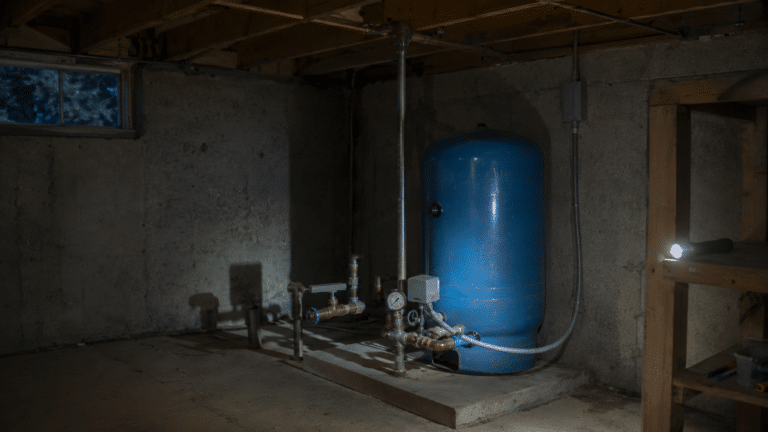
Most modern private wells use an electrically powered pump to lift groundwater into a pressure tank and distribute it through the home’s plumbing. In a typical drilled well, the pump is submerged below the water level. A pressure switch monitors household pressure and starts the motor when the pressure falls to its preset cut-in point.
When the grid fails, the motor cannot restart unless another compatible source of electricity is available. Water already pressurized in the plumbing and tank may still flow, but the pressure will fall as it is used. Eventually the faucets slow down or stop.
Why the Pressure Tank Does Not Provide Days of Water
A pressure tank contains both water and a compressed air cushion, or a bladder separating the two. Its advertised capacity is not the amount of usable water available between pump cycles. A nominal 40-gallon tank, for example, does not ordinarily deliver 40 gallons before the pump must restart. Actual drawdown depends on tank design, precharge, and pressure-switch settings.
That means a shower, several toilet flushes, or a load of laundry could consume much of the remaining pressure-tank water. During a blackout, conserve it immediately. Fill clean drinking-water containers only while adequate pressure remains, and avoid unnecessary water use.
Can Water Still Come From the Well Without Electricity?
Yes, but not automatically. A properly designed hand pump, an independent solar-powered pump, or a gravity-fed storage system may deliver water without utility power. Each requires equipment that is compatible with the well. Removing a well cap and lowering an improvised bucket is not a safe or practical solution for most modern narrow-casing drilled wells; it can contaminate the water supply or damage equipment.
For broader planning, see how to make a homestead blackout-ready, including water, livestock, refrigeration, and other critical systems.
Identify Your Well Pump Before Buying Backup Power
The first step is to learn what is already installed. Two houses with wells of similar depth may have different pump motors, controls, pressure settings, and electrical requirements. The depth of the well alone does not tell you how much electricity the pump needs.
Find the Pump’s Voltage and Horsepower
Look for the installation paperwork, well-driller records, pump invoice, control-box label, or electrical-panel circuit identification. Many submersible residential pumps operate on 230/240-volt service, while some smaller pumps and shallow-well jet pumps use 115/120 volts. Some motors can be configured for either voltage, but the installed configuration matters.
Record the pump’s manufacturer and model, rated horsepower, supply voltage, full-load amperage, service-factor amperage if listed, and whether it uses a separate control box or variable-frequency controller. If this information is not accessible, ask a qualified well contractor or electrician to identify it.
| Equipment detail | Why it matters | Where to check |
|---|---|---|
| 120V or 240V | Determines required backup output | Pump documentation or electrician |
| Motor horsepower | Helps estimate load but does not establish exact input watts | Pump model or motor label |
| Running amperage | Helps assess continuous load | Motor specifications or qualified measurement |
| Starting current or locked-rotor amps | Determines whether backup power can start the motor | Manufacturer data or professional assessment |
| Control type | May affect surge, waveform, and compatibility | Control box, drive, or installer |
Submersible Pumps Versus Jet Pumps
A submersible pump sits down in the well and pushes water upward. It is common in drilled wells and can serve substantial depths. A jet pump normally sits above ground or in a pump house and uses suction and, in some designs, additional piping to move water. Shallow-well jet pumps have practical suction-lift limitations; deep-well jet systems use a different arrangement.
Both can require a significant starting surge. Jet pumps also may need priming after certain failures. Do not assume a backup system that works for one type will work for the other.
How Many Watts Does a Well Pump Need?
There are two separate electrical demands to consider: the power required while the motor is running and the much higher short-duration demand when it starts. A pump that appears modest during normal operation can overwhelm a small generator or inverter at startup.
Running Watts Are Not Starting Watts
Motor horsepower describes mechanical output, not electrical input. A one-horsepower motor produces approximately 746 watts of mechanical power at its rated output, but it draws more electrical power because of motor losses and other operating characteristics. Multiplying voltage by current gives apparent power in volt-amperes for a single-phase circuit, not necessarily real watts, because motor power factor matters.
Starting current can be several times normal operating current, especially for conventional motors starting directly across the line. The exact requirement varies with pump design, control equipment, supply voltage, and load. A soft-start device or variable-speed controller may change startup behavior, but only if it is approved for the specific pump and properly installed.
Illustrative Pump Sizing Scenarios
The following scenarios show why generator sizing must be based on verified equipment data. These are planning examples, not universal ratings or guaranteed specifications for a particular horsepower.
| Example situation | What to verify | Backup-power implication |
|---|---|---|
| Small 120V shallow-well pump | Running amps and motor startup | Some 120V generators may be suitable |
| Typical 240V submersible pump | 240V output and starting capacity | Requires compatible 240V source |
| Larger deep-well pump | Higher current and surge | May need larger generator or specialized drive |
| Variable-speed well system | Controller input, power quality, and surge | Follow drive manufacturer requirements |
A generator’s published surge-watt rating may also be limited to a short interval. Ask the pump and generator manufacturers whether the combination is compatible, including starting volt-amperes and acceptable voltage drop. An electrician can measure or assess the existing installation and design the transfer connection.
Use the preparedness calculators hub for generator sizing, fuel planning, battery runtime, and solar charging estimates. These tools are useful for planning but cannot replace verified motor-starting specifications.
Option 1: Run the Well Pump With a Portable Generator
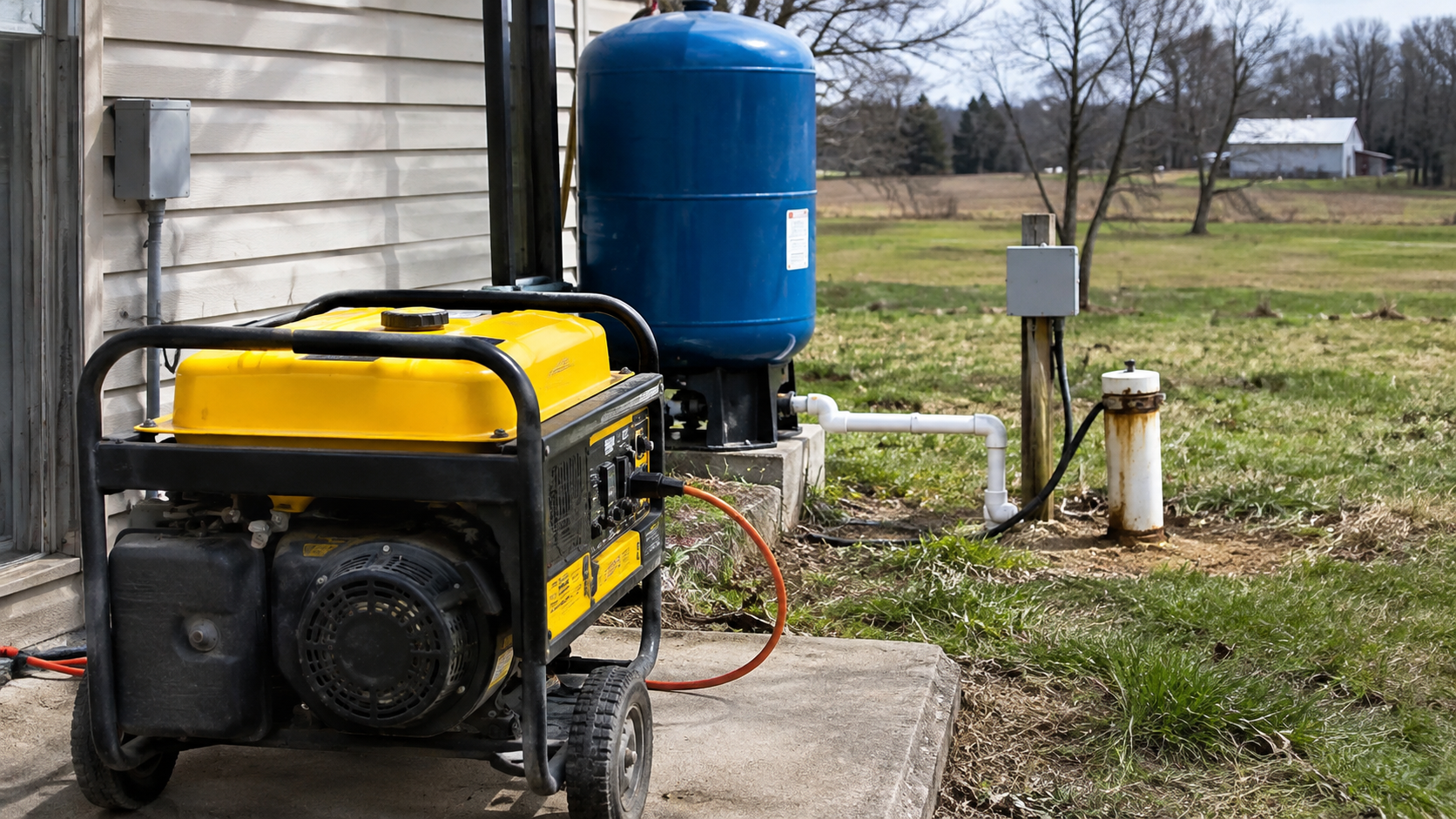
For many homes with an existing electric well, a portable generator is the most practical way to restore water during a blackout. It can supply the same type of AC electricity the pump normally uses, provided the generator has the correct voltage, enough continuous output, enough starting capacity, and an approved connection to the pump circuit.
Choose a Generator With the Correct Voltage
Many portable generators provide 120-volt receptacles, but not all provide a true 120/240-volt output. A conventional 240-volt pump cannot simply run from a 120-volt outlet. A large wattage number on the generator’s packaging does not fix a voltage mismatch.
Check the generator’s nameplate and outlet specifications, including whether its 240-volt output and neutral/ground arrangement are suitable for the intended transfer equipment. A generator that supplies 240 volts must still have sufficient starting capacity for the pump.
Gasoline, Propane, or Dual Fuel?
Gasoline generators are widely available and can provide strong output, but stored gasoline requires safe handling and rotation. Propane can be convenient for households that already keep approved cylinders or a larger storage tank. Dual-fuel models allow the owner to choose between the two fuels, although rated output commonly differs by fuel and may be lower on propane.
Fuel consumption depends on the generator model, actual electrical load, operating schedule, and fuel. Instead of running the generator all day, many households can operate it for planned water-pumping sessions and then shut it down. A properly functioning pressure tank can supply water between those sessions, while dedicated storage containers provide an additional reserve.
Recommended product: 120/240V dual-fuel portable generator


Install a Safe Generator Connection Before an Emergency
A hardwired well pump is not an ordinary plug-in appliance. Its circuit may run through a pressure switch, control box, disconnect, and electrical panel. A qualified electrician should install an approved transfer switch, listed interlock arrangement where permitted, or another code-compliant transfer method that positively isolates utility power.
Have the electrician label the well-pump circuit and demonstrate the approved operating procedure. Test the complete installation under normal conditions, including pump startup and any other essential loads expected to run at the same time.
Where to Place the Generator
Operate gasoline, propane, and other combustion-powered generators outdoors at least 20 feet from doors, windows, and vents, with the exhaust directed away from occupied buildings. Never use one in a house, garage, basement, enclosed porch, or partially enclosed shed. Install functioning carbon-monoxide alarms in the home.
Protect the generator from rain and snow only with a manufacturer-approved outdoor enclosure or arrangement that preserves required ventilation and clearance. Do not improvise a tightly enclosed shelter that traps exhaust or heat.
Option 2: Run a Well Pump With Solar Power and Batteries
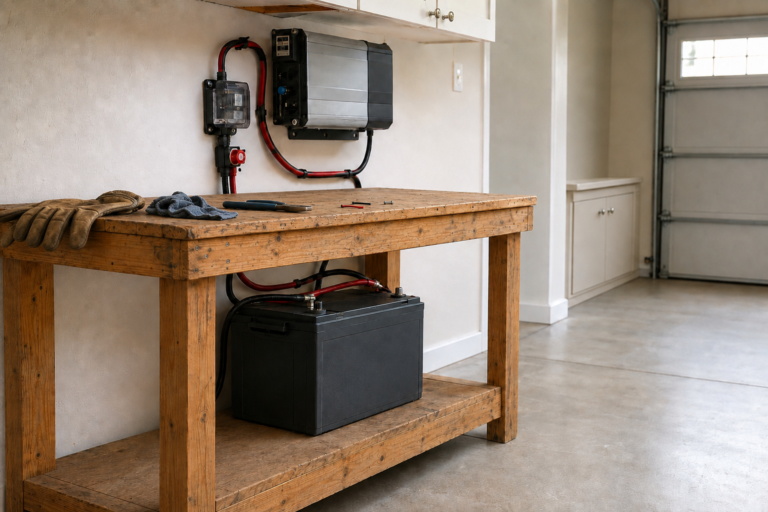
A solar-and-battery backup system can provide water during an outage without continuously burning gasoline or propane. However, powering a conventional household well pump is more complicated than plugging a refrigerator or television into a portable power station.
Many residential submersible pumps operate on 240-volt AC power and require substantial starting current. Most smaller portable power stations supply only 120 volts, making them unsuitable for directly powering these pumps regardless of their advertised battery capacity.
Before purchasing a solar power station, determine whether it can provide the correct voltage, sufficient continuous power, and enough motor-starting capacity. Some expandable battery systems can produce 240 volts when configured with compatible equipment, but not every system supports this arrangement.
How a Solar Well Pump Backup System Works
A typical battery-backed solar system includes solar panels, a charge controller or integrated solar input, battery storage, and an inverter that converts stored DC electricity into AC electricity.
During daylight hours, solar panels generate electricity that can charge the batteries. When the well pump needs to run, the inverter supplies electricity from the battery bank. The system must be designed to handle the pump’s starting requirements without shutting down from overload.
Solar panels do not guarantee continuous operation. Cloud cover, winter daylight hours, snow accumulation, and shading can substantially reduce charging. Battery capacity determines how much energy is available when solar production is insufficient.
Can a Portable Power Station Run a 240V Well Pump?
Some large power stations and expandable battery systems can operate 240-volt appliances, but compatibility must be confirmed for the exact model and configuration. A power station with a 120-volt output cannot directly supply a conventional 240-volt well pump.
Even a system offering 240 volts may struggle with the starting surge of a submersible motor. Check the inverter’s continuous output, surge rating, surge duration, and manufacturer guidance for inductive motor loads.
Also consider whether the equipment requires special paired inverters, additional batteries, or an external 240-volt distribution accessory. These components can significantly increase the total system cost.
Recommended product: 240V-capable expandable solar power station

How Much Battery Capacity Does a Well Pump Need?
The answer depends on how much electricity the pump consumes while operating and how long it runs each day.
For example, suppose a particular pump draws 1,500 watts while running and operates for a combined 30 minutes per day. Its daily energy consumption would be approximately:
1,500 watts × 0.5 hours = 750 watt-hours per day.
That calculation does not include inverter losses, standby consumption, battery operating limits, or other connected appliances. It also does not establish whether the inverter can start the motor.
A battery with 2,000 watt-hours of nominal storage might appear capable of supplying more than two days of pumping under those assumptions, but actual usable runtime will be lower after accounting for system losses and battery limits.
Use the battery and power station runtime calculator to estimate energy needs, and verify starting compatibility separately.
Would a Dedicated Solar Well Pump Be Better?
For some properties, a separate solar-powered water pump may be more practical than trying to run the existing AC submersible pump through a large inverter.
Dedicated solar pumping systems may use DC motors or specialized controllers designed to operate from solar panels. Some can pump water into an aboveground storage tank during daylight hours, reducing the need for a large battery bank.
However, installing a second pump inside an existing well requires adequate casing diameter, clearance around the existing pump and drop pipe, suitable well depth, and proper sanitary protection.
A well contractor should determine whether a secondary pump can be installed without interfering with the primary system.
Option 3: Install a Manual Hand Pump for Emergency Water
A manual hand pump offers a different approach to well-water preparedness. Instead of depending on electricity, it uses human effort to lift water from the well.
For households preparing for prolonged outages, a properly installed manual pump can provide an independent water source when generators run out of fuel or batteries become depleted.
However, not every hand pump works with every well.
Shallow-Well Versus Deep-Well Hand Pumps
Many inexpensive hand pumps rely on suction. Under ideal conditions, atmospheric pressure limits suction lift to approximately 34 feet at sea level, and practical operating limits are generally much lower.
These pumps are unsuitable for wells with water levels significantly below their practical suction range.
A deep-well hand pump uses a different design, typically placing the pumping mechanism down in the well so water can be lifted from much greater depths.
The important measurement is the water level, including how far it drops during pumping, rather than simply the total drilled depth of the well.
Can a Hand Pump Be Installed Alongside an Electric Pump?
Some deep-well hand pump systems are designed to operate alongside an existing electric submersible pump. This arrangement can provide normal electric operation with manual backup during emergencies.
Compatibility depends on casing diameter, available clearance, the location of the existing drop pipe and electrical cable, water depth, and the manufacturer’s installation requirements.
Some systems require specialized well caps, additional piping, or professional installation. A poorly installed system can introduce contamination into the well.
Recommended product: compatible manual deep-well pump system

Is a Manual Pump Worth the Investment?
For someone who experiences frequent short outages, a generator may be more convenient. For a rural household concerned about extended grid failures, a manual pump can provide another layer of resilience.
The disadvantages include installation expense, physical effort, lower flow rates, and possible compatibility problems.
Manual pumping may also be impractical for supplying an entire household’s normal water demand. It is better viewed as an emergency water-access method unless the installation is specifically designed for broader use.
Option 4: Store Water Before the Power Goes Out
Even with a generator, solar system, or hand pump, every household using a private well should maintain a separate emergency water supply.
Backup equipment can fail. Fuel may become unavailable, solar panels may produce very little electricity during a winter storm, and well components can suffer mechanical damage.
Stored water provides immediate access without starting a generator or operating a pump.
How Much Emergency Water Should You Store?
Ready.gov recommends storing at least one gallon of water per person per day for drinking and sanitation, with a minimum three-day supply. A two-week supply is preferable when possible.
That is a minimum emergency planning allowance, not a guarantee of sufficient water for bathing, laundry, livestock, or every household need.
The following table shows basic storage requirements for different household sizes.
| Household size | 3-day minimum | 7-day supply | 14-day supply |
|---|---|---|---|
| 2 people | 6 gallons | 14 gallons | 28 gallons |
| 4 people | 12 gallons | 28 gallons | 56 gallons |
| 6 people | 18 gallons | 42 gallons | 84 gallons |
For a family of four, storing 56 gallons provides a basic two-week emergency allowance. Additional water is needed for substantial washing, cleaning, toilet flushing, pets, and livestock.
Use the emergency water storage calculator to estimate your household’s requirements.
Choose Food-Grade Water Storage Containers
Use containers specifically intended for potable water. Food-grade polyethylene tanks, purpose-built emergency water containers, and properly maintained drinking-water storage barrels are common choices.
Never reuse a container that previously held pesticides, fuel, toxic chemicals, or other hazardous substances, even if it has been thoroughly washed.
Choose a container with a secure lid, suitable dispensing method, and capacity that fits the available storage space.
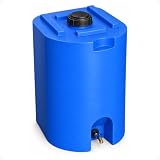
Recommended product: food-grade emergency water storage container
Can You Store 100 to 300 Gallons of Well Water?
Yes, provided the tank is approved for drinking water and the storage location can safely support its weight.
Water weighs approximately 8.34 pounds per gallon. A full 200-gallon tank contains about 1,668 pounds of water before accounting for the container itself.
A 300-gallon tank contains approximately 2,502 pounds of water. That weight requires a stable, adequately supported location.
Large storage tanks are useful for households that depend entirely on a private well, but they need protection from contamination, excessive heat, and freezing.
Prevent Stored Water From Freezing
Outdoor water tanks can freeze during prolonged winter outages. Insulation slows heat loss but does not generate heat, so it cannot indefinitely prevent freezing during sustained cold weather.
Whenever possible, store drinking water inside a temperature-controlled area or another location that remains safely above freezing.
For larger outdoor tanks, consider a properly designed insulated enclosure and an appropriate freeze-protection system. Remember that electric tank heaters will also stop working when their power supply fails.
For additional winter protection, read how to keep pipes from freezing during a power outage.
How to Prepare Your Well System Before an Outage
Buying backup equipment is only part of the preparation. A reliable system requires installation, testing, maintenance, and a clear operating procedure.
1. Have the Well System Inspected
Ask a qualified well professional to inspect the pump, pressure switch, pressure tank, electrical controls, and visible plumbing components.
Determine whether the system has existing problems that could become more serious during an extended outage.
2. Identify the Electrical Circuit
Locate the well-pump breaker and determine whether the pump operates on 120 or 240 volts. Confirm the actual motor specifications rather than relying solely on the breaker size.
A 30-amp breaker, for example, does not mean the pump continuously consumes 30 amps.
3. Install Approved Backup Connections
Have a qualified electrician install any required transfer equipment and verify that the generator or inverter can safely operate the pump.
Label all relevant switches and provide written instructions for household members.
4. Test the Backup Under Real Conditions
Test the system before storm season. Confirm that the pump starts, fills the pressure tank, shuts off normally, and restarts when pressure falls.
Watch for generator overloads, inverter shutdowns, unusual pump noises, or abnormal pressure behavior.
Never defeat electrical protections to force a pump to run.
5. Store Fuel and Water
Maintain an appropriate fuel reserve for the generator and store potable water separately.
Use approved fuel containers, follow local fire codes, and keep fuel away from ignition sources and occupied living areas.
6. Prepare for Winter Weather
Insulate exposed piping where appropriate, protect the pressure tank and controls from freezing, and identify how to shut off water if a pipe bursts.
If the home cannot be kept warm enough to prevent freezing, follow a qualified plumber’s instructions for winterizing the system.
How to Operate a Well Pump During a Power Outage
The exact procedure depends on the installed transfer equipment and pump configuration. The following general approach applies to a properly designed generator backup system.
- Confirm that the outage has affected the well-pump circuit and that there are no visible electrical or plumbing hazards.
- Move the generator to its approved outdoor operating location, at least 20 feet from openings, with exhaust directed away from the building.
- Inspect fuel, oil, cords, and connections according to the generator manufacturer’s instructions.
- Start the generator following its operating manual.
- Use the professionally installed transfer equipment exactly as instructed to supply the designated well circuit.
- Allow the pump to refill the pressure tank while monitoring the generator for overloads or abnormal operation.
- When pumping is complete, follow the approved shutdown and transfer procedure.
If the pump fails to start, trips a breaker, or produces unusual sounds, stop and investigate rather than repeatedly attempting to restart it.
Common Well Pump Problems During a Blackout
The Generator Runs but the Pump Does Not Start
Possible causes include incorrect output voltage, inadequate starting capacity, an open breaker, transfer-equipment problems, or a pump/control malfunction.
Check only the items covered by the equipment’s safe user instructions. Have an electrician or well contractor investigate wiring and motor faults.
The Pump Starts but Water Pressure Is Weak
Low pressure can result from insufficient generator voltage under load, a pressure-system problem, a leak, a clogged filter, or a well-related issue.
Do not assume the generator is the cause without checking the complete system.
The Pump Repeatedly Starts and Stops
Rapid cycling can indicate a pressure tank problem, incorrect air precharge, a pressure-switch issue, leakage, or another system fault.
Frequent cycling can damage equipment and should be investigated.
The Pump Runs but No Water Comes Out
Possible causes include a low water level, pump damage, a closed valve, a broken pipe, or a jet pump that has lost its prime.
Shut the system down if dry running is suspected, and contact a qualified well professional.
The Well Water Looks Cloudy After Power Returns
Cloudiness may result from air, disturbed sediment, or another issue. Changes in odor, color, or taste should not automatically be dismissed as harmless.
If flooding, damage, or contamination is suspected, do not drink the water until the well has been evaluated and appropriate testing confirms it is safe.
What If the Power Stays Out for Two Weeks or Longer?
Extended outages require a different strategy than a blackout lasting a few hours. Generator fuel, battery charging, household water consumption, and equipment maintenance become increasingly important.
During a prolonged emergency, prioritize drinking, cooking, essential hygiene, and necessary animal care. Reduce water-intensive activities such as laundry, long showers, and unnecessary outdoor watering.
One practical strategy is to use backup power for scheduled pumping sessions, filling approved storage containers while the generator operates. This may reduce generator runtime compared with leaving it running continuously.
However, stored water must remain protected from contamination, and any connection between storage tanks and household plumbing must be designed to prevent backflow.
Households with livestock or large gardens should calculate those water requirements separately. The one-gallon-per-person emergency minimum does not account for substantial animal or agricultural demand.
Which Well Pump Backup Option Is Best?
The best choice depends on the existing pump, available budget, expected outage duration, and the household’s water needs.
A portable generator is often the simplest way to restore an existing electric well pump, particularly when the house already has a compatible 240-volt pump and a professionally installed transfer connection.
A solar-and-battery system can reduce dependence on stored fuel, but it may require a substantial investment to operate a conventional pump with high starting current.
A manual deep-well pump offers an independent backup where the well and installation permit it. It is especially appealing for households preparing for prolonged grid failures.
Emergency water storage is essential regardless of which pumping method is selected. It provides immediate access when electrical or mechanical systems are unavailable.
For many rural households, a layered approach offers the greatest reliability: stored drinking water for immediate needs, a properly sized generator for the existing pump, and an independent secondary water source where practical.
Frequently Asked Questions
Will a 2,000-Watt Generator Run a Well Pump?
It depends on the pump’s voltage, running demand, and starting requirements. Many conventional 240-volt well pumps cannot operate from typical 120-volt-only 2,000-watt generators. Even a compatible-voltage generator may lack sufficient starting capacity.
Can a 5,000-Watt Generator Run a Well Pump?
Some 5,000-watt generators can operate certain residential well pumps, but the wattage rating alone is not enough to confirm compatibility. Verify the generator’s 240-volt output, motor-starting capacity, and the pump’s actual electrical specifications.
Can You Run a Well Pump Directly From Solar Panels?
Some dedicated solar pumping systems are designed to operate directly from solar panels through a compatible controller. A conventional AC well pump generally requires suitable power-conversion equipment, and reliable operation during low sunlight may require battery storage.
How Long Will a Pressure Tank Supply Water Without Power?
It depends on the tank’s actual drawdown capacity, pressure settings, and water consumption. A pressure tank generally provides a limited reserve rather than enough water for several days of normal household use.
Can You Install a Hand Pump on an Existing Deep Well?
Sometimes. Certain deep-well hand pump systems can be installed alongside an electric submersible pump, but casing diameter, water depth, clearance, and sanitary installation requirements must be verified.
Will a Well Pump Work When the Electricity Comes Back On?
Normally, a properly functioning electric well pump resumes operation when power returns and the pressure switch calls for water. However, electrical damage, low water levels, frozen pipes, or other problems may prevent normal operation.
How Much Water Should a Family of Four Store?
At one gallon per person per day, a family of four needs at least 12 gallons for three days or 56 gallons for two weeks. Additional water is advisable for hygiene, pets, livestock, and other household needs.
Can I Plug a Well Pump Into a Portable Power Station?
Only if the pump’s electrical connection, voltage, running load, starting requirements, and the power station’s output are compatible. Most hardwired well pumps require an approved electrical connection rather than a standard extension cord.
Final Thoughts
Losing electricity should not automatically mean losing access to water. With the right preparation, many private-well households can continue pumping water during a blackout or maintain a separate emergency supply until utility service returns.
The most important step is identifying the pump’s actual electrical requirements before purchasing equipment. A generator or battery system that cannot deliver the correct voltage and starting capacity will not provide reliable backup, no matter how impressive its advertised specifications appear.
For most households, a properly matched generator and safe transfer installation offer a practical starting point. Solar-and-battery systems, compatible manual pumps, and dedicated water storage can provide additional protection against longer outages.
Prepare before the next storm, test the system while the power is still on, and maintain enough drinking water to cover the possibility that backup equipment fails. A private well can be an important preparedness advantage—but only when there is a reliable way to access its water.
Further Reading
- Preparedness Calculators: Water Storage, Generator Fuel, Battery Runtime, and More
- How to Keep Pipes From Freezing During a Power Outage
- Homestead Blackout Preparedness