How to Build a Wood Gasifier to Run an Engine: DIY Generator Guide
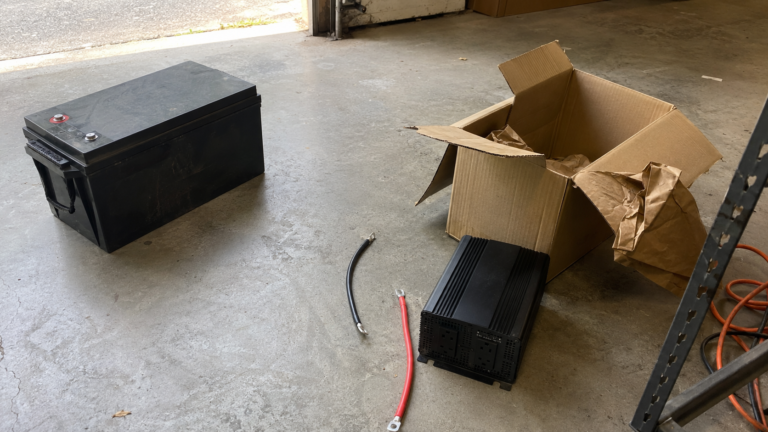
Imagine being able to run a gasoline engine after the gas stations have closed, fuel deliveries have stopped, and the last few gallons in your storage containers are gone. It sounds like something from an old survival manual, but the technology already exists. During World War II, wood gas generators allowed vehicles, tractors, and stationary engines to operate using fuel produced from wood rather than petroleum.
This post contains affiliate links. I may earn a small commission at no extra cost to you. Learn more.
Even more interesting, the United States government revisited this technology decades later. In 1989, researchers working with the Federal Emergency Management Agency (FEMA) and Oak Ridge National Laboratory published detailed plans for a simplified wood gas generator that could be assembled using commonly available materials. They built a prototype, mounted it on a farm tractor, and successfully tested it using wood chips as the engine’s fuel.
That historical project provides an unusually useful starting point for anyone researching how to build a wood gasifier to run an engine. Unlike speculative survival projects, the FEMA system was documented, photographed, and tested.
A wood gasifier does not turn wood into liquid gasoline. Instead, it converts solid biomass into a combustible mixture known as producer gas or wood gas. When properly produced, cleaned, and delivered to a compatible engine, that gas can provide mechanical power for a tractor, stationary engine, or electrical generator.
However, building an engine-powered gasifier is not comparable to assembling a simple wood-burning stove. The system must produce consistent gas, control extremely high temperatures, remove damaging contaminants, and prevent dangerous leaks of carbon monoxide. Engine compatibility, electrical safety, and proper testing are essential.
In this guide, we’ll examine the original FEMA wood gasifier design, explain how the equipment works, identify its major components, and explore the engineering requirements for powering an internal combustion engine or emergency generator. We’ll also examine the advantages, limitations, fuel requirements, and safety considerations that determine whether this technology is practical for long-term preparedness.
Quick Answer
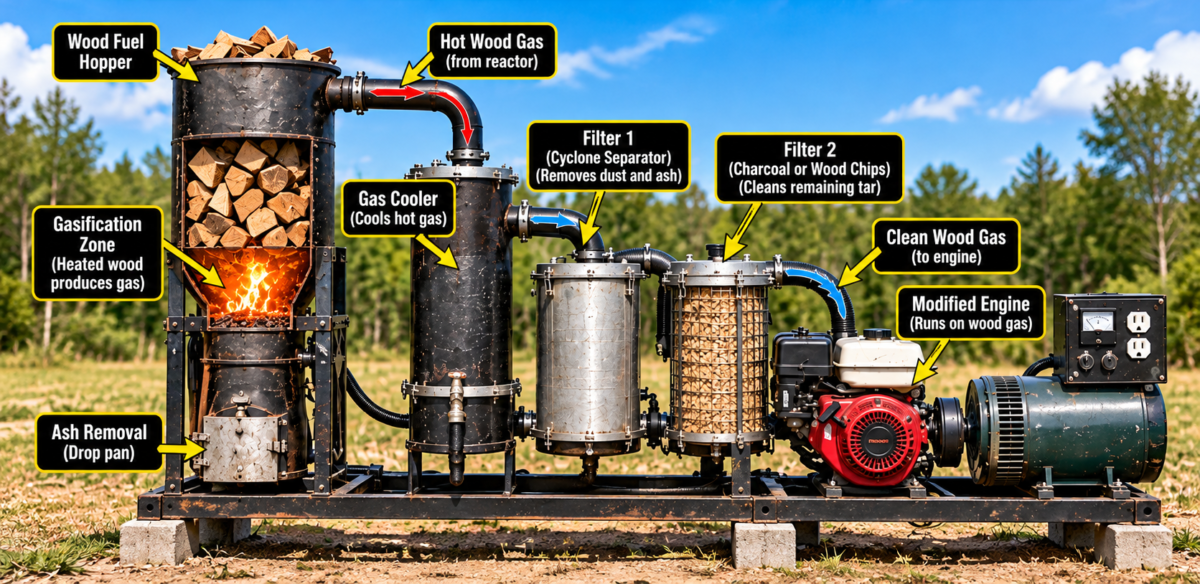
A wood gasifier can power certain gasoline engines by converting dry wood into combustible producer gas. The most relevant historical DIY example is the FEMA simplified downdraft gasifier, documented in 1989 and successfully tested on a farm tractor. Its major components include a wood hopper, gasification reactor, grate, ash collection area, gas cooling and cleaning equipment, and an engine fuel-delivery system.
For emergency electricity, the engine must also drive a generator capable of producing stable voltage and frequency. The gasifier and engine conversion require a complete, validated design, appropriate gas monitoring, and qualified testing because producer gas contains potentially lethal carbon monoxide and can form explosive mixtures with air.
Key Takeaways
- Wood gasifiers really can run engines. This technology was used historically during petroleum shortages and demonstrated in the FEMA-sponsored research project.
- The FEMA design is our primary reference. Its simplified stratified downdraft reactor was built and tested on a tractor using wood chips.
- A gasifier produces fuel gas, not gasoline. Producer gas contains carbon monoxide, hydrogen, methane, nitrogen, carbon dioxide, and other constituents.
- Gas cleaning is essential. Tar, moisture, acids, and particulates can damage an engine if they are not adequately controlled.
- Not every engine is suitable. Engine compatibility, fuel controls, ignition behavior, and available power must be evaluated before conversion.
- Expect reduced engine output. An engine running on producer gas generally produces less power than the same engine running on gasoline.
- Fuel preparation matters. Wood moisture, size, consistency, and cleanliness directly affect gasifier performance.
- Carbon monoxide is a major hazard. Gasifiers must not be operated in enclosed or partially enclosed areas.
- Generator applications require additional engineering. Electrical load changes, engine speed, and power quality must be considered.
Can You Really Run a Gasoline Engine on Wood?
Yes. Certain spark-ignition internal combustion engines can operate on producer gas generated from wood. The underlying principle is straightforward: a gasoline engine requires a combustible fuel-air mixture inside its cylinders, and producer gas contains gases capable of burning when mixed with an appropriate quantity of air.
The difficult part is producing gas with sufficiently consistent properties and low contaminant levels to operate the engine without excessive wear or unreliable performance.
Ordinary wood smoke cannot simply be directed into a carburetor. Smoke contains water vapor, tar compounds, particles, and other substances that can foul the engine. An engine gasifier must convert biomass under controlled conditions and then condition the resulting gas before it reaches the engine.
The United Nations Food and Agriculture Organization (FAO) explains in its technical manual Wood Gas as Engine Fuel that spark-ignition engines can operate on producer gas, provided the fuel and engine system are suitable. The manual also emphasizes the importance of removing dust, tar, and acidic contaminants.
How Much Power Does an Engine Lose on Wood Gas?
Producer gas has a much lower energy content per unit of volume than conventional gaseous fuels such as natural gas. It also contains substantial quantities of nitrogen and carbon dioxide that do not contribute useful combustion energy.
Consequently, a gasoline engine operating on wood gas generally cannot produce its original rated horsepower without significant design changes. The exact reduction depends on the engine, gas composition, fuel-delivery arrangement, compression ratio, and operating conditions.
This distinction becomes especially important when the engine drives an electrical generator. A generator originally rated for 5,000 running watts should not automatically be expected to deliver 5,000 watts when operating on wood gas.
For emergency planning, the only dependable rating is the output actually demonstrated by the completed and properly tested system.
The History of Wood Gas Generators
Wood gasification is not a modern invention. Early producer-gas systems were developed long before today’s portable generators, and the technology became especially valuable when access to conventional petroleum fuels was restricted.
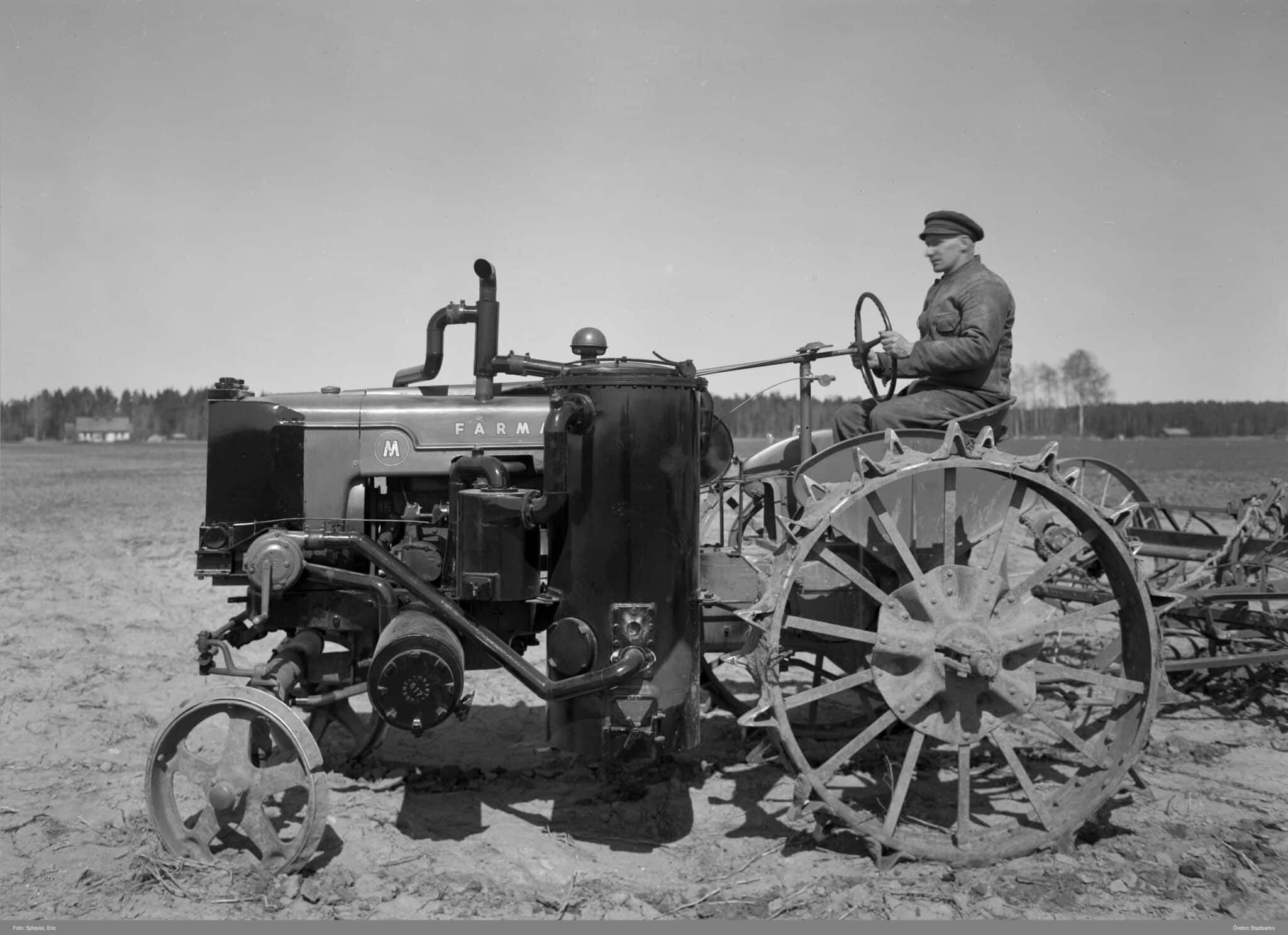
During World War II, gasoline shortages encouraged the use of gas generators on cars, trucks, buses, agricultural machinery, and other engines. Some vehicles carried bulky gasifier units mounted behind the body or on trailers, while others incorporated equipment into specially modified vehicle structures.
These systems converted wood or charcoal into fuel gas that could be supplied to an adapted engine. They demonstrated that internal combustion engines did not always require liquid petroleum fuel, but they also exposed operators to significant maintenance demands, reduced power, and serious safety hazards.
Why FEMA Studied Wood Gasification in 1989
Decades after World War II, FEMA sponsored research into emergency technologies that might become useful during a prolonged disruption of petroleum supplies.
One result was the report Construction of a Simplified Wood Gas Generator for Fueling Internal Combustion Engines in a Petroleum Emergency, prepared by H. LaFontaine and G. P. Zimmerman through work associated with Oak Ridge National Laboratory.
The report’s objective was to preserve practical knowledge about wood gasification and demonstrate a relatively simple system that could be constructed using materials likely to remain available during a major fuel shortage.
Rather than designing an elaborate industrial gasification plant, the researchers developed a simplified version of historical downdraft gasification technology.
According to the report, the prototype used ordinary metal containers, plumbing components, and a stainless steel mixing bowl incorporated into the grate assembly. The completed unit was installed on a farm tractor and successfully field-tested using wood chips.
Original FEMA Wood Gasifier Plans
The complete government technical report contains historical construction drawings, photographs, component descriptions, and operating information.
View the original Oak Ridge National Laboratory wood gas generator report.
The report documents an experimental design, not a modern certified consumer product. Anyone considering fabrication should have the complete system independently reviewed for current mechanical, fire, gas-handling, and electrical safety requirements.
How a Wood Gasifier Works
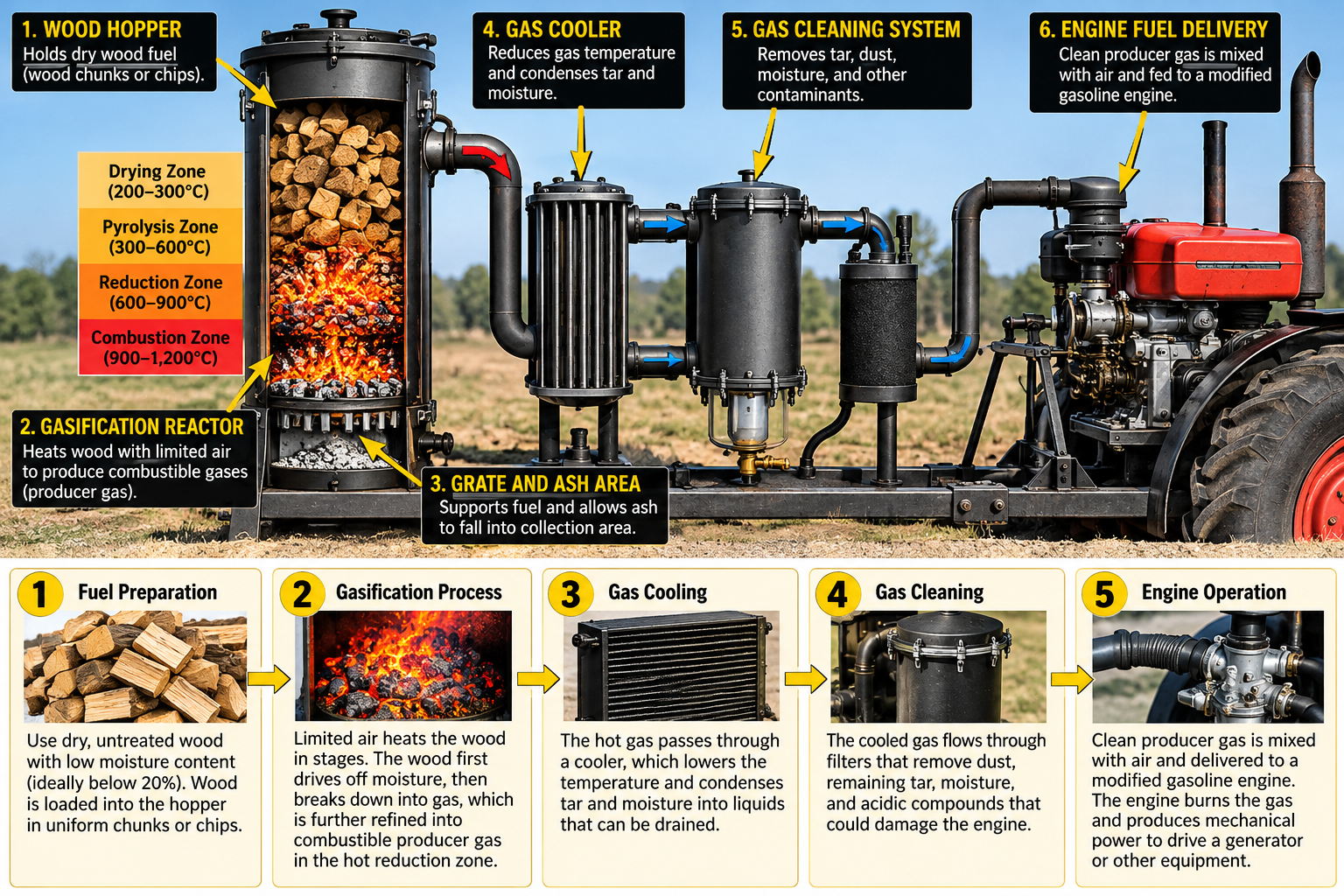
To understand how a wood gasifier powers an engine, it helps to separate the process into two systems: the gasifier that converts wood into combustible gas, and the engine that burns the conditioned gas to produce mechanical power.
Inside the gasifier, wood passes through several overlapping thermal and chemical stages. The arrangement of these stages depends on the reactor design, but downdraft gasifiers generally rely on drying, pyrolysis, oxidation, and reduction.
1. Drying: Removing Moisture From the Wood
As wood enters the heated reactor, its moisture begins to evaporate. This requires energy, which is why excessively wet wood is undesirable for engine gasification.
Every additional quantity of water entering the reactor must be heated and vaporized. That energy is no longer available to support the high-temperature reactions needed to produce useful gas.
Excess moisture can also contribute to condensation in downstream equipment, complicating filtration and gas delivery.
2. Pyrolysis: Breaking Down the Wood
When wood is heated sufficiently, its chemical structure begins to break down. This process releases gases and vapors while leaving behind a carbon-rich solid commonly called char.
Some released compounds are combustible, but others form condensable tar. Tar is particularly troublesome in engine applications because it can accumulate in pipes, filters, intake components, and engine passages.
Successful engine gasification therefore requires more than simply heating wood until it smokes.
3. Oxidation: Producing the Required Heat
In the oxidation region, part of the fuel reacts with a controlled supply of oxygen. These reactions release heat that helps sustain the gasification process.
The amount and distribution of air are critical. Too much air can consume a greater portion of the fuel through combustion, while insufficient or poorly distributed air can prevent the reactor from maintaining the conditions needed for effective gas production.
4. Reduction: Producing Additional Combustible Gas
As hot gases move through the charcoal-rich reduction region, additional chemical reactions produce combustible components, including carbon monoxide and hydrogen.
The resulting producer gas also contains noncombustible gases and potentially harmful impurities. Its composition varies with fuel characteristics, reactor design, temperature, and operating conditions.
5. Gas Conditioning and Engine Use
After leaving the reactor, the gas must be cooled and cleaned to a level appropriate for the engine. Only then can a compatible engine fuel system use the gas as part of a controlled combustion process.
When the engine runs, it converts the fuel’s chemical energy into rotating mechanical power. That rotation can drive a tractor transmission, a stationary machine, or the alternator in an electrical generator.
Why a Downdraft Gasifier Is Used for Engines
Gasifiers can be classified according to the direction in which fuel, air, and gas move through the reactor. The two designs most commonly discussed in introductory biomass gasification are updraft and downdraft systems.
In an updraft gasifier, the gas stream can pass through cooler fuel regions and carry substantial quantities of tar and other condensable compounds. Such gas may be suitable for certain direct-heating applications but often requires significant treatment before engine use.
In a downdraft gasifier, the gas stream passes through hot reaction regions that can help break down some tar compounds. This makes the configuration particularly relevant to engine applications, although it does not eliminate the need for gas cleaning.
| Feature | Updraft Gasifier | Downdraft Gasifier |
|---|---|---|
| Typical application | Direct thermal use | Engine fuel and selected thermal applications |
| Gas flow | Generally upward through fuel | Generally downward through reaction regions |
| Tar in raw gas | Often relatively high | Can be lower when correctly operated |
| Fuel requirements | Depend on reactor design | Generally requires well-prepared, relatively dry fuel |
| Engine suitability | Usually requires substantial gas cleaning | Common historical choice for producer-gas engines |
| Main limitation | Tar management | Fuel consistency and stable operating conditions |
The FEMA prototype used a simplified stratified downdraft configuration. This is an important distinction from the more traditional Imbert-style gasifier, which uses a different internal arrangement. Although both are associated with downdraft gasification, their reactor geometries and operating characteristics should not be treated as interchangeable.
The Main Components of a FEMA-Style Wood Gasifier
Before examining construction, it is important to understand the complete system. The gasification reactor is only one part of the equipment required to power an engine.
A functional installation must account for fuel storage and movement, controlled gasification, ash handling, gas cooling, contaminant removal, fuel delivery, engine operation, and emergency shutdown.
| Component | Purpose | Important Consideration |
|---|---|---|
| Wood hopper | Holds prepared biomass | Fuel movement, heat, gas leakage |
| Reactor body | Contains the gasification process | Thermal resistance and structural integrity |
| Air inlet system | Supplies controlled air | Distribution and safe isolation |
| Grate assembly | Supports the reacting fuel bed | Ash movement and temperature exposure |
| Ash collection | Collects solid residue | Safe maintenance and hot material |
| Gas cooler | Reduces producer-gas temperature | Condensate and corrosion |
| Gas filter | Removes particles and contaminants | Filter performance and pressure drop |
| Gas monitoring and controls | Tracks system conditions | Leak detection and emergency shutdown |
| Engine fuel interface | Delivers conditioned gas to a compatible engine | Fuel mixture, flashback, engine safety |
| Generator head | Converts engine rotation into electricity | Speed, voltage, frequency, load |
How to Build a Wood Gasifier: The FEMA Design Explained
The original FEMA project is particularly interesting because it was designed around relatively ordinary materials rather than specialized industrial equipment. Its construction manual documents the prototype’s major assemblies and shows how the researchers integrated them into an operational system.
However, the design was developed as an emergency technology demonstration, not as a certified residential generator. Its historical material choices and operating procedures should not be assumed to satisfy modern requirements.
The following construction framework explains what must be designed, fabricated, and verified. For exact historical component specifications, the original report should be consulted directly. Any modern implementation needs competent engineering review before construction, commissioning, or connection to an engine.
Step 1: Choose the Engine and Determine Its Fuel Demand
One of the first decisions is selecting the engine the gasifier is intended to supply. The reactor must produce enough usable gas for the engine’s operating requirements, and the entire system must remain stable across the anticipated load range.
A small stationary gasoline engine, a larger agricultural engine, and a portable generator engine can have very different fuel demands and operating characteristics.
For an emergency generator, begin by identifying the electrical equipment you actually need to operate. A refrigerator, freezer, well pump, battery charger, and a few lights may represent a manageable essential-load plan, while attempting to operate an entire electrically heated household creates a much larger demand.
The engine’s displacement, operating speed, fuel requirements, and expected power reduction must be considered together. Simply attaching a larger hopper to a small reactor will not necessarily increase its useful output.
Step 2: Study the Reactor and Fuel Hopper Assembly
In the FEMA prototype, the fuel storage and reactor sections formed the core of the gasification unit. Wood chips were supplied from above, and the reactor was arranged so that fuel could move through the heated regions as gasification proceeded.
Reliable fuel movement is essential. Irregular pieces of wood may become lodged against one another, creating a bridge that interrupts the supply of material to the reaction zone.
The hopper must also be designed to account for hot gases, thermal expansion, fuel movement, and the possibility of combustible gas escaping through unintended openings.
Although the historical report describes ordinary metal containers as part of the prototype, modern material selection should consider heat exposure, coatings, corrosion, structural strength, and the possibility of hazardous emissions. A container that looks similar to the historical example is not automatically an acceptable substitute.
Step 3: Understand the Air Supply and Reaction Zones
The reactor needs a carefully controlled air supply to maintain the conditions required for gasification. The location, distribution, and resistance of the air passages affect temperature, fuel conversion, and the quality of the resulting gas.
These features must be treated as part of the reactor’s engineered geometry. Arbitrarily adding openings, changing their size, or modifying the gas flow path can substantially alter performance.
The FAO technical manual provides detailed discussion of downdraft gasifier design and the relationship between fuel properties, reactor configuration, and operating conditions.
For a construction project, the selected design must specify these relationships as a complete system rather than leaving critical airflow characteristics to guesswork.
Step 4: Examine the Grate and Ash Collection System
The grate supports the reacting fuel bed while allowing the intended movement of gas and ash. It operates in a harsh environment involving elevated temperatures, hot charcoal, and abrasive residues.
The FEMA report’s use of a stainless steel mixing bowl in its grate assembly is one of the distinctive features of the historical prototype. That choice illustrates the researchers’ emphasis on using commonly available materials during a petroleum emergency.
Nevertheless, the grate’s material, shape, support arrangement, and maintenance access all affect system operation. An unsuitable grate can deform, restrict gas movement, or interfere with the fuel bed.
Ash collection must also allow safe servicing after shutdown. Residual charcoal and ash can remain hot, and opening equipment before it is safe can expose the operator to heat and hazardous gas.
Step 5: Design the Gas Cooling System
Producer gas leaving the reactor can be too hot for suitable delivery to an engine. Cooling the gas increases its density and helps manage conditions in the downstream fuel system.
However, cooling also encourages water and certain organic compounds to condense. Those liquids can accumulate in equipment, create corrosion problems, and introduce contaminated waste that requires proper handling.
Gas cooling therefore cannot be considered separately from filtration, drainage, maintenance access, and the overall gas-handling design.
A complete system needs appropriate temperature and pressure monitoring, suitable materials, and provisions for safely managing any collected condensate.
Step 6: Design the Gas Cleaning and Filtration System
Gas cleaning is one of the most important differences between a wood-burning stove and a wood gasifier intended to run an engine.
Wood gas may contain dust, soot, tar, acidic compounds, and moisture. These contaminants can restrict passages, create deposits, accelerate wear, and interfere with normal engine operation.
The FAO manual specifically identifies gas cleanliness as a major requirement for reliable producer-gas engines. It also explains that particle removal and tar management must be considered when selecting and operating a gasifier.
Some systems use multiple cleaning stages because no single simple filter necessarily removes every problematic contaminant. The appropriate arrangement depends on gas composition, flow requirements, reactor characteristics, and engine tolerance.
Ordinary household air filters, improvised fabric cartridges, and untested containers should not be assumed to produce engine-quality gas. A properly designed cleaning system requires validated performance and a safe maintenance procedure.
Step 7: Evaluate the Engine Fuel-Delivery System
Once producer gas has been adequately conditioned, a compatible engine must receive a suitable mixture of combustible gas and air. This requires engineering attention to fuel delivery, engine operating conditions, ignition behavior, and the possibility of flashback.
The original FEMA research describes historical approaches to operating an engine on wood gas. Those descriptions are useful for understanding the technology, but an engine conversion must be evaluated for the particular engine and modern safety requirements.
Do not connect raw producer gas directly to an ordinary gasoline engine’s intake or improvise gas delivery using unapproved household hoses and fittings. Leaks, uncontrolled fuel mixtures, and flashback can cause serious injury, fire, or poisoning.
Step 8: Integrate the Engine With an Electrical Generator
Once a suitable engine can reliably operate on conditioned producer gas, mechanical power can potentially be used to drive a generator.
This does not automatically mean the installation will provide stable household electricity. The engine must maintain sufficient speed and torque as electrical demand changes, and the generator must maintain appropriate voltage and frequency.
Starting loads can be especially challenging. A refrigerator compressor, well pump, or other electric motor may require substantially more power for a short period during startup than during normal operation.
Because producer gas generally reduces available engine power, generator sizing should be based on verified wood gas operation rather than the engine’s original gasoline rating.
Any connection to household wiring must use properly installed transfer equipment and meet applicable electrical requirements. Never backfeed a generator through a household receptacle.
Step 9: Arrange Professional Inspection and Controlled Testing
Completing the mechanical assembly does not establish that a gasifier is ready to operate. The system must be evaluated for gas leakage, thermal behavior, gas quality, filtration performance, emergency isolation, engine compatibility, and safe shutdown.
Commissioning requires a suitable outdoor location, competent personnel, appropriate gas monitoring, fire protection, and a documented test procedure. Carbon monoxide cannot be reliably detected by smell, and the absence of visible smoke does not indicate that the gas is safe.
The equipment should not be considered a dependable emergency power source until its performance and safety have been demonstrated under the actual operating conditions it is expected to encounter.
Critical Safety Warning: Wood Gas Can Be Deadly
Producer gas contains carbon monoxide, an invisible and potentially lethal poison. It can also form flammable or explosive mixtures when combined with air.
Never operate a wood gasifier, generator, or gas-handling system inside a home, garage, basement, greenhouse, shed, tent, or partially enclosed structure. Never route raw producer gas into an occupied building, and never use a flame to check for leaks.
The historical FEMA plans are a technical reference, not a substitute for modern engineering review, gas monitoring, fire protection, and qualified commissioning.
What Kind of Engine Can Run on Wood Gas?
Engine selection is one of the most important decisions in a wood gasification project. Although historical examples demonstrate that producer gas can power internal combustion engines, not every engine is an equally suitable candidate.
Gasoline Engines
Spark-ignition gasoline engines are the most familiar category for wood gas conversion. Their combustion process can be compatible with a suitable producer-gas mixture, provided the engine and fuel system are properly engineered.
However, modern gasoline engines may incorporate electronic fuel injection, emissions controls, oxygen sensors, electronic ignition management, and other systems that complicate alternative-fuel operation.
Older mechanically simpler engines may be easier to study, but simplicity does not eliminate the need for suitable fuel delivery, gas cleaning, monitoring, and protection against hazardous operating conditions.
Diesel Engines
Diesel engines present additional complications because they normally rely on compression ignition rather than spark ignition.
Some producer-gas applications use a dual-fuel arrangement in which the engine continues to consume a portion of diesel fuel. Other conversions require much more extensive mechanical changes.
Therefore, a wood gasifier should not be described as a simple diesel replacement without specifying the engine technology and the type of conversion involved.
Small Portable Generator Engines
Small spark-ignition generator engines are attractive because many households already own them. However, a conventional portable generator is designed around a particular fuel system and rated engine output.
Conversion requires assessing engine compatibility, reduced power, fuel controls, gas quality, and electrical stability. A small generator may also have limited reserve power for sudden load changes.
For preparedness purposes, it is sensible to maintain the generator’s original approved fuel system unless a professionally reviewed conversion has been demonstrated to operate safely and reliably.
Wood Gasifier Engine Compatibility Comparison
| Engine Type | Wood Gas Potential | Main Challenge |
|---|---|---|
| Older carbureted gasoline engine | Historically demonstrated | Safe fuel conversion and reduced output |
| Modern fuel-injected gasoline engine | Technically possible in specialized systems | Electronic controls and fuel management |
| Small gasoline generator engine | Potentially suitable after engineering evaluation | Power derating and electrical stability |
| Diesel engine | Specialized dual-fuel or converted operation | Ignition requirements and mechanical changes |
| Stationary industrial engine | Documented applications | System sizing, gas conditioning, and controls |
For someone planning a long-term off-grid power project, engine suitability should be established before investing in reactor fabrication. A gasifier designed without a defined engine and load requirement may produce insufficient gas, operate inefficiently, or prove difficult to control.
How Much Wood Does a Gasifier Need to Run an Engine?
One of the most important questions for anyone considering a wood-powered generator is how much fuel the system will consume. A wood gasifier may eliminate the need for gasoline during certain operating conditions, but it does not eliminate the need to store, prepare, and handle a substantial quantity of fuel.
The actual amount of wood required depends on several variables, including moisture content, wood species, reactor efficiency, gas cleaning losses, engine efficiency, generator efficiency, and electrical load. A system operating near its intended load may perform very differently from one running inefficiently at low output.
For that reason, fuel calculations should be treated as planning estimates until the completed system has been tested.
Understanding the Energy Available in Firewood
Dry wood contains stored chemical energy that can be released through combustion or converted into producer gas. The energy content varies with moisture and wood composition, but approximately 4 kilowatt-hours of chemical energy per kilogram of reasonably dry wood is a useful illustrative assumption.
That does not mean one kilogram of wood will generate four kilowatt-hours of electricity. Energy is lost during gasification, cooling, engine operation, and electrical generation.
For example, if a complete system converts 10% of the wood’s original chemical energy into delivered electricity, one kilogram would produce approximately 0.4 kWh. At 15% overall efficiency, it would produce approximately 0.6 kWh.
These are hypothetical whole-system efficiency assumptions used to illustrate fuel planning. They are not guaranteed performance figures for the FEMA gasifier or any other specific design.
Estimated Wood Consumption for Emergency Electricity
| Electricity Produced | Wood at 10% Efficiency | Wood at 15% Efficiency |
|---|---|---|
| 1 kWh | 5.5 lb | 3.7 lb |
| 5 kWh | 27.6 lb | 18.4 lb |
| 10 kWh | 55.1 lb | 36.7 lb |
| 15 kWh | 82.7 lb | 55.1 lb |
| 20 kWh | 110.2 lb | 73.5 lb |
Calculation assumptions: The table uses 4 kWh of chemical energy per kilogram of wood and hypothetical overall electrical efficiencies of 10% and 15%. Values are rounded. Startup consumption, shutdown losses, idling, fuel variability, and maintenance interruptions are not included.
The table illustrates why reducing household electrical demand can be just as important as finding an alternative fuel. Running a few essential appliances may require a manageable amount of prepared wood, while attempting to operate an entire household continuously could consume a surprisingly large supply.
Example: Powering Essential Appliances for One Day
Consider a hypothetical household that wants to keep a refrigerator and freezer operating, recharge communications equipment, power efficient lighting, and occasionally run a small water pump.
Suppose those essential loads consume a combined 5 kWh over 24 hours. Using the assumptions above, the gasifier-generator system would require approximately 18 to 28 pounds of dry wood to produce that electricity, before allowing for additional startup and operational losses.
Actual consumption could be higher, particularly if the engine operates inefficiently at low load or the gasifier requires frequent shutdowns and restarts.
The important lesson is that a wood gas generator should be sized around realistic essential loads rather than the expectation that it will power every appliance in the home.
How Long Can a Wood Gas Generator Run?
A wood gas generator’s operating duration depends on the usable fuel capacity of its hopper, the rate at which the engine consumes producer gas, the consistency of the wood supply, and the system’s maintenance requirements.
Unlike a conventional gasoline generator, where runtime can often be estimated from a known fuel tank capacity and a published consumption rate, a wood gas system may require additional attention to fuel movement, ash accumulation, filters, and reactor conditions.
For example, a hypothetical generator delivering an average of 2 kW would produce 8 kWh of electricity during four hours of operation. Under the illustrative efficiency assumptions used above, that electricity would represent approximately 29 to 44 pounds of dry wood, excluding startup and other losses.
That estimate does not establish how much wood a particular hopper can hold or whether the reactor can operate continuously for four hours. Those questions require the actual system’s design and measured performance.
Why Continuous Operation Can Be Difficult
Several factors can interrupt operation even when an adequate supply of wood is available. Fuel may bridge inside the hopper, ash may restrict the reaction zone, gas cleaning equipment may accumulate contaminants, or changing electrical loads may cause the engine to operate outside its preferred range.
A system that runs successfully for a short demonstration is therefore not necessarily suitable for continuous overnight electricity production.
For emergency preparedness, a more realistic strategy may be to use a properly engineered generator during planned operating periods to recharge batteries and operate essential equipment, then rely on stored electrical energy between those periods.
Such an arrangement would still require professional evaluation, but it illustrates how reducing continuous engine runtime could lower operator demands and fuel consumption.
What Is the Best Wood for a Gasifier?
Fuel quality plays a major role in gasifier performance. The best fuel is not necessarily the same firewood that burns well in a fireplace or outdoor fire pit.
Engine gasifiers generally require biomass prepared to meet the reactor’s specific requirements for moisture, size, shape, ash characteristics, and consistency.
Hardwood vs. Softwood
Both hardwood and softwood can be used in appropriately designed gasification systems, but differences in density, composition, and physical behavior may affect fuel handling and reactor performance.
Dense hardwoods such as oak and hickory contain substantial energy per unit of volume, which can be advantageous for storage. Softer woods may be easier to cut and process into appropriately sized pieces, but they can behave differently in the hopper and reaction zone.
The correct choice depends on the design’s documented fuel specifications rather than a general rule that hardwood is always better.
Why Wood Size Matters
Uniformly prepared wood helps maintain predictable airflow and movement through the reactor. Oversized pieces can interfere with fuel descent, while excessively fine material may restrict gas flow or create handling problems.
Some systems are designed for wood chips, while others use relatively uniform chunks or other prepared biomass. Ordinary fireplace logs generally cannot be placed directly into an engine gasifier unless the reactor was specifically designed to accept them.
Why Moisture Content Matters
Wet wood absorbs heat as its water evaporates, reducing the energy available for the chemical reactions needed to generate useful producer gas.
Excessive moisture can also increase condensate formation and contribute to unstable gas production. A fuel supply that appears dry on the outside may still contain substantial moisture internally.
A wood moisture meter can help assess fuel condition, but readings must be interpreted according to the meter’s instructions and the gasifier’s fuel requirements.
Wood and Materials to Avoid
- Pressure-treated lumber.
- Painted or chemically coated wood.
- Plywood and manufactured wood products containing unsuitable adhesives.
- Plastic, rubber, or household trash.
- Unknown industrial wood waste.
- Fuel that does not meet the selected reactor’s size and moisture requirements.
Contaminated biomass can release hazardous compounds and introduce unwanted substances into the reactor, gas cleaning equipment, and engine.
How to Store Wood for a Gasifier
Long-term fuel preparation is one of the most practical aspects of wood gasification for emergency preparedness. If wood must be cut, dried, and processed after an emergency begins, the system may not provide power when it is most urgently needed.
Prepared fuel should be stored in a dry, ventilated location that protects it from rain and ground moisture while avoiding unsafe accumulations near operating machinery or ignition sources.
Fuel should also be organized so that batches can be inspected and rotated. Keeping a record of wood species, preparation date, and moisture condition can help identify which fuel performs most consistently.
For a long-term preparedness plan, it is useful to estimate how much fuel would be required for several days or weeks of essential electricity production and then compare that requirement with the actual available storage space.
Preparedness Planning Tip
Do not assume that having a large stack of ordinary firewood means you have a ready supply of gasifier fuel. Engine gasifiers may require dry, uniformly sized pieces that must be prepared well before use. Fuel processing, storage, and handling are part of the overall energy system.
Operating a Wood Gasifier: What the Historical Manuals Explain
Operating an engine gasifier involves more than lighting a fire and starting a motor. The historical FEMA and FAO manuals describe a sequence of operating conditions that must be established and maintained before producer gas can be used reliably.
These include developing suitable reactor temperatures, maintaining consistent fuel movement, controlling gas flow, managing contaminants, and ensuring that the engine receives gas of appropriate quality.
Because raw producer gas is toxic and flammable, the following discussion explains the operating principles rather than providing an improvised ignition, gas-venting, or engine-connection procedure. Actual commissioning and operation must follow a complete, professionally reviewed system design.
Startup Considerations
During startup, a gasifier has not yet reached stable operating conditions. Gas composition and contaminant levels can change as the reactor heats and the fuel passes through its initial thermal stages.
This period requires particular care because the gas produced may not be suitable for engine use, and the equipment may contain combustible mixtures capable of igniting unexpectedly.
A validated installation needs an engineered startup system, appropriate instrumentation, gas monitoring, and a documented method for preventing unsafe gas accumulation.
Stable Operation
Once the reactor reaches suitable operating conditions, consistent fuel preparation and airflow help maintain gas production. The operator must monitor the parameters specified by the design, including relevant temperatures, pressure conditions, gas quality, and engine behavior.
Changes in generator load can affect the amount of gas required by the engine. If the gasifier cannot respond adequately, engine speed and electrical output may become unstable.
Shutdown and Residual Hazards
Stopping the engine does not instantly make the gasifier safe. The reactor can remain extremely hot, charcoal can continue reacting, and toxic or combustible gas may remain inside equipment.
Maintenance openings, fuel handling, and ash removal must therefore follow the system’s engineered shutdown and cooling procedures.
Never assume that the absence of visible flames means carbon monoxide is no longer present.
Common Wood Gasifier Problems and Troubleshooting
Historical gasifier operators faced recurring problems involving fuel preparation, reactor conditions, gas cleanliness, and engine performance. Understanding these problems is valuable even when the actual system is maintained by experienced personnel.
| Problem | Possible Cause | Recommended Response |
|---|---|---|
| Engine loses power | Inconsistent gas production, restricted flow, unsuitable fuel | Stop operation safely and have the system evaluated |
| Excessive tar deposits | Unsuitable reactor conditions or inadequate gas cleaning | Inspect design performance and gas quality before reuse |
| Fuel stops descending | Fuel bridging or unsuitable wood size | Follow the documented shutdown and maintenance procedure |
| Gas flow becomes restricted | Filter loading, ash accumulation, or condensate | Service equipment only after safe isolation and cooling |
| Generator voltage fluctuates | Unstable engine speed or inadequate available torque | Disconnect sensitive loads and investigate safely |
| Unexpected gas odor or suspected leak | Potential loss of gas containment | Keep clear, avoid ignition sources, and follow emergency procedures |
Because carbon monoxide cannot be reliably detected by smell, a suspected leak should always be treated seriously even when there is no obvious odor.
How Much Maintenance Does a Wood Gas Generator Require?
A wood gas generator generally demands more routine attention than a conventional portable generator. The reactor produces ash and charcoal residues, while the gas cleaning system collects contaminants that must be managed safely.
Filters may require inspection or replacement, condensate collection systems need maintenance, and components exposed to high temperatures should be checked for deterioration.
The engine itself also remains subject to ordinary maintenance requirements, including lubrication, cooling, ignition-system service, and inspection for abnormal wear.
Maintenance intervals cannot be established from a generic schedule because they depend on the particular design, operating conditions, fuel characteristics, and measured gas cleanliness.
Maintenance Planning Checklist
- Document operating hours and fuel batches.
- Record relevant reactor and gas-system measurements.
- Inspect gas cleaning components according to the engineered maintenance plan.
- Monitor for unusual engine behavior or power reduction.
- Check equipment for corrosion, damage, and deterioration after safe shutdown.
- Maintain appropriate replacement parts and specialized service equipment.
- Handle contaminated filters and condensate using suitable disposal procedures.
- Review emergency shutdown and response procedures periodically.
Can a Wood Gasifier Power a House During a Blackout?
Technically, a properly engineered wood gas generator can supply electricity to selected household loads. Whether it can reliably power an entire house is a different question.
A typical household may have substantial peak demand from air conditioning, electric heating, water heaters, ovens, clothes dryers, well pumps, and other equipment. Some of these loads require high starting currents, while others consume large amounts of electricity over many hours.
A wood gas generator may have less available engine power than a comparable gasoline-powered generator, making careful load selection essential.
Prioritize Essential Electrical Loads
During a prolonged outage, the most important electrical needs may include refrigeration, medical equipment, communications, efficient lighting, battery charging, and selected water-system components.
Reducing unnecessary loads lowers fuel consumption and makes it easier for the generator to maintain stable operation.
Any equipment essential to life safety should have a dependable backup arrangement independent of an experimental wood gas system.
Use Batteries to Reduce Generator Runtime
One potential approach is to operate an appropriately engineered generator during planned periods while charging a battery system that supplies smaller loads between operating sessions.
This arrangement can reduce the need to keep an engine running continuously, although charging efficiency, battery capacity, inverter output, and generator compatibility must all be considered.
A conventional generator and solar battery system may still be a simpler and more reliable option for most households.
Wood Gasifier vs. Gasoline Generator vs. Solar Power
| Power Source | Main Advantage | Main Limitation |
|---|---|---|
| Wood gas generator | Potentially uses locally available biomass | Complexity, toxic gas, reduced power, maintenance |
| Gasoline generator | Established and relatively straightforward technology | Requires gasoline supplies |
| Dual-fuel generator | Fuel flexibility using approved fuels | Stored fuel remains finite |
| Solar panels and batteries | Quiet electricity without combustion exhaust | Weather dependence and storage limitations |
| Installed standby generator | Potential automatic backup operation | Higher installation costs and fuel dependence |
The most resilient solution is often a combination of technologies rather than reliance on one system. A properly sized conventional generator, adequate fuel reserves, solar charging, battery storage, and efficient appliances can provide several ways to meet essential needs when utility electricity is unavailable.
Can You Build a Smaller Wood Gasifier for Cooking?
Although engine-powered gasifiers are the main focus of this guide, the same general gasification principles can also be used in small outdoor cooking stoves.
A top-lit updraft (TLUD) stove is a common example. Rather than collecting producer gas and transporting it to an engine, this type of stove burns gases released from biomass near the top of the combustion chamber.
Some TLUD designs use natural draft, while others employ a small fan to improve airflow control. Both arrangements require suitable fuel, heat-resistant construction, stable cookware support, and appropriate outdoor operating conditions.
How a TLUD Stove Differs From an Engine Gasifier
The main difference is what happens to the produced gas. A cooking gasifier burns it immediately to provide heat, while an engine gasifier must deliver appropriately conditioned fuel gas to separate machinery.
As a result, a small cooking stove does not require the same elaborate cooling, filtration, and engine-control systems. However, it still produces combustion emissions and must never be operated indoors.
What a Small Cooking Gasifier Can Do
A properly designed biomass gasifier stove can be useful for outdoor meal preparation, boiling water, and learning about staged combustion.
It may be particularly interesting to people who already have access to dry, untreated wood chips or other suitable biomass.
However, a homemade stove should not be considered a dependable emergency appliance until its stability, combustion performance, and safe operating characteristics have been demonstrated.
Can a Cooking Gasifier Be Converted Into an Engine Gasifier?
Not simply. An outdoor cooking stove is designed to burn its gases near the combustion opening, while an engine gasifier must produce, cool, clean, and safely deliver gas to a compatible engine.
Attempting to collect gas from an ordinary cooking stove and route it into an engine can introduce severe carbon monoxide, flashback, and fire hazards. The two applications should be treated as separate equipment designs.
Wood Gasifier Safety: The Risks You Cannot Ignore
Wood gasification is an established technology, but it involves hazards that are not present in ordinary battery-powered equipment. The most important are carbon monoxide poisoning, combustible gas leaks, flashback, high-temperature surfaces, and mechanical or electrical failures.
Carbon Monoxide Poisoning
Producer gas contains carbon monoxide, a colorless and potentially lethal gas. It can cause headache, dizziness, weakness, nausea, confusion, loss of consciousness, and death.
Carbon monoxide cannot be reliably detected by smell, and visible smoke is not a dependable indicator of exposure risk.
Wood gasifiers and combustion-powered generators must never be operated in homes, garages, basements, sheds, greenhouses, tents, or other enclosed or partially enclosed spaces.
Portable generators should be operated outdoors at least 20 feet from homes, with exhaust directed away from windows, doors, and vents, in accordance with U.S. Consumer Product Safety Commission guidance.
Fire, Flashback, and Explosion
Producer gas is combustible and may form flammable or explosive mixtures when combined with air. Uncontrolled leaks, unsuitable piping, improper ignition sources, and poorly engineered fuel systems can create serious hazards.
Gas-handling components require appropriate engineering, isolation arrangements, monitoring, and emergency procedures. Never use an open flame to check for leaks or attempt to store raw producer gas in improvised containers.
Hot Equipment and Residual Charcoal
Gasifier reactors can remain dangerously hot after the engine stops. Ash and charcoal may retain enough heat to ignite nearby materials, while residual gas can remain hazardous during maintenance.
Equipment should be serviced only after the documented shutdown, isolation, and cooling requirements have been satisfied.
Electrical Safety
A generator connected to household circuits must use properly installed transfer equipment to prevent dangerous backfeeding into utility lines.
Voltage, frequency, grounding, overcurrent protection, and generator capacity must be evaluated by a qualified electrician. Experimental generator equipment should never be connected to household wiring through improvised arrangements.
Critical Safety Warning
A wood gasifier is not an indoor heater, and producer gas is not a safe substitute for household natural gas. Never pipe raw wood gas into a house or connect it to ordinary gas appliances. If carbon monoxide exposure is suspected, move everyone to fresh air immediately and contact emergency services.
Is Building a Wood Gasifier Worth It?
A wood gasifier can be an interesting long-term preparedness project, particularly for someone with advanced fabrication skills, a suitable outdoor work area, access to qualified technical assistance, and a reliable source of prepared biomass.
The technology offers a possible way to produce mechanical power from locally available wood, but its advantages must be weighed against the time, expense, maintenance, and safety requirements of building and operating a complete system.
For most households, a conventional generator and battery backup system will provide a simpler starting point for emergency electricity.
For experienced builders interested in historical alternative-fuel technology, the FEMA and FAO publications offer a much stronger foundation than improvised internet diagrams or unverified construction claims.
Frequently Asked Questions About Wood Gasifiers
1. Can a wood gasifier really run a gasoline engine?
Yes. Historical wood gasification systems operated compatible internal combustion engines, and the FEMA-sponsored research project successfully demonstrated a simplified gasifier on a farm tractor. Reliable operation requires suitable gas quality, engine compatibility, and appropriate fuel controls.
2. Can a wood gasifier power an electrical generator?
Yes, a properly engineered producer-gas engine can drive an electrical generator. However, available engine power is generally lower than during gasoline operation, and the system must maintain stable voltage and frequency under changing electrical loads.
3. What type of gasifier is best for running an engine?
Downdraft gasifiers are commonly associated with producer-gas engines because their internal gas flow can help reduce tar under appropriate operating conditions. Gas cleaning remains necessary, and the selected reactor must be matched to the engine and fuel.
4. Can you run a generator on ordinary firewood?
Not necessarily. Engine gasifiers commonly require wood prepared to specific dimensions and moisture requirements. Ordinary fireplace logs may be too large or inconsistent for the reactor’s fuel-handling system.
5. How much wood does a gasifier generator use?
Consumption depends on electrical output and overall system efficiency. As an illustrative calculation, producing 5 kWh of electricity could require approximately 18 to 28 pounds of dry wood at assumed whole-system efficiencies of 15% and 10%, respectively. Actual systems may consume more or less.
6. Does a wood gasifier produce gasoline?
No. It produces a combustible gaseous fuel mixture commonly called producer gas or wood gas. That gas is chemically and physically different from liquid gasoline and cannot be used as a direct substitute without an appropriately engineered engine system.
7. Can a diesel engine run on wood gas?
Some diesel engines have been operated using specialized producer-gas dual-fuel arrangements or more extensive conversions. These systems are not equivalent to a straightforward gasoline-engine conversion and may continue to require diesel fuel for ignition.
8. Can a wood gasifier operate indoors?
No homemade engine gasifier or outdoor cooking gasifier should be operated indoors or in partially enclosed areas. Producer gas contains carbon monoxide, and combustion equipment introduces additional fire and explosion hazards.
9. Are the original FEMA wood gasifier plans still available?
Yes. The 1989 Oak Ridge National Laboratory report, Construction of a Simplified Wood Gas Generator for Fueling Internal Combustion Engines in a Petroleum Emergency, is available through public technical archives. It documents the historical prototype, including its construction and tractor testing.
10. Is a wood gasifier a good emergency backup power source?
It may be useful for a technically capable operator with a validated system, adequate prepared fuel, and suitable safety equipment. However, the maintenance requirements, reduced engine output, toxic gas hazards, and need for operator supervision make it less practical than conventional backup power for many households.
Final Thoughts: Can Wood Replace Gasoline in an Emergency?
The idea of running an engine on wood may sound unusual today, but it is a genuine technology with a documented history. During periods of petroleum shortages, wood gasifiers provided fuel for vehicles, tractors, and stationary machinery, demonstrating that mechanical power could be produced without relying exclusively on liquid petroleum fuels.
The 1989 FEMA-sponsored project is especially valuable because it preserved practical engineering knowledge and demonstrated a simplified downdraft gasifier on a working farm tractor. Its technical report remains an important resource for understanding how the system was constructed and why its various components matter.
For modern emergency preparedness, however, the existence of a historical working prototype does not mean that any homemade gasifier will be safe, reliable, or suitable for household electricity production. Gas cleaning, fuel preparation, engine compatibility, carbon monoxide protection, and electrical integration all require careful attention.
A small outdoor biomass gasifier stove can be an approachable way to study the underlying principles. A full engine-powered wood gasifier is a considerably more demanding undertaking that should be treated as an advanced engineering project.
Ultimately, the value of this technology lies in understanding another way that stored energy in wood can be converted into useful work. For households preparing for extended power outages, that knowledge can complement a broader plan built around reliable heating, safe outdoor cooking, conventional backup generators, battery storage, and realistic fuel reserves.
Further Reading
- Blackout Survival Hub — Essential guides to emergency electricity, heating, water, and communications.
- Emergency Preparedness Plan — Build a practical household emergency plan for extended disruptions.
- Blackout Preparedness Buyer’s Guide — Compare established emergency power and preparedness equipment.
- How Long Will Natural Gas Work During a Blackout? — Understand the limitations of utility gas supplies during major outages.
Technical References and Safety Resources
- Oak Ridge National Laboratory / U.S. Department of Energy: Construction of a Simplified Wood Gas Generator for Fueling Internal Combustion Engines in a Petroleum Emergency (1989). The original FEMA-sponsored technical report documenting a simplified downdraft gasifier and tractor testing.
- Food and Agriculture Organization of the United Nations: Wood Gas as Engine Fuel (1986). A technical manual covering gasification theory, gasifier design, fuel preparation, engine operation, and gas cleaning.
- U.S. Department of Energy: Thermochemical Conversion Processes. Background information on converting biomass into useful fuels and energy products.
- Centers for Disease Control and Prevention: Carbon Monoxide Poisoning Basics. Guidance on carbon monoxide exposure, symptoms, and prevention.
- U.S. Consumer Product Safety Commission: Carbon Monoxide Information Center. Safety guidance for generators and other combustion equipment.