Can a Solar Generator Run a Refrigerator During a Blackout?
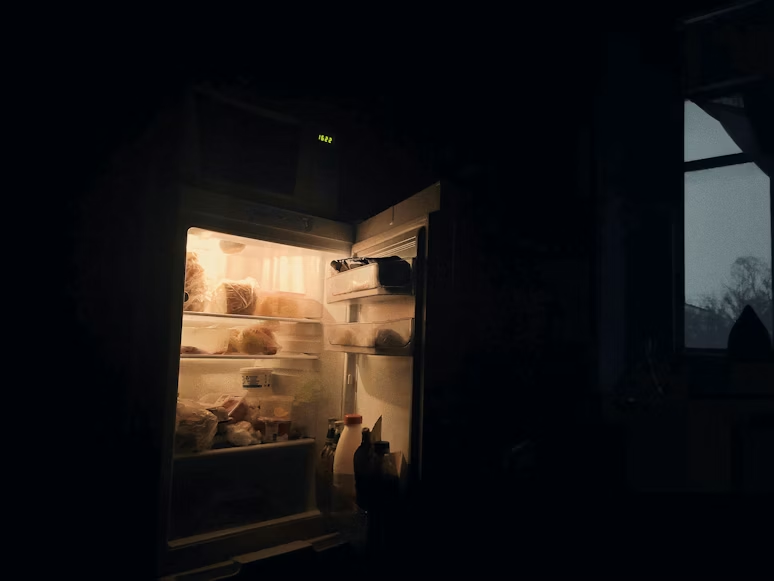
If the grid goes down, your refrigerator instantly becomes the most expensive appliance in your house — because everything inside it starts ticking toward spoilage.
This post contains affiliate links. I may earn a small commission at no extra cost to you. Learn more.
So the real question isn’t just can a solar generator run a refrigerator during a blackout — it’s for how long, and under what conditions?
Food spoilage can begin within hours. Temperature-sensitive medications can become unsafe.
Here are survival foods that last 10+ years without refrigeration during emergencies.
And most homeowners underestimate two critical factors: refrigerator startup surge and daily watt-hour demand.
According to food safety guidelines, if a refrigerator loses power for 4 hours or more, perishable food may no longer be safe unless it has remained below 40°F.
This guide is part of a complete blackout power strategy. For system planning, solar setup, and generator layering, see our complete grid-down power guide.
In this guide, we break down exactly:
- How much power a refrigerator actually uses
- What inverter surge rating you need
- How long 1000Wh, 2000Wh, and 3000Wh systems realistically last
- When solar alone isn’t enough
No guessing. Just practical blackout planning.
Choosing the right generator size matters because refrigerators have startup surges. Our guide on how large a solar generator you need breaks down watt-hours and appliance loads for blackout planning.
⚡ Quick Answer
Yes — a solar generator can run a refrigerator during a blackout if:
- It has at least a 2000W inverter
- Surge rating is 4000W or higher
- Battery capacity is 2000Wh minimum
Anything smaller is unreliable.
If your fridge is full right now, your blackout clock is already running.
If you’re trying to keep a refrigerator running during a blackout, this is where most people stop researching and start choosing. See real-world tested systems here: best solar generators for blackouts.
✅ Do This First (Before You Buy Anything)
- Find your fridge label amps (inside the door) and write it down
- Confirm your inverter surge rating (this is what trips systems)
- Plan your recharge path (solar watts + daylight hours, or hybrid)
- Stop opening the fridge once power drops (it matters more than people think)
🔌 How Much Power Does a Refrigerator Actually Use?
Most modern refrigerators use:
- Running watts: 100–200W
- Startup surge: 600–1200W
- Average daily use: 1,000–2,000 watt-hours (Wh)
Important:
Your fridge does not run constantly. It cycles.
But startup surge is what shuts generators down.
If your inverter can’t handle the surge spike, it trips — even if the battery is full.
⚡ Surge Watts: The #1 Blackout Mistake
When the compressor kicks on:
- A 150W fridge can spike to 900W+
- Older units can spike even higher
So your solar generator must have:
- At least a 2000W inverter output
- Surge capacity above 2000W (ideally 4000W surge rating)
Anything less risks shutdown loops.
This is why “1000W portable stations” often fail for refrigeration.
🔋 How Many Watt-Hours Do You Need?
Let’s break it down by outage length.
Reality check: you won’t get the full battery rating. Plan on 10–15% loss from inverter conversion and overhead.
🧮 Real-World Example: Standard Kitchen Refrigerator
Let’s say you have an 18 cubic foot fridge:
• Running draw: 150W
• Startup surge: ~900W
• Daily energy use: ~1,600Wh
Here’s what that means:
• A 1000Wh unit won’t last a full day
• A 2000Wh unit covers ~24 hours
• A 3000Wh unit gives breathing room
If you add 400W of solar panels, you can recharge during daylight and extend runtime indefinitely under good sun conditions.
This is why 2000Wh is the practical baseline — not the marketing minimum.
🕒 24-Hour Blackout
Average refrigerator daily use:
≈ 1,200–1,800Wh
That means:
- 1000Wh → borderline / likely insufficient
- 1500Wh → risky
- 2000Wh → practical minimum
- 3000Wh → comfortable margin
Real-world takeaway:
A 2000Wh solar generator is the starting point for 24-hour fridge survival.
🧮 Simple Runtime Math (Why 2000Wh Is the Real Baseline)
Most fridges don’t run nonstop—they cycle.
Example:
- Running draw: 150W
- Estimated compressor run time: ~8–10 hours/day (cycling)
- Daily energy: 150W × 9 hours ≈ 1,350Wh/day
- Add inverter loss + warm kitchen reality → ~1,500–1,800Wh/day
That’s why 1000Wh fails, and 2000Wh is the practical minimum.
🕒 48-Hour Blackout
Double the demand.
Now you’re looking at:
≈ 2,400–3,600Wh total
Without solar recharging:
- 2000Wh will not last 48 hours continuously
- You must recharge during daylight
Recommended setup:
- 2000–3000Wh battery
- 400W+ solar panel input
If you’re planning for longer outages, read our Two-Week Power Outage Survival Guide to understand how refrigeration, water, and backup power systems work together during extended grid failures.
🕒 72-Hour Blackout (Multi-Day Scenario)
This is where most people get it wrong.
Three days = 3,600–5,000Wh
Now you need:
- 3000Wh+ battery
- Strong solar recharge plan
- Or hybrid strategy (solar + gas generator)
Battery alone will not carry you.
| Battery Size | Can Run Fridge? | Runtime (No Solar) | Practical? |
|---|---|---|---|
| 1000Wh | Maybe briefly | 6–12 hrs | ❌ Not reliable |
| 1500Wh | Yes | 12–18 hrs | ⚠ Short outages |
| 2000Wh | Yes | ~24 hrs | ✅ Practical minimum |
| 3000Wh | Yes | 24–36 hrs | ✅ Better margin |
Key takeaway:
2000Wh is the real-world baseline.
🌡 Winter vs Summer: The Hidden Variable
In summer:
- Fridges cycle more frequently
- Demand increases
In winter:
- Units cycle less
- Power draw decreases slightly
However, if your home gets cold during a blackout, insulation and door-opening behavior matter more than season.
Practical advice:
Open the fridge less. Use coolers strategically.
🧊 Fridge Survival Rules (Adds Hours of Runtime)
- Set fridge colder now (before storms)
- Freeze water bottles to fill dead air space
- Keep a fridge thermometer inside (target ≤40°F)
- Open once, grab everything, close
- Move critical meds to a small cooler if outages extend (less door-opening)
🏥 What If You’re Also Running a CPAP?
Typical CPAP usage:
- 30–60W
- 250–400Wh per night
Combine that with refrigeration and your 24-hour demand becomes:
1,500–2,200Wh
Now a 2000Wh battery is tight.
If medical devices are involved, 3000Wh gives safer margin.
☀️ Solar Recharging Strategy
A single 100W panel is not a fridge plan. Under real conditions (angle, clouds, winter sun), output is often far below the label rating—so your recharge plan needs real panel wattage, not wishful thinking.
Battery size is only half the plan.
For sustainable multi-day outages:
- 2000Wh → minimum 400W solar
- 3000Wh → 600–800W solar recommended
Winter sunlight dramatically reduces recharge efficiency.
You cannot rely on a single 100W panel to support a refrigerator.
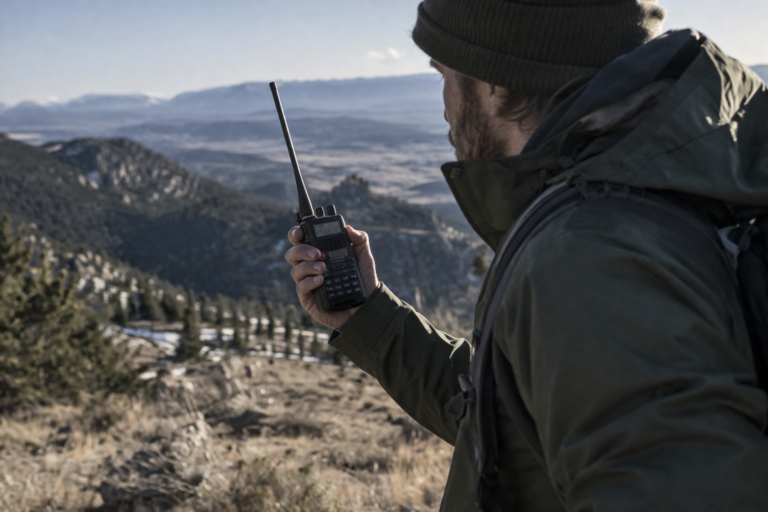
Many blackout kits also include solar radios, which require very little power compared to refrigerators and communication equipment.
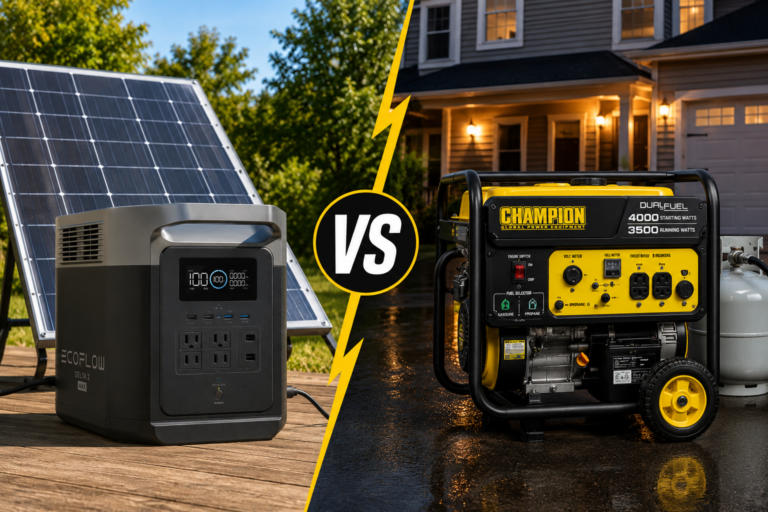
Generator sizing matters because refrigerators have startup surges. Our guide explains how to size a solar generator correctly for blackout situations.
🔥 You Need Hybrid Backup If…
- You’re in a storm-prone area with 2–3 day outages
- Winter sunlight is weak where you live
- You’re powering medical devices
- You can’t get 600W+ of panels deployed quickly
🔄 When Solar Isn’t Enough
Extended storms.
Cloud cover.
Heavy usage.
In those cases, grid-down power strategy wins.
Solar generator handles:
- Nighttime quiet operation
- Indoor safe usage
Gas generator handles:
- Rapid battery recharge
- High-draw appliances
That combination builds real resilience.
🎯 So What Size Do You Actually Need?
For most families during a blackout:
Example Total 24-Hour Load:
- Refrigerator: ~1,600Wh
- CPAP: ~350Wh
- Lights + router: ~250Wh
- Total: ~2,200Wh
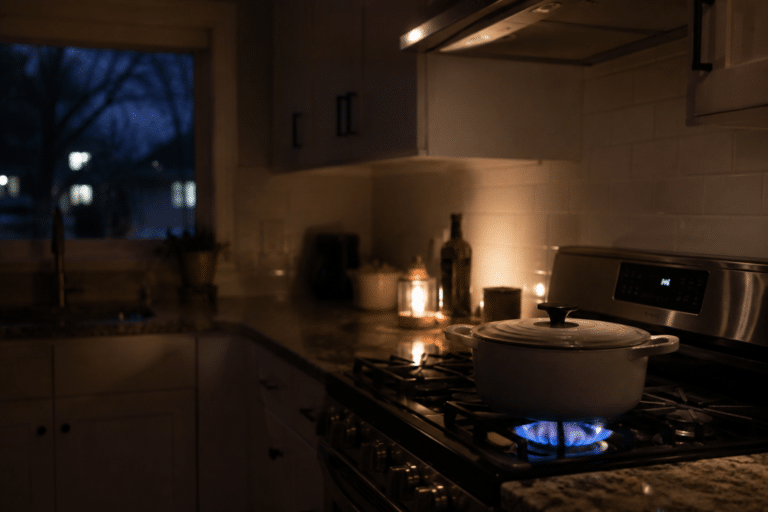
Low-watt emergency lighting can drastically reduce power consumption during outages.
This is why 2000Wh is the floor — not the comfort zone.
- 2000Wh battery
- 2000W inverter minimum
- 400W solar capability
🔹 2000Wh Class (24-Hour Fridge Backup Minimum)
Look for:
• 2000Wh battery capacity
• 2000W inverter output (minimum)
• 4000W surge rating
• 400W+ solar input capability
The practical minimum that actually handles refrigerator surge without shutdown loops.
👉 See top-rated 2000Wh blackout-ready solar generators →
Best Solar Power Stations for Blackouts

🔹 3000Wh Class (Medical Devices + Multi-Day Outages)
Best for:
• Fridge + CPAP
• Fridge + lights + router
• Extended 48–72 hour outages
Look for:
• ~3000Wh battery (usable capacity)
• 3000W inverter (minimum)
• 4000W+ surge rating
• 600–800W solar input capability
👉 See top-performing 3000Wh blackout-ready systems →
Best Solar Power Stations for Blackouts


If running fridge + CPAP + lights + router:
→ Consider 3000Wh.
If multi-day outages are common:
→ Plan hybrid.
⚠️ Common Refrigerator Power Mistakes
- Ignoring surge rating
- Buying 1000Wh thinking it’s enough
- Forgetting inverter losses (10–15%)
- No recharge plan
- Opening fridge constantly
Avoid dangerous backfeeding — here’s how to connect generators safely.
Proper generator grounding is also critical when running appliances during a blackout.
🏷 How to Check Your Refrigerator’s Actual Power Use
Don’t guess.
Open your refrigerator door and look for:
• A manufacturer label listing amps (A)
• Voltage (usually 120V in the U.S.)
Use this formula:
Watts = Volts × Amps
Example:
120V × 1.5A = 180W running draw
This gives you a more accurate sizing baseline than estimates.
❓ Quick FAQ
Can a 1000Wh power station run a refrigerator?
Sometimes briefly—but most fail on either surge rating or runtime.
How long will 2000Wh run a fridge?
Often about ~20–28 hours depending on fridge efficiency, room temp, and door openings.
What surge rating do I need?
Aim for 4000W surge for consistent fridge startup headroom.
Is 400W solar enough for a fridge?
It can be, if sunlight is good and you manage loads—but multi-day resilience usually needs more panel wattage.
What’s the fastest way to size accurately?
Use the fridge label amps (Volts × Amps) and build from daily watt-hours.
🔗 Don’t Guess Your Backup Power
If you haven’t calculated your full blackout load yet, start with:
What Size Solar Generator Do I Need for a Blackout? (Complete 2026 Sizing Guide)
That guide covers:
- Total household watt-hour planning
- Inverter sizing
- Surge calculations
- Multi-device loads
This refrigerator guide is just one piece of the equation.
For full household planning, see our complete blackout sizing guide.
If you’re building a serious blackout plan, these guides will help you go deeper:
- What Size Solar Generator Do I Need for a Blackout?
- Generator Power Connections Made Safe (Avoid the #1 Dangerous Mistake)
- Grid-Down Power Strategy
Don’t size power blindly. Build it correctly once.
The worst time to find out your backup power isn’t enough is when your food is already warming and the grid isn’t coming back anytime soon.