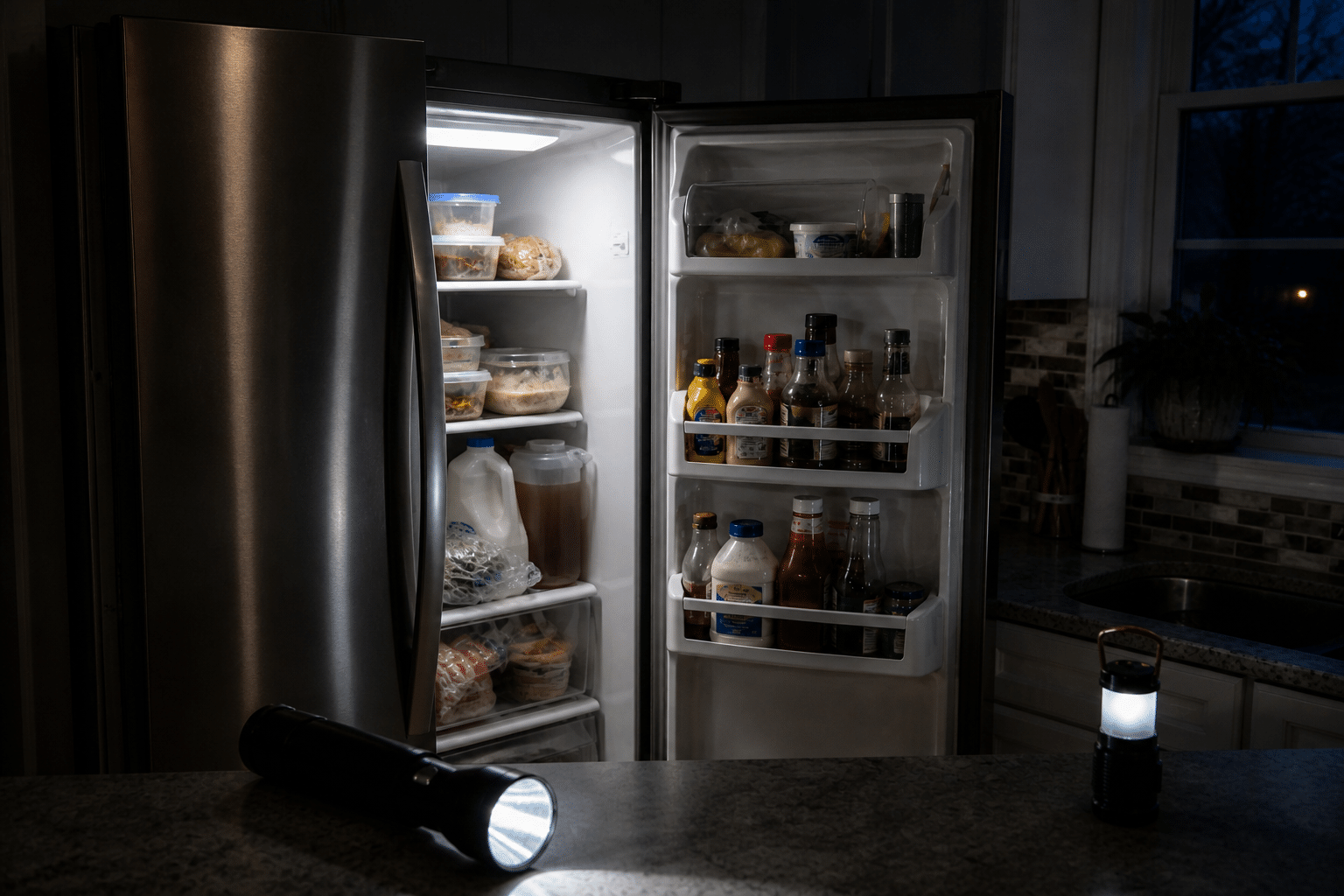
How Long Food Lasts Without Power (Fridge, Freezer & Pantry Breakdown)
How long food lasts without power is one of the most important things to understand during a blackout.
This post contains affiliate links. I may earn a small commission at no extra cost to you. Learn more.
Because the truth is—most people think they have time.
They don’t.
What feels like a short inconvenience—a few hours without electricity—quietly turns into a full-blown food loss situation faster than most people are prepared for. And the worst part is, it doesn’t happen all at once. It happens in stages… and by the time you realize what’s going on, you’re already behind.
Most households underestimate how fast systems begin failing after the grid goes down. See what actually happens during the first 72 hours after a disaster.
Your refrigerator doesn’t just stay cold—and your freezer doesn’t just keep things frozen.
They both start failing the moment the power cuts off.
And if you don’t understand how fast that process happens, you’re left guessing:
- Is this still safe to eat?
- Can I refreeze this?
- How long has it actually been too warm?
- Am I about to waste hundreds of dollars… or risk getting sick?
That uncertainty is exactly what causes people to make bad decisions during a blackout.
If you’re building a complete outage plan, start with our Two-Week Power Outage Preparedness Guide.
Recommended Gear: See our complete Emergency Power & Lighting Gear List for recommended solar generators, backup batteries, thermometers, lanterns, and blackout-ready power systems that help keep food safe during outages.
⚠️ Why This Matters More Than You Think
This isn’t just about spoiled groceries.
When the grid goes down—even temporarily—food becomes one of the first real problems you face.
Within hours:
- Cold storage starts failing
- Perishable food begins breaking down
- Bacteria begins multiplying rapidly
Within a day:
- Most refrigerated food is unsafe
- Freezer contents are at risk
- You’re forced to rely on whatever shelf-stable food you have
And if the outage lasts longer?
You’re no longer managing food—you’re managing survival.
That’s why this topic connects directly to everything else in your preparedness plan.
👉 If you haven’t seen how quickly basic systems fail, read this next:
First 72 Hours After a Disaster: What Actually Happens (And How to Survive It)
Because once power goes out, food is just one piece of a much bigger chain reaction.
🧠 The Hidden Risk: Food That “Looks Fine”
One of the biggest mistakes people make during a power outage is trusting their senses.
If it smells okay, they assume it’s safe.
If it looks normal, they assume it’s fine to eat.
That’s how people get sick.
Bacteria like Salmonella and E. coli infection don’t always give obvious warning signs. Food can be contaminated long before you see or smell anything wrong.
That means:
- You can’t rely on appearance
- You can’t rely on smell
- You can’t rely on “it should still be good”
You need to rely on time and temperature—and that’s exactly what this guide breaks down.
🔍 What You’re Going to Learn
This isn’t guesswork or generic advice. This is a full breakdown of what actually happens when your power goes out.
Inside this guide, you’ll learn:
✔ How long food lasts in your refrigerator after power loss
✔ How long a freezer really holds—and what affects it
✔ Which foods spoil first (and which last longer than expected)
✔ What you can safely keep vs what needs to go immediately
✔ How to stretch your food supply during a blackout
✔ What gear actually makes a difference when the grid goes down
🔗 Where This Fits in Your Survival Plan
Food loss during a power outage doesn’t happen in isolation.
It connects directly to:
- Water supply failures
- Cooking limitations
- Fuel and power availability
- Long-term food storage planning
👉 If you’re building a complete system, this guide pairs directly with:
2-Week Blackout: What You’ll Run Out of First (Most People Get This Wrong)
Because most people don’t run out of food first…
They lose the food they already had.
⚡ The Bottom Line Before We Start
Once the power goes out:
- Your refrigerator starts warming immediately
- Your freezer begins losing its protective buffer
- Your food supply starts shrinking hour by hour
This isn’t something you figure out later.
It’s something you need to understand before it happens.
Now that you understand why this matters…
Let’s break down exactly what happens in real time when the power goes out—and how fast things actually start to fail.
⚠️ Real-Time Breakdown: What Happens in the First 24 Hours Without Power
When the power goes out, the biggest mistake people make is assuming everything stays “basically fine” for a while.
It doesn’t.
What actually happens is a steady temperature climb inside your refrigerator and freezer—and once that climb crosses certain thresholds, food safety drops off fast.
This isn’t random. It follows a predictable timeline.
If you understand that timeline, you stay in control.
If you don’t, you’re guessing—and that’s where people lose food or take risks they shouldn’t.
⏱️ 0–2 Hours: The False Sense of Security
Right after the power goes out, everything feels normal.
- The fridge is still cold
- The freezer still looks solid
- Food appears unchanged
This is where most people relax—and start opening the door to check things.
That’s the first mistake.
Every time you open the refrigerator or freezer, you dump cold air and pull in warm air, accelerating temperature rise inside.
Even during this early window, unnecessary door openings can shave hours off your safe time.
🧊 2–4 Hours: Temperature Starts Climbing
By this point, internal temperatures inside your refrigerator are beginning to rise—slowly, but steadily.
- The fridge is approaching 40°F
- Cold air is no longer being actively circulated
- Sensitive foods are starting to warm
If the door stays closed, you’re still within a narrow safe window.
If it doesn’t, that window closes fast.
🚨 4–6 Hours: The Critical Threshold
This is the turning point.
Once your refrigerator crosses 40°F, food enters what’s known as the danger zone—a temperature range where bacteria multiply rapidly.
From here on out:
- Perishable food is no longer reliably safe
- Bacterial growth accelerates
- Food quality begins to degrade quickly
At this stage, most high-risk foods are already compromised—even if they still look fine.
☠️ 6–12 Hours: Rapid Food Breakdown
Now you’re in the phase where real losses begin.
Inside the refrigerator:
- Meat and poultry are breaking down
- Dairy is warming into unsafe territory
- Leftovers are becoming high-risk
Inside the freezer:
- Ice crystals begin softening
- Food starts losing its frozen core
- Outer layers of food begin thawing
This is where people start making judgment calls—and most of those calls are wrong.
Food can be unsafe long before it looks spoiled.
⚠️ 12–24 Hours: Major Loss Phase
By the time you hit the 12 to 24-hour mark, the situation changes completely.
Refrigerator:
- Most perishable food is unsafe
- Internal temperatures are well above safe levels
- Even “borderline” items should be treated with caution
Freezer:
- A half-full freezer is now at serious risk
- A full freezer may still be holding—but only if unopened
- Thawing becomes widespread in less-insulated areas
This is the point where your cold storage system is no longer reliable.
🚨 After 24 Hours: You’re Transitioning to Survival Mode
Once you pass the 24-hour mark without power:
- The refrigerator is essentially a loss
- The freezer is unstable unless tightly packed and unopened
- You are now relying heavily on non-perishable food
This is where most people realize they weren’t prepared.
And by then, there’s no way to recover what’s already gone.
🧠 Why This Timeline Matters
This isn’t just about “how long food lasts.”
It’s about decision-making under pressure.
If you don’t understand this timeline:
- You open doors too often
- You hold onto unsafe food too long
- You throw away food that could’ve been saved
- You misjudge how much time you actually have
And all of that adds up to lost food, wasted money, and increased risk.
⚠️ The Invisible Danger
Foodborne bacteria don’t wait for obvious signs.
Pathogens like Listeria infection can grow even in conditions that still feel “cool,” and once food enters unsafe temperature ranges, that growth can happen fast.
That’s why time matters more than appearance.
Now that you understand how fast temperatures rise…
We need to break down exactly what that means for your food.
Because not everything spoils at the same rate—and knowing the difference is what saves your food supply.
🧊 Refrigerator Breakdown: What Spoils First (Full Food-by-Food Guide)
Your refrigerator is where most food loss happens—and it happens faster than people expect.
Once temperatures rise above 40°F, you’re no longer preserving food—you’re slowing down spoilage at best. And once that line is crossed, the clock moves fast.
Not all foods fail at the same speed, though.
Some become unsafe within hours.
Others hold slightly longer—but still degrade quickly.
Knowing the difference is what allows you to make the right call when it matters.
☠️ High-Risk Foods (Spoil Fastest — First to Go)
These are the foods you should assume are unsafe after about 4 hours without power.
They are highly perishable, support rapid bacterial growth, and are responsible for most foodborne illness cases during outages.
🥩 Raw Meat & Poultry
- Chicken, turkey, beef, pork
- Ground meats (highest risk)
- Fresh seafood
Raw meat is extremely sensitive to temperature change.
As soon as it rises into the danger zone, bacteria begin multiplying rapidly—and there’s no reliable way to detect that just by looking at it.
Ground meat is especially dangerous because bacteria is distributed throughout the product, not just on the surface.
🥛 Milk & Liquid Dairy
- Whole milk
- Skim milk
- Cream and half-and-half
Milk spoils fast once it warms—and it doesn’t take much temperature change to push it past the safe limit.
Even if it doesn’t smell sour yet, it may already be unsafe.
🧀 Soft Cheeses
- Cream cheese
- Cottage cheese
- Ricotta
- Brie
Soft cheeses contain more moisture, which makes them ideal environments for bacterial growth once refrigeration is lost.
🍲 Leftovers & Cooked Meals
- Cooked meat dishes
- Pasta
- Rice
- Takeout food
These are some of the highest-risk items in your fridge.
They’ve already been cooked, handled, and exposed to air—giving bacteria multiple opportunities to grow once temperatures rise.
🥚 Eggs (Refrigerated)
Eggs rely on consistent refrigeration for safety.
Once they warm up for extended periods, their protective barrier breaks down, increasing contamination risk.
⚠️ Moderate-Risk Foods (Short Grace Period)
These foods may last slightly longer—but they’re not safe for long.
🧈 Butter & Margarine
Butter is more stable than milk due to its fat content, but it still degrades over time when warm.
Short-term exposure may be okay, but extended warmth increases spoilage risk.
🧀 Hard Cheeses
- Cheddar
- Swiss
- Parmesan
Hard cheeses have lower moisture content, which slows bacterial growth.
They may last longer than soft cheeses—but they are not immune to spoilage if temperatures stay elevated.
🥫 Opened Condiments
- Mayonnaise
- Salad dressings
- Cream-based sauces
Once opened, these rely on refrigeration.
Without it, bacteria can develop quickly—especially in products containing eggs or dairy.
✅ Lower-Risk Refrigerator Items (More Forgiving)
These foods are less sensitive to temperature changes and may last longer during an outage.
🥤 Beverages
- Soda
- Juice
- Sports drinks
These are generally stable and safe beyond the initial outage period.
🥬 Certain Fruits & Vegetables
- Apples
- Oranges
- Carrots
- Bell peppers
Whole produce can often survive outside refrigeration for short periods, depending on conditions.
🧂 High-Acid or Preserved Items
- Pickles
- Mustard
- Vinegar-based products
Acidity helps slow bacterial growth, making these more resilient.
🚨 The Real Rule: Time + Temperature = Safety
Forget guessing.
Food safety during a power outage comes down to two things:
- How long it’s been without proper refrigeration
- How warm it has become
Once food sits above 40°F for too long, the risk increases rapidly—even if nothing looks wrong.
This is where bacteria like Salmonella and E. coli infection become a real threat.
Anyone trying to protect refrigerated food during an outage should also use the Emergency Power Planner to estimate realistic backup battery and generator needs before the power goes out.
🔧 Gear That Helps You Make the Right Call
Without a way to monitor temperature, you’re guessing—and guessing is how food gets wasted or becomes dangerous.
A simple thermometer or backup cooling option gives you real data, not assumptions.
These are the exact tools that let you know—without guessing—if your food is still safe.


👉 Most people don’t realize how quickly food disappears during a blackout—this breakdown shows what runs out first:
2-Week Blackout: What You’ll Run Out of First (Most People Get This Wrong)
Now that you know what fails first in your refrigerator…
Let’s look at the one thing that actually buys you time during an outage—your freezer.
Because if you use it right, it can extend your food supply significantly.
❄️ Freezer Breakdown: What You Can Save vs What You Lose
Your freezer is the only thing standing between you and losing your entire food supply during a power outage.
But here’s the problem:
Most people completely misunderstand how long a freezer actually lasts—and what “safe” really means once things start thawing.
A freezer doesn’t stay frozen forever.
It slowly loses ground—and once that process starts, you have a limited window to act.
⏱️ How Long a Freezer Really Lasts Without Power
The timeline depends heavily on one thing:
👉 How full your freezer is
🧊 Full Freezer (Best Case)
- Holds safe temperatures for ~48 hours
- Dense food mass helps retain cold
- Items in the center stay frozen longest
🧊 Half-Full Freezer
- Drops to around 24 hours
- More air space = faster warming
- Uneven thawing begins much sooner
⚠️ Nearly Empty Freezer
- Can begin failing in under 12–18 hours
- Temperature rises quickly
- Very little thermal mass to retain cold
🚨 The Biggest Mistake: Opening the Freezer
Every time you open the freezer:
- Cold air escapes
- Warm air rushes in
- Internal temperature rises faster
Even one or two unnecessary openings can cut your safe time significantly.
If you want your freezer to last—keep it closed.
🧊 What Happens Inside as It Warms
Freezers don’t fail all at once—they fail in layers.
Phase 1: Surface Softening
- Outer layers of food begin to soften
- Ice crystals shrink
- Food still appears mostly frozen
Phase 2: Partial Thaw
- Ice crystals melt in outer areas
- Food becomes soft or slushy
- Temperature rises unevenly
Phase 3: Full Thaw
- Food loses all ice crystals
- Internal temperature rises into unsafe range
- Bacterial growth becomes a serious risk
🥩 What You Can Still Save
Not everything is lost once thawing begins.
Food that is still partially frozen or contains ice crystals is generally safe to keep or refreeze.
✅ Typically Safe to Save (If Still Cold/Frozen)
- Meat (beef, pork, poultry)
- Vegetables
- Frozen meals
- Bread
As long as the food is still cold to the touch and hasn’t fully warmed, it can often be salvaged.
☠️ What You Should Throw Away
Once food has fully thawed and warmed, the risk rises fast.
🚫 High-Risk Thawed Foods
- Raw or cooked meat that is no longer cold
- Seafood (spoils extremely fast)
- Ice cream (if melted, it’s done)
- Dairy-based frozen items
These are not worth risking.
Even if they look okay, bacteria may already be present.
🚨 The Refreezing Rule (What Most People Get Wrong)
Here’s the rule that actually matters:
👉 If it still has ice crystals or is below 40°F — you can refreeze it
👉 If it has fully thawed and warmed — don’t risk it
This is where bacteria like Listeria infection become a serious concern.
Refreezing unsafe food doesn’t “fix” it—it just preserves the problem.
🧠 Why Freezers Buy You Time
Freezers work differently than refrigerators:
- Lower starting temperature
- Denser food storage
- Less air circulation
- Better insulation
All of this slows down temperature rise—but it doesn’t stop it.
Eventually, everything begins to warm.
🔧 Gear That Extends Freezer Survival Time
A properly powered freezer during an outage can extend your food supply by days—or even keep it fully intact.

That’s the difference between a short disruption and a long-term food problem.
👉 If you’re planning for longer outages, you need backup power—this guide breaks down exactly what size you need:
What Size Solar Generator Do I Need for a Blackout?
Refrigerators fail first.
Freezers buy you time.
But when both start going down…
There’s only one thing left to rely on:
👉 Your pantry.
🥫 Pantry Breakdown: The Food That Actually Carries You Through a Blackout
Once your refrigerator fails and your freezer starts losing ground, there’s only one thing left keeping you fed:
👉 Your pantry.
This is where most people either stay in control—or realize they weren’t prepared at all.
Because here’s the truth:
Most households don’t run out of food during a blackout…
They run out of usable food.
Everything they were relying on needed refrigeration.
⚠️ The Shift Most People Don’t See Coming
During the first 24 hours of a power outage:
- You’re still trying to save refrigerated food
- You’re watching the freezer closely
- You’re hoping power comes back on
By 24–48 hours:
- The refrigerator is gone
- The freezer is unstable
- You are now relying almost entirely on shelf-stable food
This is the moment where your pantry stops being “extra food”…
And becomes your primary food supply.
✅ Pantry Foods That Actually Last (No Power Required)
These are the foods that carry you through an outage without relying on refrigeration.
🥫 Canned Goods (Your First Line of Defense)
- Canned meats (tuna, chicken, spam)
- Beans (black beans, kidney beans, lentils)
- Vegetables (corn, green beans, carrots)
- Soups and stews
Canned food is one of the most reliable options because it’s:
- Shelf-stable
- Pre-cooked
- Safe for long-term storage
In a real outage, this is often the first food you start using once refrigerated items fail.
🍚 Dry Staples (Long-Term Backbone)
- Rice
- Pasta
- Oats
- Dry beans
These foods last a long time—but they come with one limitation:
👉 They require water and cooking
That becomes a problem if your water supply is limited or your cooking options are restricted.
👉 If you haven’t planned for that, read this next:
Long-Term Water Storage: The Complete Emergency Guide
🥜 Ready-to-Eat Shelf Foods
- Peanut butter
- Crackers
- Protein bars
- Trail mix
These are critical during outages because they:
- Require no cooking
- Require no refrigeration
- Provide quick calories
This is the kind of food that keeps you going when everything else is down.
🧂 Preserved & High-Acid Foods
- Pickles
- Vinegar-based foods
- Mustard
- Hot sauce
These last longer due to their acidity and preservation methods, making them reliable additions to your pantry.
⚠️ Pantry Foods With Limitations
Not everything in your pantry is built for outages.
Some items fail faster than people expect.
🍞 Bread & Baked Goods
- Molds quickly without refrigeration
- Short shelf life even under normal conditions
🥫 Opened Canned Goods
Once opened, canned food must be eaten quickly.
Without refrigeration, it becomes unsafe much faster.
🍪 Snack Foods
- Chips, cookies, and junk food
- Provide calories—but not much nutrition
These can help short-term but won’t sustain you for long.
🚨 The Real Problem: Most Pantries Aren’t Built for This
Take a look at a typical kitchen pantry.
It’s usually filled with:
- Ingredients—not ready meals
- Snacks—not real sustenance
- Items that require cooking, water, or power
That’s fine for everyday life.
It’s a problem during a blackout.
Because when power is out, you may not have:
- Reliable cooking methods
- Unlimited water
- Time to prepare complex meals
🧠 What Actually Works in a Real Outage
The most valuable pantry foods during a blackout are:
- Ready to eat
- Calorie-dense
- Shelf-stable for long periods
- Easy to portion and ration
This is what allows you to stretch your food supply instead of burning through it.
🔧 Pantry Survival Gear (Backup Food That Actually Works)
These aren’t just “prepper items”—they’re what bridge the gap when your normal food supply fails.

👉 If you don’t already have a solid food supply built for outages, start here:
best survival foods with a long shelf life
👉 If you’re dealing with extreme heat, food safety becomes even more critical:
15 Best Foods to Pack for Hot-Weather Camping
Now you understand:
- What fails first (refrigerator)
- What buys time (freezer)
- What sustains you (pantry)
But there’s still one major problem left:
👉 How do you actually tell if food is still safe to eat?
Because guessing wrong here can cost you more than just food.
🚨 How to Tell If Food Is Still Safe to Eat (Without Guessing)
When the power goes out, one of the hardest decisions you’ll face isn’t what to eat…
It’s whether something is safe to eat at all.
This is where most people get it wrong.
They rely on smell.
They rely on appearance.
They rely on “it should still be okay.”
That’s exactly how people end up getting sick during outages.
Because food doesn’t have to look spoiled to be dangerous.
⚠️ Why You Can’t Trust Smell or Appearance
One of the biggest misconceptions about food safety is that spoiled food always gives clear warning signs.
It doesn’t.
Foodborne bacteria can grow rapidly without:
- Changing the smell
- Changing the texture
- Showing visible signs
That means food can look completely normal—and still make you sick.
Bacteria like Salmonella and E. coli infection thrive in temperatures between 40°F and 140°F, often referred to as the danger zone.
Once food enters that range for too long, it becomes unsafe—even if nothing seems wrong.
⏱️ The Only Rule That Matters: Time + Temperature
Forget guessing.
Food safety during a power outage comes down to two things:
👉 How long the food has been without proper refrigeration
👉 How warm the food has become
If you don’t know both of those, you’re making a blind decision.
🚨 The 4-Hour Rule (Critical for Refrigerated Food)
If perishable food has been above 40°F for more than 4 hours, it should be considered unsafe.
This applies to:
- Meat
- Dairy
- Eggs
- Leftovers
There are exceptions—but unless you have exact temperature data, it’s not worth the risk.
🧊 The Ice Crystal Rule (For Frozen Food)
Frozen food follows a different guideline.
👉 If it still contains ice crystals, it’s usually safe
👉 If it’s fully thawed and warm, it’s not
This is one of the simplest and most reliable checks you can make without specialized tools.
🥩 High-Risk Foods (No Second Chances)
Some foods should never be gambled with once they warm up.
🚫 Do NOT eat if questionable:
- Raw or cooked meat
- Poultry
- Seafood
- Dairy products
- Cooked leftovers
These are the most common sources of foodborne illness during outages.
⚠️ Lower-Risk Foods (More Forgiving)
Some foods are less sensitive and may still be safe depending on conditions.
✅ Safer (but still evaluate carefully):
- Hard cheeses
- Butter
- Whole fruits and vegetables
- High-acid foods (pickles, vinegar-based items)
These don’t spoil as quickly—but they are not immune to contamination.
🧠 When in Doubt, Throw It Out
This isn’t about being overly cautious—it’s about avoiding a problem you can’t afford during an emergency.
Food poisoning during a blackout isn’t just uncomfortable.
It can mean:
- Dehydration
- Weakness
- Inability to function
- Increased risk in an already unstable situation
Pathogens like Listeria infection can be especially dangerous because they can grow even at lower temperatures.
🔧 Tools That Remove the Guesswork
During a power outage, guessing isn’t good enough—you need to know if your food is still safe.
If you can actually measure the temperature, you don’t have to guess whether your food is still safe.

👉 Most people don’t realize how quickly food can go from safe to dangerous—this breakdown shows what fails first during a blackout:
2-Week Blackout: What You’ll Run Out of First (Most People Get This Wrong)
Now you know:
- How fast food spoils
- What lasts longer
- How to tell what’s safe
But there’s one more critical piece most people overlook:
👉 How to actually extend your food supply during an outage
Because once the power is out, what you do next determines how long your food lasts.
🔥 How to Make Your Food Last Longer Without Power
Once the power goes out, you’re not just waiting for it to come back—you’re managing a limited food supply.
Every decision you make from that moment on either buys you time… or costs you food.
And when outages stretch beyond a few hours, those decisions add up fast.
⚠️ Control Starts With Limiting Temperature Loss
The faster your refrigerator and freezer warm up, the faster your food becomes unsafe.
That means your first priority is simple:
👉 Slow down temperature change as much as possible
🚪 Keep Doors Closed
Every time you open your fridge or freezer:
- Cold air escapes
- Warm air enters
- Internal temperature rises faster
What feels like a quick check can cost you hours of safe storage time.
🧊 Consolidate Cold Items
If your freezer isn’t full:
- Move items closer together
- Pack them tightly
- Reduce empty air space
Dense food holds cold longer than air.
❄️ Use Ice to Extend Cooling
If you have access to ice:
- Transfer it into the refrigerator
- Use it to stabilize temperature
- Focus on protecting high-risk foods
Even a small amount of added cold mass can slow the warming process.
🧊 Shift Food Before It’s Too Late
One of the biggest mistakes people make is waiting too long to act.
If power isn’t coming back quickly:
- Move high-risk foods into a cooler early
- Use ice or frozen items to keep temperatures down
- Prioritize meat, dairy, and leftovers
Waiting until everything is already warm limits your options.
🥫 Switch to Pantry Food Sooner
Most people try to stretch refrigerated food too long.
That’s backwards.
👉 The smarter move is to protect it early and switch to shelf-stable food sooner
This allows you to:
- Preserve what can still be saved
- Avoid unnecessary food loss
- Reduce the risk of eating unsafe food
👉 If you need a stronger pantry setup, start here:
Survival Foods With a Long Shelf Life (19 Foods That Last for Years)
⚡ Use Backup Power Strategically
If you have access to backup power:
- Don’t run everything—focus on essentials
- Prioritize refrigerators and freezers
- Use power in intervals if needed
Even limited power can significantly extend food life when used correctly.
👉 Learn how to size your setup here:
What Size Solar Generator Do I Need for a Blackout?
🧠 Think in Phases, Not Hours
Short outages and long outages require different thinking.
⏱️ Short Outage (0–12 Hours)
- Keep doors closed
- Monitor temperatures
- Avoid unnecessary access
⚠️ Medium Outage (12–24 Hours)
- Begin planning for food loss
- Shift high-risk items
- Prepare to rely on pantry food
🚨 Extended Outage (24+ Hours)
- Refrigerator is no longer reliable
- Freezer is declining
- Pantry becomes primary food source
This shift is where preparation either pays off—or exposes gaps.
🚨 The Real Advantage: Being Ready Before It Happens
Once the power is out, your options are limited.
You can’t:
- Go back and stock better food
- Fix poor storage decisions
- Recover food that’s already spoiled
That’s why understanding this now matters.
Because during an outage, you don’t get time to figure it out.
Preparing for blackouts in a small space? See our recommended apartment preparedness gear here.
🔥 Final Takeaway
When the power goes out:
- Your refrigerator fails first
- Your freezer buys time—but not forever
- Your pantry becomes your lifeline
Most people lose food not because the outage was too long…
But because they didn’t understand how fast things break down.
Most people don’t realize they’re unprepared until it’s too late.
If your power went out tonight, would you actually have enough food—and know how to keep it safe?
👉 Start fixing that now:
👉 If you want to be fully prepared for a real blackout scenario, don’t stop here:
2-Week Blackout: What You’ll Run Out of First (Most People Get This Wrong)