How Much Water Does a Family Need for 30 Days?
How much water does a family need for 30 days? The answer depends on family size, climate, activity level, and sanitation needs, but most households require more water than they initially expect.
This post contains affiliate links. I may earn a small commission at no extra cost to you. Learn more.
Water is often the first supply people think about when preparing for emergencies, yet it is also one of the resources that families consistently underestimate. Food receives most of the attention because empty grocery store shelves are easy to imagine, but water shortages can create serious problems much faster than a lack of food. A family can stretch meals, reduce calories, and simplify cooking during a crisis, but there is very little flexibility when it comes to drinking water, sanitation, and basic hygiene.
Understanding how much water a family needs for 30 days is one of the most important parts of building an effective emergency preparedness plan.
Many preparedness guides recommend storing one gallon of water per person per day, but that number is intended as a minimum survival baseline rather than a comfortable long-term planning target. Real-world water consumption is usually much higher once cooking, washing, cleaning, and other daily needs are included. Families who build their emergency plans around the bare minimum often discover that their carefully stored supply would disappear much sooner than expected.
Water becomes even more important during large-scale disruptions. Municipal water systems can continue operating for a period of time during some emergencies, but those systems depend on electricity, treatment chemicals, fuel deliveries, maintenance crews, and functioning infrastructure. As discussed in How Long Will Municipal Water Systems Work During a Blackout?, the length of time water continues flowing from household faucets depends heavily on local conditions and the severity of the event.
For families preparing for extended emergencies, understanding realistic water requirements is one of the most important steps in building a practical preparedness plan. The goal is not simply surviving for thirty days. The goal is maintaining health, sanitation, and daily routines while reducing the stress that comes from watching essential supplies disappear faster than anticipated.
So how much water does a family actually need for thirty days?
The answer depends on family size, climate, activity level, available storage space, and whether additional water sources can be accessed during the emergency. However, once all daily needs are considered, many households discover they require significantly more water than they originally planned to store.
The Minimum Water Requirement Most Families Start With
The commonly cited emergency preparedness guideline recommends storing one gallon of water per person per day. For a family of four, that translates to 120 gallons for thirty days.
At first glance, 120 gallons sounds like a tremendous amount of water. Many people struggle to visualize just how much space that quantity occupies until they begin stacking containers in a garage, basement, closet, or storage room. Yet despite sounding substantial, this recommendation represents only a basic emergency survival target.
The one-gallon guideline generally assumes approximately half of the water will be used for drinking while the remaining portion covers extremely limited food preparation and sanitation needs. Under ideal conditions, it may be enough to sustain life for a short period. The problem is that real emergencies rarely occur under ideal conditions.
Summer heat increases water consumption. Physical labor raises hydration requirements. Children and elderly family members may require special considerations. Medical conditions can increase daily fluid needs. Even simple activities such as preparing dehydrated foods, cleaning cookware, brushing teeth, or washing hands gradually consume more water than many people realize.
Consider a family attempting to live for an entire month on the one-gallon-per-person standard. Every cup used for cooking, every handwashing session, every dish cleaned, and every effort to maintain hygiene draws from that limited reserve. Over time, families often find themselves forced to choose between hydration, cleanliness, and comfort.
That is why experienced preparedness planners frequently treat the one-gallon guideline as the starting point rather than the final goal.
For short disruptions lasting several days, the minimum recommendation may be adequate. For longer emergencies measured in weeks, many households benefit from planning for additional reserves whenever storage space and budget allow.
Breaking Down Water Usage by Daily Activity
Understanding where water actually goes during an emergency provides a clearer picture of what families may need to store. Drinking water usually receives the most attention, but it is only one piece of the equation.
Drinking Water
Most adults require roughly half a gallon to one gallon of drinking water daily depending on temperature, health conditions, and activity levels. Hot weather can push requirements even higher. Children generally consume less, but their needs still add up quickly over the course of a month.
For a family of four, drinking water alone may require sixty to one hundred twenty gallons during a thirty-day period.
Cooking and Food Preparation
Many shelf-stable preparedness foods require water before they can be eaten. Rice, pasta, beans, dehydrated meals, powdered milk, oatmeal, and freeze-dried foods all consume part of the emergency water supply.
Families who rely heavily on stored staples often underestimate how much water will be diverted toward meal preparation. A pantry that appears capable of feeding a household for a month may require dozens of gallons of water simply to make the food usable.
Basic Hygiene
Handwashing becomes critically important during emergencies because illness can spread rapidly when sanitation standards decline. Small amounts of water used repeatedly throughout the day can consume several gallons surprisingly fast.
Maintaining personal hygiene also helps prevent skin irritation, infections, and other health problems that become more difficult to address when medical services are limited.
Cleaning and Sanitation
Dishes, utensils, food preparation surfaces, and temporary sanitation systems all require water. Even families attempting to conserve aggressively often use more water than expected once daily cleaning tasks are included.
As discussed in Emergency Toilet and Sanitation Solutions, sanitation problems tend to grow rapidly during extended emergencies, making water conservation strategies an important part of any preparedness plan.
When these categories are combined, the total requirement often exceeds the basic one-gallon-per-person recommendation, especially during a thirty-day scenario where maintaining health and sanitation becomes increasingly important.
Realistic 30-Day Water Requirements for Different Family Sizes
One of the biggest mistakes families make when planning emergency water storage is focusing only on the minimum survival recommendation instead of calculating what they are likely to use in a real-world situation. While one gallon per person per day provides a useful baseline, most households will consume more once drinking, cooking, sanitation, and basic hygiene are taken into account.
A more realistic planning target for long-term emergencies is often between 1.5 and 2 gallons per person per day. This provides a larger safety margin and allows families to maintain a more sustainable routine during an extended disruption. The exact amount varies based on climate, health conditions, activity levels, and available water sources, but using realistic numbers helps prevent unpleasant surprises later.
The difference between minimum survival requirements and practical preparedness becomes significant over a thirty-day period. Small daily increases in water usage can add up to dozens or even hundreds of additional gallons by the end of the month.
The table below shows minimum and realistic 30-day water storage targets for different household sizes.
| Family Size | 1 Gallon Per Day | 1.5 Gallons Per Day | 2 Gallons Per Day |
|---|---|---|---|
| 1 Person | 30 Gallons | 45 Gallons | 60 Gallons |
| 2 People | 60 Gallons | 90 Gallons | 120 Gallons |
| 4 People | 120 Gallons | 180 Gallons | 240 Gallons |
| 6 People | 180 Gallons | 270 Gallons | 360 Gallons |
Looking at these numbers helps explain why many preparedness experts recommend treating stored water as only one part of a larger water strategy. Even a relatively modest family of four may need between 180 and 240 gallons to maintain a reasonable level of comfort for an entire month. Storing that much water is possible, but it requires planning, space, and a commitment to maintaining the supply over time.
A family living in a hot southern climate may find itself closer to the higher end of these estimates. Increased sweating, outdoor work, storm cleanup, and elevated temperatures can dramatically increase hydration needs. During summer emergencies, water often disappears faster than people expect.
Families with young children should also account for additional sanitation requirements. While children may drink slightly less water than adults, they often create greater cleaning needs, especially during prolonged emergencies when laundry facilities, running water, and normal household conveniences may not be available.
Older adults can present another challenge. Dehydration becomes more dangerous with age, and some medications can increase fluid requirements. A thirty-day emergency plan should account for every member of the household rather than relying on generic averages.
Storage limitations often force families to make practical compromises. Not everyone has room for two hundred gallons of emergency water. Apartment dwellers, renters, and people living in smaller homes frequently have to balance ideal preparedness goals against available space.
That reality is one reason why many experienced preppers combine stored water with backup collection and filtration methods. Rather than attempting to store every gallon they might need for an entire month, they store a substantial reserve while also preparing to obtain additional water if conditions require it.
This layered approach reduces dependence on a single supply source and creates more flexibility during longer disruptions. As discussed in 2-Week Blackout Survival Plan, successful preparedness often involves building multiple layers of redundancy rather than relying entirely on one solution.
The most important takeaway is that every family should perform its own calculations. A retired couple living in a cool climate will have different requirements than a household with four children living in the middle of a humid summer. Understanding your family’s realistic needs provides a far more useful planning target than relying solely on minimum survival recommendations.
How Much Storage Space Does 30 Days of Water Require?
One reason many families delay building a serious water reserve is that the numbers seem overwhelming at first. Storing enough water for thirty days sounds simple on paper, but once people begin calculating actual gallon requirements, they quickly realize that water is heavy, bulky, and requires more storage space than almost any other preparedness supply.
A single gallon of water weighs approximately 8.34 pounds. That means a family storing the minimum recommendation of 120 gallons for thirty days is actually storing more than 1,000 pounds of water. Families aiming for a more realistic target of 180 to 240 gallons could easily be storing between 1,500 and 2,000 pounds.
Weight is rarely a problem when water is distributed throughout a home, garage, basement, or storage building, but it is something to consider when selecting storage locations. Concentrating hundreds of gallons in one small area may place unnecessary stress on floors or shelving systems that were never designed to support that much weight.
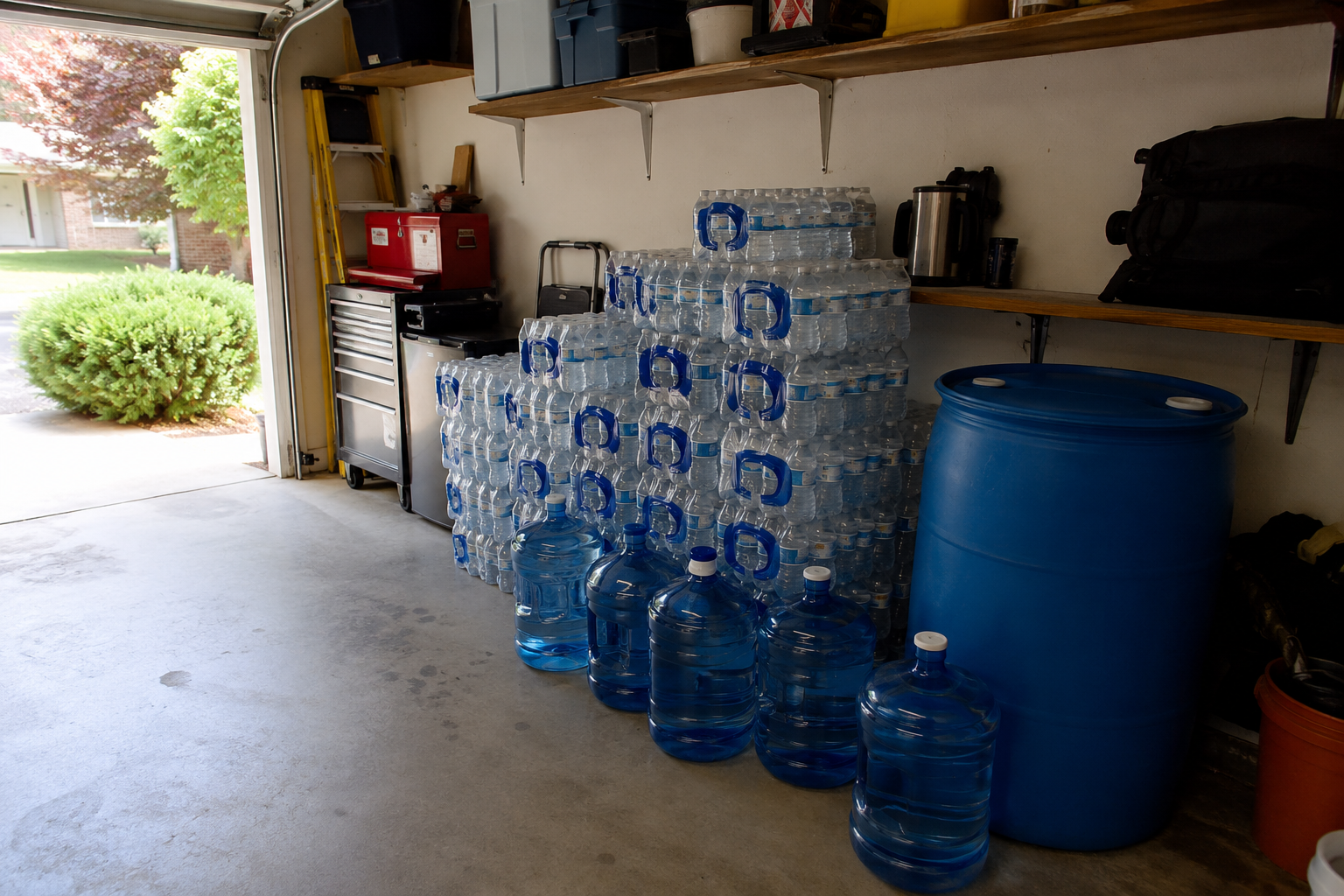
Space requirements often surprise people even more than weight. A standard case of bottled water contains roughly 4.5 gallons. While bottled water is convenient and easy to rotate, storing enough cases for an entire family can quickly consume valuable storage space.
| Water Amount | Approximate Weight | Equivalent 24-Pack Cases |
|---|---|---|
| 30 Gallons | 250 Pounds | 7 Cases |
| 60 Gallons | 500 Pounds | 13 Cases |
| 120 Gallons | 1,000 Pounds | 27 Cases |
| 180 Gallons | 1,500 Pounds | 40 Cases |
| 240 Gallons | 2,000 Pounds | 53 Cases |
Looking at the numbers another way, a family of four attempting to store 240 gallons entirely through bottled water could easily fill a large section of a garage or storage room. While bottled water works well as part of a preparedness strategy, larger containers often provide a more efficient solution for long-term storage.
Five-gallon water containers remain one of the most popular options because they strike a balance between capacity and portability. Most adults can move a filled five-gallon container without specialized equipment, making them practical for both storage and daily use during an emergency.
Water bricks and stackable storage containers offer another advantage for families with limited space. Their rectangular design allows them to fit efficiently beneath beds, inside closets, or along garage walls where traditional round containers may waste valuable storage area.
For households with larger preparedness goals, fifty-five-gallon water drums can dramatically increase storage capacity while reducing the amount of floor space required. Two drums can hold 110 gallons, nearly enough to meet the minimum thirty-day requirement for a family of four. The tradeoff is that once filled, these containers become extremely heavy and are not intended to be moved frequently.
Many families discover that a combination of storage methods works best. Bottled water provides convenience and portability, stackable containers maximize indoor storage space, and larger drums create a substantial reserve capable of supporting longer emergencies.

Storage location matters almost as much as the containers themselves. Water should generally be kept in a cool location away from direct sunlight whenever possible. Excessive heat can shorten the lifespan of certain plastic containers and may affect taste over time. Garages, utility rooms, basements, storage closets, and climate-controlled outbuildings are often suitable locations depending on local conditions.
Families should also avoid concentrating every gallon in one location. Spreading water supplies throughout the home reduces the risk of losing an entire reserve because of leaks, contamination, storm damage, or accessibility problems. During emergencies, redundancy often proves just as valuable as the quantity of supplies stored.
Even households that cannot realistically store two hundred gallons should not become discouraged. Every gallon stored today is one less gallon that must be found during an emergency. Building a water reserve gradually over time is often more practical than attempting to purchase and store an entire month’s supply all at once.
What Happens When Stored Water Runs Out?
Most families spend a great deal of time thinking about how much water they should store, but far fewer spend time considering what happens when that supply eventually runs out. Yet this is exactly the situation many households could face during a prolonged emergency if they underestimate their needs or encounter a disruption that lasts longer than expected.
The first few days after water supplies become limited are usually manageable. Families begin conserving more aggressively, shortening handwashing sessions, using disposable plates, postponing cleaning tasks, and reducing water consumption wherever possible. At first these adjustments seem minor, but they become increasingly difficult as days turn into weeks.
Drinking water quickly becomes the top priority. Human beings can survive for extended periods with reduced food intake, but dehydration begins affecting physical performance, decision-making, energy levels, and overall health much sooner. Headaches, dizziness, fatigue, and impaired concentration often appear before more serious symptoms develop.
As water supplies continue shrinking, sanitation usually becomes the next major concern. Dishes begin accumulating. Laundry becomes difficult or impossible. Handwashing may become less frequent. Bathrooms become harder to maintain. These issues may seem like inconveniences initially, but poor sanitation can eventually create health risks that rival the water shortage itself.
One reason sanitation becomes such a challenge is that many households rely heavily on running water for tasks they barely notice during normal daily life. Flushing toilets, washing hands, cleaning countertops, brushing teeth, rinsing dishes, and preparing meals all require water. When that water supply disappears, even simple routines become more complicated.
Families that have not prepared alternative water sources often find themselves facing difficult decisions. Water that might have been used for hygiene may be redirected toward drinking. Cooking methods may change to reduce water consumption. Some foods may no longer be practical because preparing them requires more water than the household can spare.
The situation becomes even more serious if municipal water service has been interrupted. As explained in When the Faucet Stops Working, This Happens Next, most people are accustomed to unlimited water arriving at the turn of a handle. Once that convenience disappears, the reality of obtaining, transporting, filtering, and conserving water becomes impossible to ignore.
Communities experiencing widespread outages may see increased demand at any remaining water distribution points. Stores that still have bottled water available often sell out quickly, and emergency distribution centers may have long lines, limited supplies, or transportation challenges that make access difficult.
The longer the disruption continues, the more valuable every gallon becomes. A family that initially viewed water as a simple supply item may eventually realize it is the foundation upon which nearly every other preparedness activity depends. Food preparation, hygiene, sanitation, medical care, and even morale become harder to maintain when water is scarce.
Extended blackouts make these challenges even worse because several critical systems can fail simultaneously. As discussed in What Happens After 7 Days Without Power?, longer emergencies often create cascading problems that affect utilities, supply chains, communications, transportation, and public services at the same time. Water shortages rarely occur in isolation.
The good news is that running out of stored water does not necessarily mean running out of water entirely. Families that plan ahead can identify backup sources, purification methods, and collection strategies before an emergency occurs. Those preparations can dramatically extend available supplies and reduce dependence on stored reserves alone.
For this reason, the most resilient preparedness plans do not stop at water storage. They also include methods for obtaining additional water if conditions require it. Stored water buys valuable time, but long-term preparedness often depends on having a strategy for replenishing that supply when the emergency lasts longer than expected.
As discussed in How Fast Society Changes During a Long-Term Power Outage, shortages of essential resources often create secondary problems that extend far beyond the initial emergency.
Ways to Increase Your Water Supply During an Emergency
Even families that invest heavily in emergency water storage should have a plan for obtaining additional water during a prolonged disruption. A thirty-day supply sounds substantial until a heat wave, unexpected guests, medical needs, or a longer-than-expected emergency begins consuming reserves faster than anticipated. The households that handle extended emergencies most effectively are often the ones that combine stored water with multiple backup sources.
The good news is that many homes already contain significant amounts of water that people rarely think about until an emergency occurs. Knowing where to find these hidden reserves can dramatically increase the amount of water available to a household.
Water Heaters Can Hold Dozens of Gallons
One of the largest emergency water sources inside many homes is the water heater. Depending on the model, a residential water heater may contain between forty and eighty gallons of water. For a family that suddenly loses access to municipal water, this reserve can provide several additional days of drinking, cooking, and sanitation water.
The water inside a properly maintained water heater is generally safe because it has already passed through the home’s plumbing system. However, homeowners should become familiar with their water heater before an emergency occurs and understand how to safely access the stored water if necessary.
A forty-gallon water heater alone can provide enough drinking water to significantly extend emergency reserves when used wisely.
Toilet Tanks May Provide Emergency Water
Many preparedness guides mention toilet tanks as a backup water source, and for good reason. The clean water stored in the tank behind the toilet bowl can often be used for sanitation purposes and, in some circumstances, emergency use if it has not been treated with cleaning chemicals.
It is important to understand that this refers to the tank itself, not the water inside the bowl. While the amount available is relatively small, every gallon becomes valuable during an extended emergency.
Most families will not rely heavily on toilet tank water, but it can serve as a useful short-term reserve when combined with other sources.
Rainwater Collection Can Supplement Stored Supplies
Rainwater collection has supported households for centuries and remains one of the most practical methods of increasing available water during emergencies. Even a modest rainfall can produce a surprising amount of water when collected from a rooftop.
A roof measuring one thousand square feet can potentially collect hundreds of gallons from a single significant rain event. The exact amount depends on rainfall totals, roof design, and collection methods, but the potential volume often surprises homeowners.
Collected rainwater should generally be filtered and treated before drinking, particularly if it has contacted roofing materials, gutters, or debris. However, even untreated rainwater can often be valuable for sanitation, cleaning, and other non-drinking purposes.
Families who already have rain barrels or collection systems in place gain a considerable advantage during longer emergencies because they have a renewable source capable of replenishing stored reserves.
Swimming Pools Provide Large Volumes of Water
While pool water is not considered a primary drinking source, it can still serve important functions during emergencies. Many residential pools contain thousands of gallons of water that can be used for flushing toilets, cleaning, basic sanitation, and other non-potable purposes.
By using pool water for tasks that do not require drinking-quality water, families can preserve their treated supplies for hydration and food preparation.
Pool water generally requires specialized treatment before being considered safe for consumption, particularly because of chemical additives. Nevertheless, its value as a sanitation resource should not be overlooked during extended emergencies.
Lakes, Ponds, Rivers, and Creeks
Natural water sources have sustained communities throughout history and may become important emergency resources when stored supplies begin running low. Nearby ponds, streams, creeks, and lakes can provide substantial amounts of water, but they should never be assumed safe simply because the water appears clean.
Bacteria, parasites, agricultural runoff, industrial contamination, and other hazards may be present even in water that looks crystal clear. Every natural source should be treated as potentially contaminated until properly filtered and purified.
Families living near reliable natural water sources often have a significant preparedness advantage, provided they possess the equipment and knowledge necessary to make that water safe.
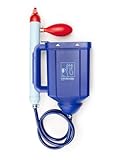
Water Filtration and Purification Are Essential
Finding water is only part of the challenge. Making that water safe to drink is equally important. A family that stores two hundred gallons of water may eventually exhaust its reserves, but a family equipped with quality filtration equipment can continue accessing alternative sources long after stored supplies have been depleted.
Portable water filters, gravity-fed filtration systems, purification tablets, and boiling methods all play important roles in emergency preparedness. The best approach often involves multiple treatment options rather than relying on a single piece of equipment.
As discussed in How Long Will Municipal Water Systems Work During a Blackout?, even communities that continue receiving water service may eventually face boil advisories or water quality concerns if treatment systems become compromised. Having filtration and purification capabilities provides an additional layer of protection regardless of the water source.
The most effective emergency water plans combine storage, collection, and purification. Instead of viewing water as a fixed supply that eventually runs out, families can create a system capable of adapting to changing conditions. That flexibility becomes increasingly valuable as emergencies extend from days into weeks.
Building a Practical 30-Day Water Plan for Your Family
Creating a thirty-day water plan does not require storing hundreds of gallons overnight. In fact, most successful preparedness plans are built gradually over time. Families who attempt to do everything at once often become overwhelmed by the cost, storage requirements, and logistics involved. A more practical approach is to establish achievable goals and expand water reserves in stages.
The first step is calculating the actual number of people who will depend on the supply. Every family member should be included, along with pets and any relatives who might temporarily join the household during an emergency. Many preparedness plans fail because they underestimate how many people may ultimately rely on the available resources.
Once household size has been established, calculate a minimum water requirement and a preferred water requirement. For example, a family of four might identify 120 gallons as the minimum survival target while aiming for 180 to 240 gallons as a more realistic long-term preparedness goal. Having both numbers creates flexibility and helps prioritize future purchases.
Storage should then be divided among multiple locations and container types. Cases of bottled water can provide immediate access for drinking and evacuation purposes, while larger containers can serve as long-term reserves. Spreading supplies throughout the home also reduces the risk of losing everything because of leaks, contamination, storm damage, or other unexpected problems.
Families should also develop a rotation schedule. While properly stored water can remain usable for long periods, regularly inspecting containers for leaks, damage, or contamination helps ensure the supply remains dependable when needed. A water reserve only provides security if it remains accessible and safe to use.
Backup water sources should be identified before an emergency occurs. Water heaters, rainwater collection systems, nearby ponds, streams, and other potential sources should be evaluated in advance rather than during a crisis. Knowing where additional water can be obtained may be just as important as the amount currently stored.
Every water plan should include purification methods as well. Storage alone addresses only part of the challenge. Filters, purification tablets, boiling methods, and other treatment options help ensure families can safely utilize alternative water sources if stored supplies begin running low.
It is also wise to periodically practice using emergency water supplies. Many families discover weaknesses in their plans only after attempting to live from stored resources for several days. Small practice exercises can reveal storage problems, unrealistic consumption estimates, or equipment issues while conditions are still comfortable and manageable.
As discussed in 2-Week Blackout Survival Plan, preparedness is often less about having perfect supplies and more about creating practical systems that can adapt to changing circumstances. Water planning follows the same principle. A family that understands its needs, maintains reasonable reserves, and has multiple backup options will generally be far better prepared than one that relies entirely on a single source.
The goal is not perfection. The goal is ensuring that a temporary disruption does not immediately become a crisis because one of life’s most essential resources is unavailable.
Frequently Asked Questions
How much water does a family of four need for 30 days?
Using the minimum emergency recommendation, a family of four needs 120 gallons of water for 30 days. Many preparedness experts recommend planning for 180 to 240 gallons to account for drinking, cooking, and sanitation needs.
Is one gallon of water per person per day enough?
One gallon per person per day is generally considered a minimum emergency recommendation. Families often require more during hot weather, periods of physical activity, or extended emergencies.
How long does stored water last?
Commercially bottled water can last for years when stored properly. Water stored in food-grade containers should be inspected regularly and kept in a cool, dark location.
What is the best emergency water source after stored water runs out?
Rainwater collection, water heaters, and properly filtered natural water sources are among the most common backup options for emergency water supplies.
Final Thoughts
Water is the foundation of every emergency preparedness plan. Food, medical supplies, communication equipment, backup power, and survival gear all have value, but none can replace a dependable supply of clean water. That reality becomes increasingly apparent as emergencies extend beyond a few days and normal services become less reliable.
While the commonly recommended guideline of one gallon per person per day provides a useful starting point, many families will require considerably more when drinking, cooking, hygiene, and sanitation needs are considered. A household that plans for realistic consumption levels is far less likely to face difficult decisions later.
The most effective strategy combines stored water with backup collection and purification methods. By building multiple layers of redundancy, families gain the flexibility needed to handle disruptions that last longer than expected. Whether the emergency involves a natural disaster, infrastructure failure, severe weather, or a prolonged blackout, access to clean water remains one of the most important factors influencing comfort, health, and overall resilience.
Every gallon stored today reduces uncertainty tomorrow. Even small improvements made consistently over time can create a water reserve capable of supporting a family through situations that leave many others unprepared.