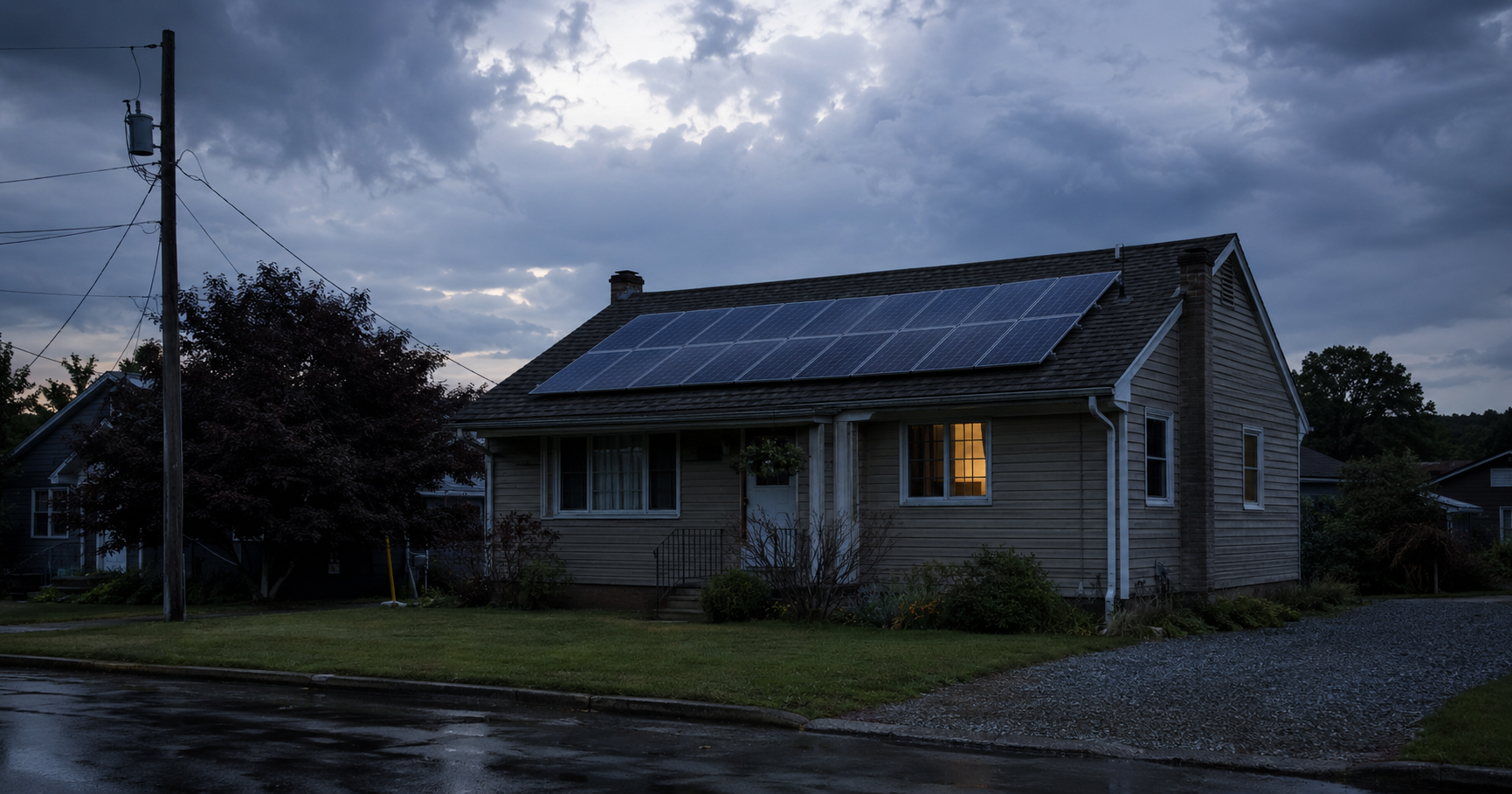
How Many Solar Panels Do You Need to Power Your Home During an Outage?
How many solar panels to power a house during an outage? The answer depends on what you expect to keep running. A system designed to operate a refrigerator, freezer, lights, internet equipment, and a few small devices will need far fewer panels than one expected to run central air conditioning, an electric water heater, a well pump, and other large appliances.
This post contains affiliate links. I may earn a small commission at no extra cost to you. Learn more.
For many households, the smartest approach is not trying to maintain normal electricity use. It is identifying essential loads, calculating how much energy they consume each day, and building a solar backup system around those needs. This can substantially reduce the number of panels, batteries, and inverter capacity required.
Solar panels are also only one part of the system. Most ordinary grid-tied solar installations automatically shut down when the electrical grid fails. To continue supplying electricity safely, the home generally needs battery storage, an outage-capable inverter, and equipment that isolates the backup system from utility lines.
Quick Answer
A home using modern 400-watt panels may need approximately 8 to 12 solar panels for basic outage essentials, 15 to 24 panels for a larger partial-home backup system, or 24 to 36 or more panels to replace something close to normal household electricity use.
These are only initial planning ranges. The actual number depends on daily energy consumption, available sunlight, system efficiency, battery capacity, and whether the household expects to operate high-demand appliances such as central air conditioning, electric heat, an electric water heater, or a clothes dryer.
Key Takeaways
- Solar-panel requirements should be based on daily energy consumption, not just the wattage of the appliances.
- Running only essential loads can dramatically reduce the size and cost of a backup system.
- Most standard grid-tied solar systems cannot power a home during an outage without additional backup equipment.
- Battery capacity determines how long the home can operate after sunset or during poor weather.
- Motors and compressors may require much more power when starting than they use while running.
- Cloud cover, shade, panel direction, seasonal sunlight, and conversion losses must be included when sizing the system.
Can Solar Panels Power a Home During an Outage?
Solar panels can power a home during an outage, but only when the solar system is specifically designed to operate without the electrical grid. Simply having rooftop panels does not guarantee that electricity will remain available when utility service fails.
Most conventional grid-tied solar systems use an inverter that depends on the utility grid to operate. When the grid goes down, the inverter automatically shuts off the solar system. This safety feature, known as anti-islanding protection, prevents electricity from being sent onto utility lines while crews may be repairing them.
A backup-capable solar system requires additional equipment that safely disconnects the home from the grid. Depending on the system, this may include:
- Solar panels that generate electricity during daylight
- A hybrid or grid-forming inverter capable of operating independently
- A battery bank that stores electricity for later use
- A transfer switch, backup gateway, or similar isolation equipment
- A critical-load panel that supplies selected household circuits
Once the utility connection has been isolated, the inverter creates a small independent electrical system for the home. The solar panels can power connected appliances while sunlight is available and use excess production to recharge the batteries. The batteries then supply electricity at night, during heavy cloud cover, or whenever household demand exceeds current solar production.
A few specialized systems can provide limited daytime electricity without a battery, but their output changes with sunlight and may be restricted to certain circuits or outlets. They are not as dependable as solar paired with storage, particularly for refrigerators, well pumps, medical equipment, and other loads that must continue operating consistently.
The more important question is therefore not whether solar panels can power a house, but how much of the house the system needs to power. Keeping essential appliances running is achievable with a much smaller system than attempting to maintain normal whole-home electricity use.
What Determines How Many Solar Panels You Need?
The number of solar panels needed during an outage cannot be determined from home size alone. Two houses of the same size may have completely different electricity requirements depending on their appliances, heating and cooling systems, water source, and how carefully the occupants conserve power.
The following factors have the greatest effect on the final panel count:
Daily Energy Consumption
Daily energy use is measured in watt-hours or kilowatt-hours. A 100-watt appliance running for five hours consumes 500 watt-hours, or 0.5 kilowatt-hours. The total energy used by all connected appliances must be replaced by the solar panels each day if the system is expected to continue operating.
Solar-Panel Wattage
Higher-wattage panels produce more electricity under the same conditions. For example, fewer 400-watt panels would be required than 250-watt panels. However, the wattage printed on a panel represents its rated output under controlled test conditions, not what it will produce continuously on a roof or in a backyard.
Peak Sun Hours
Peak sun hours measure the equivalent number of hours when sunlight reaches an intensity of approximately 1,000 watts per square meter. An area may receive ten or more hours of daylight but only four or five peak sun hours of useful solar production.
Real-World System Losses
Heat, wiring, inverter conversion, battery charging, dirt, panel angle, and partial shade all reduce usable production. A reasonable planning estimate is often 70% to 80% of the panels’ theoretical output.
Battery Capacity and Charging Needs
The panels must supply current household loads while also replacing energy removed from the batteries overnight. An undersized array may power appliances during the day but fail to recharge the batteries before sunset.
Large Household Loads
Central air conditioning, electric heat, water heaters, clothes dryers, electric ranges, and well pumps can substantially increase system requirements. Appliances with motors also have startup surges that affect the inverter size, even when their normal running wattage appears manageable.
These factors must be evaluated together. Adding panels without enough battery storage or installing a large battery bank without enough solar charging capacity can leave the system unbalanced and unreliable.
Decide What You Actually Want to Power
Before calculating the number of solar panels, decide which appliances and circuits must remain available during an outage. Trying to power everything normally can turn a manageable backup system into an extremely large and expensive project.
Most households can place their outage electricity needs into one of three levels:
- Essential loads only: Refrigerator, freezer, a few lights, phones, internet equipment, and limited water-pump operation.
- Expanded essentials: Essential loads plus a television, computers, microwave, additional lighting, or a small window air conditioner.
- Near whole-home operation: Most normal household loads, potentially including central air conditioning, electric cooking, water heating, laundry equipment, and multiple large appliances.
The table below provides general planning estimates. Actual consumption should be verified using the appliance label, manufacturer information, a plug-in watt meter, or readings from a home energy-monitoring system.
| Appliance or Device | Estimated Running Watts | Estimated Daily Use | Estimated Daily Energy |
|---|---|---|---|
| Refrigerator | 100–200 watts | 8 hours of compressor operation | 0.8–1.6 kWh |
| Chest or upright freezer | 100–200 watts | 6–10 hours of compressor operation | 0.6–2.0 kWh |
| LED lighting | 40–100 watts total | 5 hours | 0.2–0.5 kWh |
| Modem and router | 10–25 watts | 24 hours | 0.24–0.6 kWh |
| Well pump | 750–2,000 watts | 1 hour total | 0.75–2.0 kWh |
| Window air conditioner | 500–1,200 watts | 8 hours | 4.0–9.6 kWh |
| Microwave | 1,000–1,500 watts | 15 minutes | 0.25–0.38 kWh |
A basic essential-load plan may consume approximately 5 to 10 kWh per day. Adding air conditioning, frequent well-pump use, cooking appliances, or other comforts can raise consumption to 15 to 30 kWh per day. Attempting to operate an all-electric home normally may require considerably more.
Reducing consumption is often cheaper than adding more panels and batteries. During an extended outage, using propane for cooking, limiting air-conditioning hours, heating water by another safe method, and running large appliances one at a time can make a smaller solar system far more practical.
How to Calculate the Number of Solar Panels You Need
The most reliable way to estimate solar-panel requirements is to calculate how much energy the selected appliances consume each day. Panel wattage alone does not show how much electricity a system will produce because solar output changes throughout the day.
Use the following formula for an initial estimate:
Number of panels = Daily energy needed in watt-hours ÷ (Panel wattage × Peak sun hours × System efficiency)
Step 1: Calculate Daily Energy Consumption
Multiply each appliance’s running wattage by the number of hours it will operate per day. Then add the results together.
For example, an appliance using 150 watts for eight hours consumes:
150 watts × 8 hours = 1,200 watt-hours, or 1.2 kWh per day
Repeat this calculation for every appliance and device included in the outage plan. Appliances that cycle on and off, such as refrigerators and freezers, should be calculated using their estimated compressor-running time rather than assuming they operate continuously.
Step 2: Find Your Peak Sun Hours
Peak sun hours vary by location and season. For an initial estimate, many parts of the United States receive approximately four to five peak sun hours per day, although winter production may be considerably lower in some regions.
Use the expected conditions during the season when an outage is most likely. Designing around excellent summer sunlight may leave the system undersized during winter or several cloudy days.
Step 3: Account for System Losses
No solar system delivers 100% of its theoretical output. A practical planning estimate is to multiply expected production by 0.70 to 0.80. Using 0.75 assumes that approximately 75% of the panels’ rated production becomes usable energy after common losses.
Step 4: Divide by the Output of One Panel
Suppose a household needs 10,000 watt-hours, or 10 kWh, of electricity each day. The system will use 400-watt panels, receive 4.5 peak sun hours, and operate at an estimated 75% overall efficiency.
10,000 Wh ÷ (400 watts × 4.5 hours × 0.75) = 7.4 panels
Because partial panels cannot be installed, the result must be rounded up to at least eight panels. That produces a rated array size of:
8 panels × 400 watts = 3,200 watts, or 3.2 kW
Eight panels represent the mathematical minimum under the conditions used in the calculation. Increasing the system to nine or ten panels would provide a more practical buffer for weaker sunlight, aging panels, unexpected appliance use, and the need to recharge batteries after a cloudy day.
This formula estimates energy production, but it does not determine the required inverter output or battery capacity. Those parts of the system must be calculated separately based on simultaneous running loads, startup surges, overnight consumption, and the desired amount of reserve power.
Solar-Panel Estimates for Different Outage Plans
The following estimates use 400-watt solar panels, 4.5 peak sun hours per day, and 75% real-world system efficiency. Under those conditions, one panel would produce approximately:
400 watts × 4.5 peak sun hours × 0.75 efficiency = 1,350 watt-hours, or 1.35 kWh per day
The practical ranges include additional capacity for weaker sunlight, higher-than-expected consumption, and battery recharging. They should be treated as planning estimates rather than final system designs.
| Outage Plan | Estimated Daily Energy | Calculated Minimum | Practical Planning Range | Possible Loads |
|---|---|---|---|---|
| Minimum emergency power | 3–5 kWh | 3–4 panels | 4–6 panels | Refrigerator, lights, phones, radio, and limited internet use |
| Basic essentials | 5–10 kWh | 4–8 panels | 8–12 panels | Refrigerator, freezer, lighting, electronics, internet, and limited well-pump use |
| Expanded essentials | 10–15 kWh | 8–12 panels | 10–14 panels | Essentials plus television, computers, microwave, fans, and additional water use |
| Larger partial-home backup | 15–25 kWh | 12–19 panels | 15–24 panels | Essentials plus a window air conditioner, more frequent pump use, and selected kitchen appliances |
| Near-normal household use | 25–40 kWh or more | 19–30 or more panels | 24–36 or more panels | Most household circuits, depending on heating, cooling, cooking, and water-heating loads |
Basic Outage Essentials
A system with approximately 8 to 12 modern panels may be enough for a carefully managed essential-load plan. This could keep cold food protected, provide lighting and communications, recharge devices, and operate a well pump for limited periods. The household would still need to avoid running several large appliances simultaneously.
Partial-Home Backup
Approximately 15 to 24 panels may support a more comfortable outage plan that includes essential appliances, more frequent water use, cooking equipment, and limited air conditioning. Energy conservation would still be important, especially after cloudy days or when the batteries begin the morning at a low charge.
Near Whole-Home Backup
A system intended to maintain something close to normal household use may require 24 to 36 panels or considerably more. Central air conditioning, electric resistance heat, electric water heating, and vehicle charging can push consumption far beyond these ranges.
Large loads do not all affect the system in the same way. A well pump may run for only a short time each day but require a powerful inverter to handle its startup surge. An air conditioner may have a similar startup concern while also consuming electricity for many hours. Electric heat can create a sustained load that is difficult to support with residential solar during short winter days.
For most outage plans, reducing or temporarily replacing the largest electrical loads provides more value than adding enough panels and batteries to operate the home exactly as usual.
How Much Battery Storage Do You Need?
Solar panels determine how much electricity can be produced during daylight, while battery capacity determines how long the home can continue operating when production falls below demand. A large solar array paired with a small battery may generate plenty of daytime electricity but leave the home without power several hours after sunset.
Battery storage is normally measured in kilowatt-hours. This describes the amount of energy the battery can hold. It should not be confused with the battery’s output rating, which determines how much power it can deliver at one time.
Calculate Overnight Energy Use
Begin by estimating how much electricity will be consumed between the end of useful solar production and the following morning. This may include the refrigerator, freezer, lights, internet equipment, fans, medical devices, and other appliances that cannot be turned off overnight.
Suppose an essential-load plan consumes 10 kWh per day, with approximately 6 kWh used after the panels stop producing enough electricity. The battery must provide at least that amount of usable energy.
However, the battery’s advertised capacity may not all be available. Some energy is lost through the inverter, and the battery may have a recommended discharge limit. If the battery allows 90% usable capacity and the inverter operates at approximately 90% efficiency, the required rated capacity would be:
6 kWh ÷ (0.90 usable capacity × 0.90 inverter efficiency) = 7.4 kWh
Rounding up, an approximately 8 kWh battery bank would cover the estimated overnight use under favorable conditions. A larger battery would provide additional protection against unexpected consumption and poor solar production the following morning.
Plan for More Than One Day When Possible
A battery sized only for one night assumes the panels can recharge it the next day. Several hours of rain, heavy cloud cover, snow, or shade can prevent that from happening.
Providing one full day of stored energy for the same 10 kWh outage plan would require approximately 12.4 kWh of rated storage after allowing for the same discharge and inverter losses. Two days of energy would require roughly twice that amount.
More battery storage increases resilience, but it also requires enough solar capacity to recharge the larger bank. If the panels produce only slightly more electricity than the home consumes during daylight, recovering from a deeply discharged battery could take several days.
Battery Capacity Does Not Guarantee Enough Output
A battery may hold enough total energy to operate a well pump or air conditioner, yet still be unable to deliver the high startup power those appliances require. Battery discharge limits and inverter output must be checked separately from storage capacity.
For a more detailed estimate, use the Battery and Power Station Runtime Calculator to compare usable battery energy, appliance consumption, running load, and startup wattage.
Inverter and System Equipment Requirements
Panel count and battery capacity are only part of a reliable solar backup system. The inverter and electrical equipment must also be capable of supplying the home’s running loads, handling appliance startup surges, and safely separating the home from the utility grid.
Continuous Inverter Output
The inverter’s continuous output must be greater than the combined wattage of all appliances that may operate at the same time. If a refrigerator, freezer, well pump, microwave, and several lights could run together, their wattages must be added before selecting the inverter.
Managing appliances can reduce the required inverter size. For example, waiting until the well pump stops before using a microwave or other high-wattage appliance prevents unnecessary load stacking.
Startup Surge Capacity
Motors and compressors may briefly require two to five times their normal running wattage when starting. Refrigerators, freezers, well pumps, sump pumps, and air conditioners are common examples.
The inverter must have enough surge capacity to start the largest motor while continuing to operate other connected loads. A system that looks large enough based only on running watts may shut down whenever a pump or compressor starts.
Voltage Requirements
Many smaller inverters and portable power stations provide only 120-volt electricity. Homes with a 240-volt well pump, central air conditioner, electric range, clothes dryer, or other large equipment need an inverter system specifically designed to provide the correct voltage and split-phase output.
Backup Isolation Equipment
An outage-capable installation may also require a hybrid or grid-forming inverter, charge controller, backup gateway, transfer equipment, and a protected-load panel. Some modern systems combine several of these functions into one unit, while others use separate components.
A critical-load panel allows selected circuits to receive backup power while leaving high-demand circuits disconnected. This can prevent electric heat, water heaters, dryers, and other major loads from draining the batteries unexpectedly.
Never Backfeed a Home Electrical System
Do not connect solar panels, an inverter, or a portable power station to a household outlet in an attempt to energize the home. Improvised backfeeding can cause electrocution, fire, damaged equipment, or dangerous voltage on utility lines. Permanent home-connected solar backup equipment should be properly permitted and installed according to the manufacturer’s instructions and applicable electrical requirements.
The correct inverter is therefore determined by more than the total number of panels. It must match the battery system, solar-array voltage, household voltage, simultaneous running load, motor-starting requirements, and method used to isolate the home from the grid.
Grid-Tied, Hybrid, and Off-Grid Solar Systems
The type of solar system determines whether the panels can provide electricity during an outage. Systems that appear similar from the roof may operate very differently after utility power fails.
| System Type | Works During an Outage? | Battery Storage | Important Limitation |
|---|---|---|---|
| Standard grid-tied | Normally no | Usually not included | The inverter shuts down when the utility grid fails. |
| Hybrid solar with storage | Yes, when configured for backup operation | Normally included | Backup is limited by battery capacity, inverter output, and protected circuits. |
| Off-grid solar | Yes | Required for dependable operation | There is no utility grid available when solar production and stored energy are insufficient. |
A standard grid-tied system is primarily designed to reduce electricity purchased from the utility. It is not automatically a backup-power system, even if the roof contains enough panels to meet the home’s annual electricity use.
A hybrid system combines grid-connected solar with backup-capable controls and battery storage. Depending on its design, it may supply only a protected-load panel or most of the home. Not every inverter marketed as “hybrid” is installed or configured to provide outage power, so backup capability must be confirmed.
An off-grid system operates independently at all times. Because no utility power is available as a fallback, it normally requires more battery storage, additional solar capacity, stricter energy management, and often a generator for extended periods of poor weather.
How Weather and Seasons Affect Panel Count
Solar panels do not produce the same amount of electricity every day. The formula used earlier provides a useful starting point, but the final panel count should account for seasonal sunlight, cloud cover, shading, temperature, and the physical condition of the array.
Peak Sun Hours Change Throughout the Year
Many locations receive substantially fewer peak sun hours during winter than during summer. Shorter days, a lower sun angle, and more frequent cloud cover reduce daily production. A system designed using excellent summer conditions may struggle to recharge its batteries during a winter outage.
If dependable year-round backup is the goal, use the average peak sun hours for the weakest likely season rather than the annual average. This normally produces a larger but more reliable solar array.
Cloudy Weather Reduces Charging
Solar panels can still generate electricity beneath clouds, but production may fall sharply depending on cloud thickness and storm conditions. Several cloudy days can create an energy deficit even when the battery bank was fully charged at the beginning of the outage.
Additional panels can improve charging during weaker conditions, but they cannot guarantee normal output during severe weather. Battery reserves, reduced consumption, or a safely connected generator may still be necessary for a prolonged outage.
Shade, Panel Direction, and Dirt Matter
Tree branches, nearby buildings, roof features, and even small shaded areas can reduce production. Panels generally perform best when they receive direct sunlight during the strongest part of the day and are installed at an appropriate direction and angle for the location.
Dust, pollen, leaves, snow, and debris can also lower output. High panel temperatures may reduce efficiency even on a clear summer day, while cold panels can perform efficiently but still produce less total daily energy because winter sunlight is limited.
For outage planning, increasing the calculated minimum array by approximately 20% to 30% can provide useful protection against ordinary production losses. More may be required where winter sunlight is weak or shade cannot be avoided.
The Solar Panel Charging Calculator can estimate daily charging production using panel wattage, peak sun hours, efficiency, battery capacity, and power consumed while charging.
Rooftop Solar vs. Portable Solar Panels
Rooftop and portable solar panels can both provide useful electricity during an outage, but they serve different purposes. The better option depends on how much of the home must be powered and whether the system will be permanently connected to household circuits.
Rooftop Solar Systems
A permanent rooftop or ground-mounted array is generally the better choice for partial-home or whole-home backup. These systems can support a much larger number of panels and may be connected to a hybrid inverter, battery bank, backup gateway, and protected-load panel.
Permanent systems also operate without requiring panels to be unfolded, carried outside, or repositioned throughout the day. Their disadvantages include higher installation costs, permitting requirements, fixed panel placement, and the need for properly designed electrical equipment.
Portable Solar Panels
Portable panels work well for charging a portable power station or smaller battery system. They can be moved into direct sunlight, stored safely when not needed, and used by renters or households that cannot install rooftop panels.
However, portable arrays are normally too small to maintain ordinary whole-home electricity use. They are better suited for refrigerators, freezers, lights, communication devices, fans, medical equipment, and other selected essentials.
The power station or charge controller also limits how many portable panels can be connected. A power station with a 500-watt maximum solar input cannot use the full production of a 1,200-watt array, even if the connectors fit. Panel voltage, current, polarity, and connection arrangement must remain within the equipment manufacturer’s specified limits.
For many households, a portable solar generator provides an affordable entry point for basic outage power, while a permanent solar-plus-storage system is more appropriate when the goal is to operate household circuits or large 240-volt equipment.
Recommended Backup-Power Setup by Household Goal
The best solar backup system is the smallest one that can reliably operate the loads the household has identified as necessary. These three general setups provide practical starting points.
Basic Emergency Power
For a refrigerator, lights, phones, internet equipment, and a few small devices, consider approximately 4 to 6 panels rated at 400 watts each, 3 to 7 kWh of battery storage, and a 2,000- to 3,000-watt inverter. This system would require careful load management and would not normally support large 240-volt appliances.
Expanded Essential Loads
A household that also needs a freezer, well pump, microwave, fans, television, or limited air conditioning may need approximately 8 to 14 panels, 8 to 15 kWh of battery storage, and a 4,000- to 7,200-watt inverter. A 120/240-volt system may be required for a well pump or other large equipment.
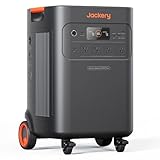
Backup-Power Option: Jackery Explorer 5000 Plus
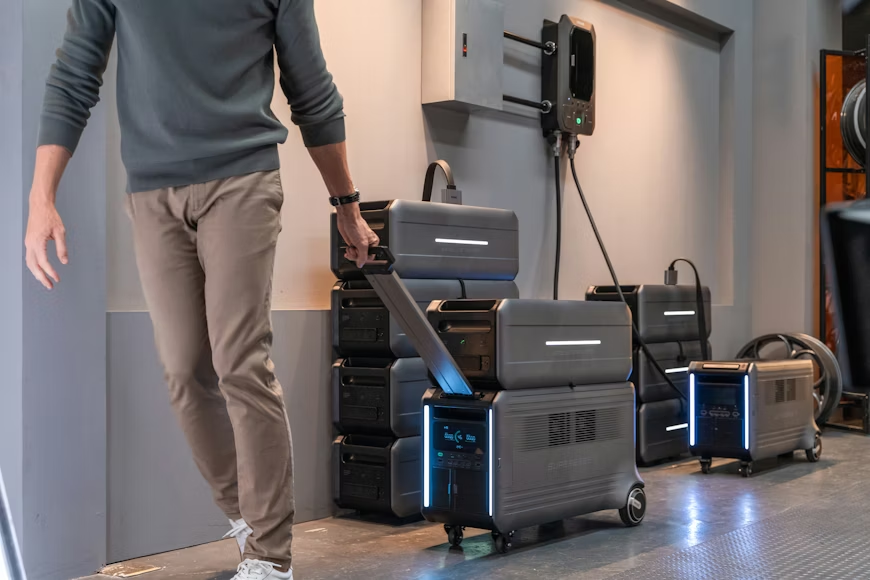
The Jackery Explorer 5000 Plus is better suited to larger essential-load or partial-home backup than a small camping power station. It provides 5,040Wh of storage, 7,200 watts of rated AC output, 120/240-volt capability, and support for up to 4,000 watts of solar input. Storage can also be expanded for longer outages.
Its base battery capacity is not enough to operate an entire home normally for days. Actual runtime still depends on the connected appliances, battery expansion, solar conditions, and how the system is connected to household circuits.

Larger Partial-Home Backup
Operating multiple household circuits may require approximately 15 to 24 panels, 15 to 30 kWh or more of battery storage, and a permanently installed 120/240-volt hybrid inverter. A protected-load panel or compatible transfer system can prevent electric heat, water heating, dryers, and other major loads from draining the batteries unexpectedly.
These ranges are not substitutes for an electrical design. Panel voltage, solar-input limits, battery compatibility, circuit requirements, and motor-starting loads must all be checked before purchasing equipment.
Common Solar-Outage Sizing Mistakes
Even a system with high-quality panels and batteries can perform poorly if it is sized around unrealistic assumptions. Avoid these common planning mistakes.
- Using panel wattage as daily production: A 400-watt panel does not produce 400 watts all day. Daily energy must account for peak sun hours and system losses.
- Assuming rooftop solar automatically works during an outage: A standard grid-tied system normally shuts down unless it includes backup-capable equipment.
- Ignoring battery storage: Panels cannot provide dependable overnight electricity without enough stored energy.
- Forgetting battery-recharging time: The array must power daytime loads while also replacing energy used overnight.
- Sizing around perfect summer weather: Winter sunlight, clouds, heat, shade, dirt, and snow can reduce production.
- Calculating only running watts: Refrigerators, air conditioners, and pumps may require several times their running wattage during startup.
- Trying to power every appliance: Electric heat, central air conditioning, water heaters, ranges, and dryers can dramatically increase system size and cost.
- Exceeding equipment limits: Solar-panel voltage and current must remain within the inverter, charge controller, or power station’s specifications.
- Buying mismatched components: Panels, batteries, inverters, transfer equipment, and household voltage requirements must be compatible.
A successful outage system begins with a realistic load list. Calculate essential energy use first, verify the largest startup surge, and then size the panels, batteries, and inverter as one complete system.
Frequently Asked Questions
How many solar panels are needed to run a refrigerator during an outage?
One modern 400-watt panel may produce enough daily energy for an efficient refrigerator under favorable conditions, but it provides little reserve. Two panels, a properly sized battery, and an inverter with sufficient startup capacity would provide a more dependable refrigerator-only setup.
Can ten solar panels power a house?
Ten 400-watt panels create a 4 kW array. With 4.5 peak sun hours and 75% system efficiency, it could produce approximately 13.5 kWh per day. That may support essential or expanded-essential loads, but it will not necessarily maintain normal whole-home electricity use.
Can solar panels power a home without batteries?
Most standard grid-tied systems shut down during an outage. Certain specialized systems can provide limited daytime electricity without batteries, but output changes with sunlight. Batteries are generally required for dependable power at night, beneath heavy cloud cover, or when appliance demand exceeds current solar production.
How many batteries are needed for one day of backup power?
The answer depends on battery capacity and household consumption. A home needing 10 kWh of usable backup energy may require approximately 12 to 14 kWh of rated battery storage after allowing for discharge limits, inverter losses, and a modest reserve.
Can a solar backup system run a well pump?
Yes, provided the inverter supplies the pump’s required voltage and can handle its startup surge. Many well pumps require 240 volts and may briefly draw several times their normal running wattage. Battery output must also be high enough to support that surge.
Can solar panels run central air conditioning during an outage?
Solar can operate central air conditioning, but doing so requires a large array, substantial battery capacity, and an inverter capable of handling compressor startup. A soft-start device may reduce startup demand, but it does not reduce the air conditioner’s total daily energy consumption.
How many solar panels are needed for whole-home backup?
A near whole-home system may require approximately 24 to 36 or more 400-watt panels. Homes with electric heat, heavy air-conditioning use, electric water heating, or vehicle charging may need considerably more. The final number must be based on actual daily electricity consumption and local solar conditions.
Further Reading
Final Thoughts
There is no single number of solar panels that will work for every home during an outage. A carefully managed essential-load system may need only 8 to 12 modern panels, while a larger partial-home system may require 15 to 24. Maintaining something close to normal whole-home electricity use could require 24 to 36 panels or considerably more.
The most accurate approach is to calculate daily energy consumption, local peak sun hours, system losses, overnight battery needs, and the startup requirements of large appliances. Panels, batteries, and inverter capacity must be sized as one complete system.
For most households, reducing electricity use during an outage is more practical than attempting to operate every appliance normally. Prioritizing refrigeration, water, lighting, communication, medical needs, and limited temperature control can make solar backup more affordable and much easier to maintain through several days without grid power.