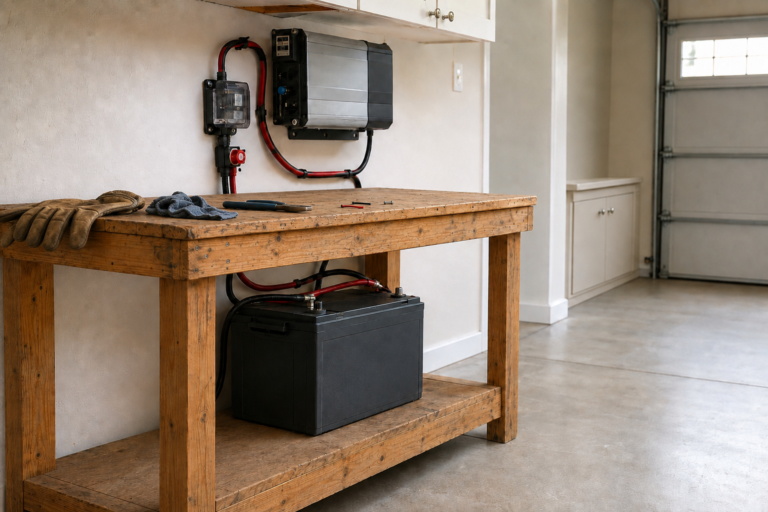
Can a Solar Generator Run a Refrigerator During a Blackout?
When the power goes out, keeping the refrigerator running quickly becomes a priority. A short outage may be little more than an inconvenience, but as the hours pass, refrigerated food can begin moving into unsafe temperature ranges and anything that requires temperature-controlled storage may become a concern.
This post contains affiliate links. I may earn a small commission at no extra cost to you. Learn more.
A solar generator, more accurately called a portable power station when referring to the battery unit itself, can keep a refrigerator running during a blackout. The important question is not simply whether it can power the refrigerator, but how long it can run it and whether the system can be recharged before the battery is depleted.
That requires looking at three separate numbers: the refrigerator’s normal power consumption, the compressor’s startup surge, and the amount of energy the refrigerator uses over an entire day. A power station can have plenty of battery capacity and still fail to start a refrigerator if its inverter cannot handle the compressor surge.
Food safety matters as well. An unopened refrigerator can generally keep food cold for about four hours during a power outage. Use a refrigerator thermometer to monitor the temperature, and follow USDA food-safety guidance if perishable food has been above 40°F. Keeping the door closed as much as possible helps preserve the cold air already inside.
If you are preparing for longer outages, it is also worth keeping some long-shelf-life survival foods that do not require refrigeration so your entire food supply does not depend on backup electricity.
This refrigerator guide focuses specifically on battery capacity, inverter surge, runtime, and solar recharging. For planning the rest of your home’s emergency power system, see our complete grid-down power guide.
Quick Answer: Can a Solar Generator Run a Refrigerator?
Yes. A properly sized solar generator or portable power station can run a refrigerator during a blackout. There is no single battery size or inverter rating that works for every refrigerator, however, because refrigerators vary considerably in energy consumption and compressor startup requirements.
The power station needs enough continuous inverter output to operate the refrigerator, enough surge capacity to start the compressor, and enough battery capacity measured in watt-hours (Wh) to provide the runtime you need.
For many households, a power station in the 1,500–2,000Wh class can be a useful starting range for refrigerator backup. That should not be treated as a universal minimum. An efficient refrigerator may require considerably less energy, while an older or larger model may require more. The amount of solar or other recharging available during the outage also changes how much battery capacity you need.
If you are comparing complete systems rather than calculating an individual refrigerator load, see our Best Solar Power Stations for Blackouts guide.
Before You Buy a Power Station
Start with your refrigerator rather than choosing a battery based only on advertised capacity. Check the appliance label and manufacturer information, and if possible measure its actual energy consumption.
- Check running power: Determine how much power the refrigerator uses while the compressor is operating.
- Account for startup surge: Make sure the inverter can handle the brief increase in power when the compressor starts.
- Estimate daily energy use: Battery runtime depends on watt-hours consumed over time, not running watts alone.
- Plan for recharging: Decide whether you will recharge with solar, a vehicle, an outdoor fuel-powered generator, utility power when available, or a combination of sources.
How Much Power Does a Refrigerator Actually Use?
Refrigerator power consumption varies by size, age, efficiency, ambient temperature, thermostat setting, and how frequently the doors are opened. That is why generic wattage figures are useful for examples but should not be treated as exact sizing numbers for your refrigerator.
A refrigerator also does not draw its rated running power continuously. The compressor cycles on and off as needed to maintain temperature. A unit might draw relatively little power while idle, increase substantially while the compressor is running, and briefly require still more power when that compressor starts.
This creates three different measurements that matter when sizing backup power:
- Running watts: The power being drawn while the refrigerator’s compressor is operating.
- Startup or surge watts: The brief higher demand that can occur when the compressor starts.
- Daily watt-hours: The total amount of electrical energy the refrigerator consumes over an entire day.
For battery sizing, daily watt-hours are usually more useful than running watts alone. For inverter sizing, however, both running power and compressor startup surge matter.
Why Refrigerator Startup Surge Matters
Compressor startup is one of the easiest refrigerator loads to overlook. A refrigerator may draw only a modest amount of power once the compressor is running but require several times that amount for a brief period when the compressor starts.
For example, a refrigerator drawing around 150W while running could require substantially more power during startup. The exact surge varies by appliance, so the refrigerator’s specifications or actual measured startup demand are more useful than assuming every refrigerator needs the same inverter size.
This is why battery capacity and inverter capacity must be considered separately. A large battery does not guarantee that a power station can start the refrigerator. If the inverter’s surge capability is too low, the power station may shut down even though plenty of stored energy remains in the battery.
The opposite can also be true. A smaller power station may successfully operate an efficient refrigerator if its inverter can handle the startup surge, although the smaller battery will provide less runtime between charges.
Do not automatically assume that you need a 2,000W inverter or a 4,000W surge rating. Match the power station’s continuous and surge ratings to the refrigerator you actually intend to run.
For a broader explanation of inverter output, battery capacity, and household appliance loads, see What Size Solar Generator Do I Need for a Blackout?.
How Much Battery Capacity Does a Refrigerator Need?
Once you know that the inverter can start and run your refrigerator, the next question is battery capacity. This is measured in watt-hours (Wh) and determines how long the power station can keep supplying energy before it needs to be recharged.
The most useful number for this calculation is your refrigerator’s estimated daily energy consumption. A refrigerator that uses 700Wh per day has very different backup-power requirements from one that consumes 1,600Wh or more per day.
Calculate Your Refrigerator Runtime
Use our Battery & Power Station Runtime Calculator to estimate how long a battery or portable power station can support your refrigerator based on battery capacity, appliance load, and system efficiency.
Treat the result as a planning estimate. Actual refrigerator runtime can change with compressor cycling, room temperature, door openings, thermostat settings, other connected loads, and the condition of the battery.
Usable Capacity vs. Advertised Battery Capacity
A 2,000Wh power station does not necessarily deliver the full 2,000Wh to an AC refrigerator. Some energy is lost through the inverter and the power station’s own electronics, and manufacturers may also reserve a portion of battery capacity to protect the battery.
Rather than assuming every system loses exactly the same percentage, use the manufacturer’s usable-capacity information when available and include some operating margin in your calculations.
A Refrigerator Battery-Sizing Example
Suppose a refrigerator consumes approximately 1,600Wh during a typical 24-hour period. A 1,000Wh power station would not contain enough stored energy to cover that entire day without recharging. A 2,000Wh-class system would provide substantially more capacity, while a 3,000Wh system would provide additional reserve or room for other essential loads.
That example does not make 2,000Wh a universal minimum. If another refrigerator consumes only 700Wh per day, its battery requirements could be much lower. Likewise, an older refrigerator, a second refrigerator or freezer, high indoor temperatures, or frequent door openings can increase the amount of energy that must be supplied.
Planning for a 24-Hour Blackout
For a one-day outage, start with the refrigerator’s estimated 24-hour energy consumption and then allow additional capacity for system losses and changing conditions.
For example, a refrigerator consuming approximately 1,200–1,800Wh per day could make a 2,000Wh-class power station a reasonable starting range, depending on usable battery capacity and whether any recharging occurs during the outage. A much more efficient refrigerator could require less capacity.
The important point is to size the battery from the refrigerator’s energy consumption rather than choosing a power station simply because it is advertised as suitable for refrigerators.
If solar panels or another charging source are available during the outage, you may not need to store the refrigerator’s entire multi-day energy requirement in the battery at once. The battery supplies the load while your charging system replaces some or all of the energy being consumed.
Planning Refrigerator Power for Multi-Day Outages
For outages lasting longer than a day, simply buying a larger battery is not always the best approach. What matters is the relationship between how much energy the refrigerator consumes and how much energy you can replace through recharging.
Suppose a refrigerator consumes approximately 1,350Wh during a typical day. Without any recharging, two days of operation would require about 2,700Wh of usable energy, while three days would require about 4,050Wh. Actual requirements can be higher or lower depending on the refrigerator and operating conditions.
This is why extended-outage planning should include both battery storage and a dependable way to recharge it.
Planning for a 48-Hour Blackout
If a refrigerator consumes approximately 1,200–1,800Wh per day, two days with no recharging could require roughly 2,400–3,600Wh of energy before allowing for system losses and changing conditions.
That does not necessarily mean you need a battery large enough to store the entire two-day requirement. If solar panels or another charging source replace part of the energy during the outage, a smaller battery may be able to support the refrigerator for much longer.
For longer outages, recharge capability becomes increasingly important. A large battery provides reserve capacity, but once that stored energy is gone, the system still needs another source of electricity.
Planning for a 72-Hour Blackout
Using the same 1,200–1,800Wh daily-consumption range as an example, three days without recharging could require approximately 3,600–5,400Wh of energy.
Again, this does not mean you automatically need a 5,400Wh power station. During a multi-day outage, the better goal is to replace enough of the refrigerator’s daily consumption that the battery does not steadily move toward empty.
For example, if a refrigerator consumes 1,200Wh per day and your charging system can reliably replace most or all of that energy during daylight hours, the battery primarily serves as storage between charging periods. If poor weather reduces solar production, however, the battery must carry more of the load.
A dependable multi-day refrigerator backup plan should account for:
- The refrigerator’s actual daily energy consumption
- Usable battery capacity
- Compressor startup requirements
- Available solar charging
- Weather and seasonal sunlight
- Other appliances sharing the battery
- A secondary charging source when appropriate
If you are preparing for outages lasting days rather than hours, our Two-Week Power Outage Survival Guide explains how refrigeration, water, lighting, communications, and backup power fit together during an extended grid failure.
Refrigerator Battery Capacity at a Glance
Important: These battery sizes are planning ranges, not guaranteed refrigerator runtimes. Actual runtime depends on the refrigerator’s energy consumption, usable battery capacity, inverter efficiency, compressor cycling, room temperature, door openings, and any other equipment connected to the power station.
How Temperature and Refrigerator Use Affect Runtime
Battery calculations provide a useful starting point, but refrigerator energy consumption can change significantly with operating conditions. During hot weather, the compressor may run more frequently because the refrigerator has to work harder to maintain its internal temperature. That can increase daily energy consumption and shorten battery runtime.
Cooler conditions can reduce the cooling load, but outside temperature alone does not determine how much electricity the refrigerator will use. Indoor temperature, insulation, thermostat settings, refrigerator efficiency, and how often the doors are opened all affect compressor runtime.
During a blackout, one of the simplest ways to conserve battery power is to keep the refrigerator and freezer doors closed as much as possible. Every unnecessary opening allows cold air to escape and warmer air to enter, which can cause the compressor to run longer when power is available.
Make Your Refrigerator Backup Last Longer
A few simple steps can reduce unnecessary refrigerator runtime and help protect food during an outage:
- Keep the doors closed: Decide what you need before opening the refrigerator and close the door promptly.
- Use a refrigerator thermometer: This lets you monitor the actual temperature instead of guessing whether food is staying cold enough.
- Freeze water ahead of severe weather: Frozen containers can add thermal mass to a freezer and can also be moved to a cooler when needed.
- Use coolers strategically: Frequently used drinks or other items can be moved to a separate cooler so the main refrigerator does not have to be opened repeatedly.
- Prepare before a predicted outage: If severe weather is approaching, make sure the refrigerator and freezer are already at their normal recommended temperatures and that your power station is fully charged.
If you store medications that require refrigeration, follow the medication’s storage instructions and guidance from the manufacturer, pharmacist, or healthcare provider. Different medications have different allowable temperature ranges and storage limits, so they should not all be treated the same way during an outage.
Powering a Refrigerator With Other Essential Loads
A refrigerator may not be the only equipment connected to your power station during a blackout. Phones, lights, a router, medical equipment, or other essential devices all consume part of the same stored energy.
When several devices share one power station, add their energy requirements together when estimating battery capacity. You also need to make sure the inverter can handle the combined operating load and any startup surge that occurs when the refrigerator compressor turns on.
Adding a CPAP Machine
If you depend on a CPAP machine, do not size your backup system using a generic CPAP wattage estimate. Power consumption varies by model, pressure settings, heated humidifier use, heated tubing, and whether the machine is powered through AC or a compatible DC connection.
Check the requirements for your specific machine and follow the manufacturer’s instructions for backup-power use. Our How to Power a CPAP During a Power Outage guide explains the subject in more detail.
If the refrigerator and CPAP will use the same power station, include the energy consumption of both when calculating battery capacity. The inverter must also be able to handle the refrigerator’s compressor startup while the CPAP and any other connected equipment are operating.
Solar Recharging for Multi-Day Refrigerator Backup
For a short outage, stored battery capacity may be enough. During a multi-day blackout, however, the ability to recharge the battery becomes increasingly important.
The goal is not simply to attach the largest solar panel you can find. Your solar array needs to replace a meaningful portion of the energy being consumed each day, and the power station must be capable of accepting that amount of solar input.
Calculate Your Solar Recharging Time
Use our Solar Panel Charging Calculator to estimate how much energy your panels can produce and how long it may take to recharge your power station based on panel wattage, battery capacity, available sunlight, and system efficiency.
For extended outages, compare the refrigerator’s estimated daily energy consumption with the amount of energy your solar array can realistically replace each day.
For example, if a refrigerator consumes approximately 1,200Wh per day, your charging system needs to replace roughly that amount of usable energy each day just to offset the refrigerator’s consumption. If the same battery is also powering lights, communications equipment, or other devices, those loads must be added as well.
Actual solar production depends on peak sun hours, cloud cover, season, shading, panel orientation, charging losses, and the power station’s maximum solar-input capability. A panel’s advertised wattage represents its rated output under specified conditions, not a guarantee of how much power it will produce throughout the day.
This is why a single small panel should not automatically be considered a complete refrigerator-backup solution. Build enough charging margin into the system to account for days when solar production is lower than expected.
Common Refrigerator Backup Power Mistakes
- Ignoring compressor startup surge: A power station can have enough stored energy but still shut down if its inverter cannot handle the refrigerator starting.
- Sizing from running watts alone: Running wattage does not tell you how much energy the refrigerator consumes over an entire day.
- Assuming advertised battery capacity equals usable AC energy: Inverter operation, system electronics, and battery-management limits can reduce the amount of stored energy available to the appliance.
- Having no recharge plan: Even a large battery will eventually be depleted during an extended outage if consumed energy cannot be replaced.
- Depending on ideal solar conditions: Clouds, shade, short winter days, and poor panel orientation can substantially reduce solar production.
- Opening the refrigerator unnecessarily: Repeated door openings allow warmer air inside and can increase the amount of cooling required.
If a fuel-powered generator is part of your backup system, never backfeed a home through a receptacle. Use appropriate transfer equipment or another connection method designed for the application. See our Generator Power Connections Made Safe guide for more information.
Generator grounding and bonding requirements depend on the generator and how it is connected. Our Generator Grounding and Bonding guide explains those differences in more detail.
When a Hybrid Backup System Makes Sense
Solar and battery storage can provide dependable refrigerator backup, but there are situations where relying on solar alone may leave too little margin. Several cloudy days, short winter daylight hours, heavy household loads, or limited space for solar panels can reduce the amount of energy you are able to replace each day.
For longer outages, combining a battery power station with solar and a fuel-powered generator can provide another layer of backup. The power station can handle the refrigerator and other essential loads quietly, while solar recharges the battery whenever conditions are favorable.
If solar production falls short, an outdoor fuel-powered generator can be used as a secondary charging source rather than running continuously just to keep the refrigerator powered.
A hybrid setup may be particularly useful when:
- Outages in your area regularly last multiple days
- Cloudy weather or short winter days can limit solar production
- Your available solar array cannot consistently replace your daily energy consumption
- The refrigerator shares the battery with other essential equipment
- You want a secondary charging option when solar conditions are poor
Any fuel-powered generator must be operated outdoors according to the manufacturer’s clearance requirements and away from doors, windows, vents, and occupied spaces. Never operate a fuel-burning generator inside a house, garage, basement, or other enclosed space.
For a broader look at combining different backup-power sources, see our Grid-Down Survival Power Guide.
What Size Power Station Makes Sense for Refrigerator Backup?
There is no single power-station size that is correct for every refrigerator. The best size depends on the refrigerator’s measured or estimated daily energy consumption, compressor startup requirement, the length of outage you are preparing for, and how often you expect to recharge the battery.
A smaller system may be enough for an efficient refrigerator during a short outage or when dependable daily recharging is available. A larger system provides more stored energy and can make more sense when the refrigerator shares the battery with lights, communications equipment, a freezer, or other essential loads.
If you are still determining your total backup-power requirement, use our What Size Solar Generator Do I Need for a Blackout? guide before choosing a system.
2,000Wh Class: A Strong Starting Range for Many Refrigerator Setups
A power station around the 2,000Wh capacity class can be a useful starting range for many refrigerator-backup systems. It provides substantially more stored energy than smaller portable units while remaining practical for households that expect to recharge with solar, utility power when available, or another backup source.
When comparing systems in this range, look beyond battery capacity. Important specifications include:
- Usable battery capacity
- Continuous inverter output
- Surge capability
- Maximum solar-input capacity
- Recharge time
- Battery expansion options, if available
The inverter still needs to match the refrigerator’s actual operating and startup requirements. A 2,000Wh battery does not guarantee that every power station in this class can start every refrigerator.
For more options, see our Best Solar Power Stations for Blackouts guide.

Price and availability can change. Check Amazon’s current listing before purchasing.
3,000Wh Class: More Reserve for Additional Essential Loads
A power station around the 3,000Wh class may make more sense when you want additional reserve between charging periods or when the refrigerator will share the battery with other essential equipment.
That additional capacity can be useful for combinations such as:
- Refrigerator and a second refrigerator or freezer
- Refrigerator and essential lighting
- Refrigerator and communications equipment
- Refrigerator and properly calculated medical-device loads
- Longer outages with inconsistent solar charging
A larger battery does not eliminate the need to check inverter output, startup surge, or charging capability. Verify that the power station can operate the equipment you intend to connect and that your charging system can replace a meaningful portion of the energy you consume each day.
For complete system comparisons, see our Best Solar Power Stations for Blackouts guide.

Price and availability can change. Check Amazon’s current listing before purchasing.
Frequently Asked Questions
Can a Solar Generator Run a Refrigerator Overnight?
Yes, provided the power station has enough usable battery capacity and its inverter can handle the refrigerator’s startup surge. Overnight runtime depends on the refrigerator’s actual energy consumption, battery capacity, system efficiency, room temperature, and how frequently the compressor cycles.
If the battery will also power lights, a router, medical equipment, or other devices overnight, include those loads when estimating the required capacity.
How Long Will a 2,000Wh Power Station Run a Refrigerator?
There is no single runtime that applies to every refrigerator. A refrigerator consuming 1,200Wh per day has very different requirements from one consuming 1,800Wh per day, and the full advertised battery capacity may not be available to the appliance.
As a simple example, a 2,000Wh power station could potentially support an efficient refrigerator for more than a day, while a refrigerator with substantially higher daily energy consumption would run for less time. Other connected loads would shorten runtime further.
For a more useful estimate, enter your power station capacity and appliance load into our Battery & Power Station Runtime Calculator.
Can a 1,000Wh Power Station Run a Refrigerator?
Possibly. A 1,000Wh power station may be enough for an efficient refrigerator during a shorter outage, particularly when the battery can be recharged during the day. However, battery capacity is only part of the requirement.
The inverter must also provide enough continuous output to operate the refrigerator and enough surge capacity to start the compressor. Check both the refrigerator’s requirements and the power station’s specifications before relying on the system for an outage.
How Much Surge Power Does a Refrigerator Need?
There is no universal refrigerator surge requirement. Compressor startup can briefly require considerably more power than normal operation, and the amount varies by refrigerator.
When possible, check the manufacturer’s specifications for your appliance. If startup demand is not provided, manufacturer information or an appropriately rated power meter capable of capturing startup demand can provide a better sizing basis than assuming a fixed surge number.
How Much Solar Do I Need to Keep a Refrigerator Running?
The solar array needs to replace enough of the refrigerator’s daily energy consumption to prevent the battery from steadily running down. Required panel capacity depends on the refrigerator’s daily energy use, available peak sun hours, weather, shading, panel orientation, system losses, and the power station’s maximum solar-input capability.
For example, if a refrigerator consumes approximately 1,200Wh per day, your charging system needs to produce roughly that amount of usable energy each day just to offset the refrigerator. Additional loads increase the amount of energy that must be replaced.
Use our Solar Panel Charging Calculator to estimate charging performance for your battery and solar-panel setup.
Can I Run a Refrigerator Directly From Solar Panels?
For a typical blackout setup, the refrigerator is normally powered by the power station rather than directly from portable solar panels. The panels recharge the battery, while the power station’s inverter supplies the AC electricity required by the refrigerator.
This arrangement also allows the refrigerator to continue operating when solar production drops because of clouds, shade, or nighttime conditions, as long as sufficient energy remains in the battery.
Is a Solar Generator Better Than a Gas Generator for a Refrigerator?
Each has advantages. A battery power station produces no combustion exhaust while operating and can be used indoors according to the manufacturer’s instructions. It also provides quiet power overnight without requiring a fuel engine to run continuously.
A fuel-powered generator can provide substantial power and can recharge a power station during an extended outage when solar production is inadequate. Fuel-powered generators must be operated outdoors according to the manufacturer’s clearance requirements and away from doors, windows, vents, and occupied spaces because they produce carbon monoxide and other exhaust gases.
For longer outages, a combination of battery storage, solar charging, and an outdoor fuel-powered generator can provide more flexibility than relying on only one source of power.
How to Check Your Refrigerator’s Actual Power Use
The best way to size backup power for a refrigerator is to use information from the refrigerator itself rather than relying only on generic wattage estimates.
There are several ways to get a better picture of its actual energy requirements.
Check the EnergyGuide Label
If your refrigerator has an EnergyGuide label, look for its estimated annual electricity consumption in kilowatt-hours (kWh). Dividing that number by 365 gives you a rough estimate of average daily energy consumption.
For example, a refrigerator rated at 438kWh per year averages approximately 1.2kWh, or 1,200Wh, per day:
438kWh ÷ 365 days = 1.2kWh per day
This is still an estimate because actual consumption changes with room temperature, refrigerator settings, door openings, food load, and other conditions.
Measure Energy Use With a Plug-In Power Meter
For a refrigerator that can safely be monitored with an appropriately rated plug-in power meter, measuring consumption over at least 24 hours can provide a much better picture of actual energy use in your home.
Instead of looking only at instantaneous watts, record the total watt-hours or kilowatt-hours consumed during the measurement period. That number is much more useful when determining how much battery capacity you need for a blackout.
If possible, measure during conditions similar to those you expect during an outage. A refrigerator may consume more energy in a hot house during summer than it does under mild indoor conditions.
Check the Refrigerator Nameplate and Manufacturer Specifications
The appliance label can provide useful electrical information, including voltage and rated current. However, simply multiplying the listed voltage by the listed amperage should not automatically be treated as the refrigerator’s actual running wattage or daily energy consumption.
Refrigerators contain motors and other electrical components, and nameplate values may represent rated electrical requirements rather than the power the appliance continuously consumes during normal operation.
Manufacturer specifications can also help determine whether startup or compressor surge information is available. That matters when checking whether the power station’s inverter can successfully start the refrigerator.
Use Both Numbers When Sizing Backup Power
Daily watt-hours help determine how much battery capacity you need.
Running and startup power help determine whether the inverter can operate the refrigerator and start its compressor.
A backup system needs to satisfy both requirements.
Build a Complete Refrigerator Backup Plan
Keeping a refrigerator running through a blackout requires more than choosing a large battery. The complete system needs enough inverter capacity to start the compressor, enough stored energy for the expected runtime, and a practical way to recharge during a prolonged outage.
Start by determining your refrigerator’s actual energy consumption. Then use our Battery & Power Station Runtime Calculator to estimate battery runtime and our Solar Panel Charging Calculator to estimate how quickly solar can replace the energy being used.
If you need to size backup power for more than the refrigerator, see What Size Solar Generator Do I Need for a Blackout?. That guide covers whole-system planning, including multiple appliances, battery capacity, inverter requirements, and startup loads.
For a broader emergency-power strategy, our Grid-Down Survival Power Guide explains how battery systems, solar charging, and fuel-powered generators can work together during longer outages.
The goal is not simply to own a power station. It is to know how much energy your refrigerator actually needs, how long your battery can supply it, and how you will replace that energy if the outage continues.