What Size Generator Do I Need to Run an Air Conditioner?
What size generator do I need to run an air conditioner? The answer depends on the type of AC, its normal running wattage, and the additional power required when the compressor starts. A small window air conditioner may work with a 2,000-watt generator, while a central air-conditioning system could require a portable generator rated for 10,000 watts or more.
This post contains affiliate links. I may earn a small commission at no extra cost to you. Learn more.
Starting wattage is usually the biggest challenge. An air conditioner’s compressor can briefly pull considerably more power when it starts than it uses while running. A generator may appear large enough based on running watts but still overload, stall, or trip a breaker when the compressor turns on.
Quick Answer
Most small window and portable air conditioners can run on a 2,000- to 4,000-watt generator. Larger window units and RV air conditioners may require 3,000 to 5,000 watts. Central air conditioners commonly require a 7,500- to 12,000-watt portable generator or larger, depending on the system’s tonnage, starting demand, voltage, and whether a compatible soft-start kit is installed.
The correct generator must also have enough capacity for other equipment you plan to operate. Refrigerators, freezers, well pumps, lights, fans, and battery chargers all use part of the generator’s available output. Ignoring these additional loads could cause an overload when the air conditioner cycles on.
This guide explains how to size a generator for window, portable, and central air-conditioning systems. It also covers starting wattage, soft-start kits, additional household loads, connection requirements, and essential generator safety.
Key Takeaways
- A 2,000- to 4,000-watt generator can operate many window and portable air conditioners.
- Central air conditioners frequently require at least 7,500 to 12,000 watts, although actual requirements vary considerably.
- The generator must handle both the AC’s running wattage and its higher starting demand.
- A compatible soft-start kit can reduce the startup demand of some central AC systems.
- Central air must be powered through properly installed transfer equipment—never by backfeeding a household outlet.
How Many Watts Does an Air Conditioner Use?
Air-conditioner power consumption varies considerably by cooling capacity, efficiency, compressor design, and operating conditions. Two air conditioners with the same BTU rating may not use the same amount of electricity, so the numbers below should only be used for initial generator planning.
Smaller window and portable air conditioners usually operate from a standard 120-volt outlet. Central air conditioners generally use 240 volts and require substantially more power, especially when the compressor starts.
| Air Conditioner | Typical Running Watts | Possible Starting Watts | Suggested Generator Range |
|---|---|---|---|
| 5,000–6,000 BTU window AC | 450–750 watts | 900–1,500 watts | 2,000 watts |
| 8,000–10,000 BTU window AC | 700–1,200 watts | 1,400–2,400 watts | 2,500–3,000 watts |
| 12,000–15,000 BTU window AC | 1,000–1,700 watts | 2,000–3,500 watts | 3,500–4,500 watts |
| Portable air conditioner | 900–1,600 watts | 1,800–3,200 watts | 2,500–4,000 watts |
| 13,500 BTU RV air conditioner | 1,300–1,800 watts | 2,800–3,500 watts | 3,500–4,500 watts |
| 2-ton central air conditioner | 2,000–3,000 watts | Varies by compressor and LRA | 7,500 watts or more |
| 3-ton central air conditioner | 3,000–4,000 watts | Varies by compressor and LRA | 9,000–12,000 watts or more |
| 4-ton central air conditioner | 4,000–5,500 watts | Varies by compressor and LRA | 12,000 watts or more |
The generator recommendations include some additional capacity above the estimated starting demand. Operating a generator continuously at its maximum rating leaves little room for changing loads, high outdoor temperatures, or another appliance switching on.
Important
Never choose a generator from this table alone. Check the electrical label on your actual air conditioner. Central AC systems can have startup requirements far above general estimates, particularly older single-stage compressors without a soft-start kit.
Running Watts vs. Starting Watts
To choose the correct generator, you need to understand the difference between running watts and starting watts. Air conditioners require both, but the starting demand is usually what determines whether a generator can operate the unit successfully.
Running Watts
Running watts are the amount of power the air conditioner uses after the compressor and fan are operating. For example, a window air conditioner might consume 900 running watts during normal operation. The generator must continuously supply at least that amount for as long as the air conditioner remains on.
Running wattage can change as outdoor temperatures, thermostat settings, fan speeds, and compressor loads change. An air conditioner may use more electricity during extremely hot weather because it operates for longer periods and works harder to remove heat from the room.
Starting Watts
Starting watts are the brief surge of power required when the compressor starts. This surge may last less than a second or continue for several seconds, but the generator must still be capable of supplying it. If the generator cannot handle the surge, its breaker may trip, the engine may stall, or the air conditioner may fail to start.
Why Starting Wattage Matters
An air conditioner using 1,000 watts while running might temporarily require 2,000 to 3,000 watts when its compressor starts. Central AC compressors can have an even larger startup demand. This is why a generator should never be selected using running wattage alone.
Generator Running and Surge Ratings
Portable generators also have two wattage ratings. The running rating shows how much power the generator can supply continuously. The surge or starting rating is the higher amount it can supply temporarily.
A generator advertised as a “4,500-watt generator” may only provide 3,500 or 3,700 continuous watts. The larger number displayed on the generator is frequently its temporary starting-watt rating. Always check both numbers before deciding whether it can operate an air conditioner.
Generator Sizing Tip
Choose a generator with enough surge capacity to start the air conditioner and enough continuous capacity to run the AC along with every other appliance that may operate simultaneously. Leaving approximately 15% to 25% of the generator’s running capacity unused provides a practical buffer for changing loads.
The safest calculation is based on the air conditioner’s actual electrical label rather than a general wattage chart. The label provides the voltage, amperage, and compressor information needed to estimate both its normal power consumption and startup demand.
How to Find Your Air Conditioner’s Wattage
The most reliable generator estimate comes from the electrical information printed on your air conditioner. Look for a metal plate or printed label on the side or back of the unit. Central air conditioners normally have this label on the outside condenser cabinet, while window and portable units may place it near the power cord, air filter, or rear panel.
The label may provide wattage directly. If it only lists volts and amps, you can calculate an approximate electrical load using this formula:
Basic Wattage Formula
Volts × Amps = Watts
For example, a 120-volt window air conditioner drawing 8 amps has an estimated load of 960 watts:
120 volts × 8 amps = 960 watts
This calculation provides a useful planning estimate, but it may not represent the exact power consumed by a motor-driven appliance. Power factor, compressor efficiency, fan operation, and changing operating conditions can affect the actual wattage.
Information Found on a Central AC Label
Central air-conditioner labels contain several electrical ratings that are easy to confuse:
- Voltage: Most residential central air conditioners require approximately 208 to 230 or 240 volts.
- RLA: Rated load amps indicate the compressor’s expected amperage under specified operating conditions.
- LRA: Locked rotor amps indicate the high current associated with a compressor that is not yet turning. This number helps show why starting a central AC can be difficult for a portable generator.
- MCA: Minimum circuit ampacity is primarily used to determine the required circuit and wire capacity. It is not the same as the unit’s normal running amperage.
- MOCP or maximum fuse size: This identifies the largest permitted overcurrent protection. It should not be treated as the air conditioner’s normal power consumption.
Do Not Size a Generator From the Breaker Alone
A central AC connected to a 30-amp breaker does not necessarily consume 30 amps continuously. Breaker size provides circuit-protection information, not an exact measurement of running or starting power. Use the equipment label, manufacturer specifications, and actual startup measurements whenever possible.
You can also use a plug-in watt meter to measure many 120-volt window and portable air conditioners. Central AC systems require specialized equipment and should be evaluated by a qualified HVAC technician or electrician.
Best Practice
Photograph the complete equipment label before shopping for a generator. Record the voltage, compressor amperage, LRA, fan amperage, and model number. A generator dealer, HVAC technician, or electrician can use that information to evaluate whether the generator has enough surge capacity.
What Size Generator Do You Need for a Window Air Conditioner?
Most window air conditioners can be operated with a portable generator rated between 2,000 and 4,500 watts. The correct size depends on the air conditioner’s BTU rating, efficiency, and compressor startup demand.
A small 5,000 or 6,000 BTU window unit may use less than 750 watts while running, but it could require approximately 1,000 to 1,500 watts when the compressor starts. A 2,000-watt inverter generator will usually provide enough capacity for this size AC, provided it is not heavily loaded with other appliances.
Larger window units require more generator capacity. An 8,000- to 10,000-BTU model may need a 2,500- to 3,000-watt generator, while a 12,000- to 15,000-BTU unit may be better matched with a generator providing 3,500 to 4,500 starting watts.
Recommended Generator Size
A 2,000-watt generator is generally suitable for a small 5,000- to 6,000-BTU window air conditioner. Choose approximately 3,000 watts for an 8,000- to 10,000-BTU unit and 3,500 to 4,500 watts for larger window air conditioners. Always confirm the AC’s actual starting and running requirements before connecting it.
Account for Other Appliances
If the generator will also power a refrigerator, freezer, lights, or chargers, add their running wattage to the air conditioner’s running load. You must also account for the largest startup surge that could occur while the other appliances are operating.
For example, suppose an air conditioner uses 900 running watts and requires 2,000 starting watts. A refrigerator using 200 watts is already operating, along with 100 watts of lights and chargers. The generator would need to supply approximately 2,300 watts when the AC compressor starts. A 2,000-watt generator would be too small for that combination, even though it could potentially run the air conditioner by itself.
Cooling One Room Is More Practical
During an extended outage, powering one efficient window air conditioner is often more practical than attempting to operate central air. Close the room’s doors, cover sun-facing windows, and keep everyone in the cooled area. These steps reduce generator load and fuel consumption while providing protection from dangerous heat.
A window unit can be combined with the strategies in our guide on keeping your house cool during a summer power outage. This approach can preserve a safer sleeping or living area without using the fuel required to cool the entire home.
What Size Generator Do You Need for a Portable Air Conditioner?
Most portable air conditioners require a generator rated between 2,500 and 4,000 watts. Despite their name, portable air conditioners are different from window units. They sit inside the room and use one or two hoses to discharge hot air through a window or wall opening.
A smaller portable AC may consume approximately 900 to 1,200 watts while running. Larger models can draw 1,400 to 1,800 watts or more. Compressor startup demand may temporarily increase the load to approximately two or three times the normal operating wattage, although newer inverter-driven models may start more gradually.
Recommended Generator Size
A 2,500- to 3,000-watt generator can operate many small and midsize portable air conditioners. Larger 12,000- to 14,000-BTU models may require a generator rated for 3,500 to 4,000 watts or more, particularly when additional appliances will be connected.
Use the Correct BTU Rating
Portable air conditioners may display two different cooling-capacity ratings. The larger number is often based on the older ASHRAE testing method, while the lower DOE or SACC rating reflects more realistic operating conditions. Generator sizing should always be based on the unit’s electrical wattage and amperage rather than the advertised BTU number alone.
A unit marketed as a 12,000-BTU portable air conditioner may have a considerably lower SACC rating. This does not necessarily mean its electrical demand is low enough for a small generator. Check the equipment label for the actual voltage and amperage.
Choose an Efficient Setup
A dual-hose portable air conditioner is generally better suited to emergency cooling because it does not pull as much hot outdoor air into the room as many single-hose models. Regardless of design, keep the exhaust hose short, straight, and properly sealed at the window.
Consider the Generator’s Available Outlets
Most portable air conditioners use a standard 120-volt plug, but the generator outlet must still be rated for the load. Avoid lightweight household extension cords. If an extension cord is unavoidable, use a properly rated outdoor cord that is as short as practical and capable of carrying the air conditioner’s full amperage.
Never Place the Generator Near the AC
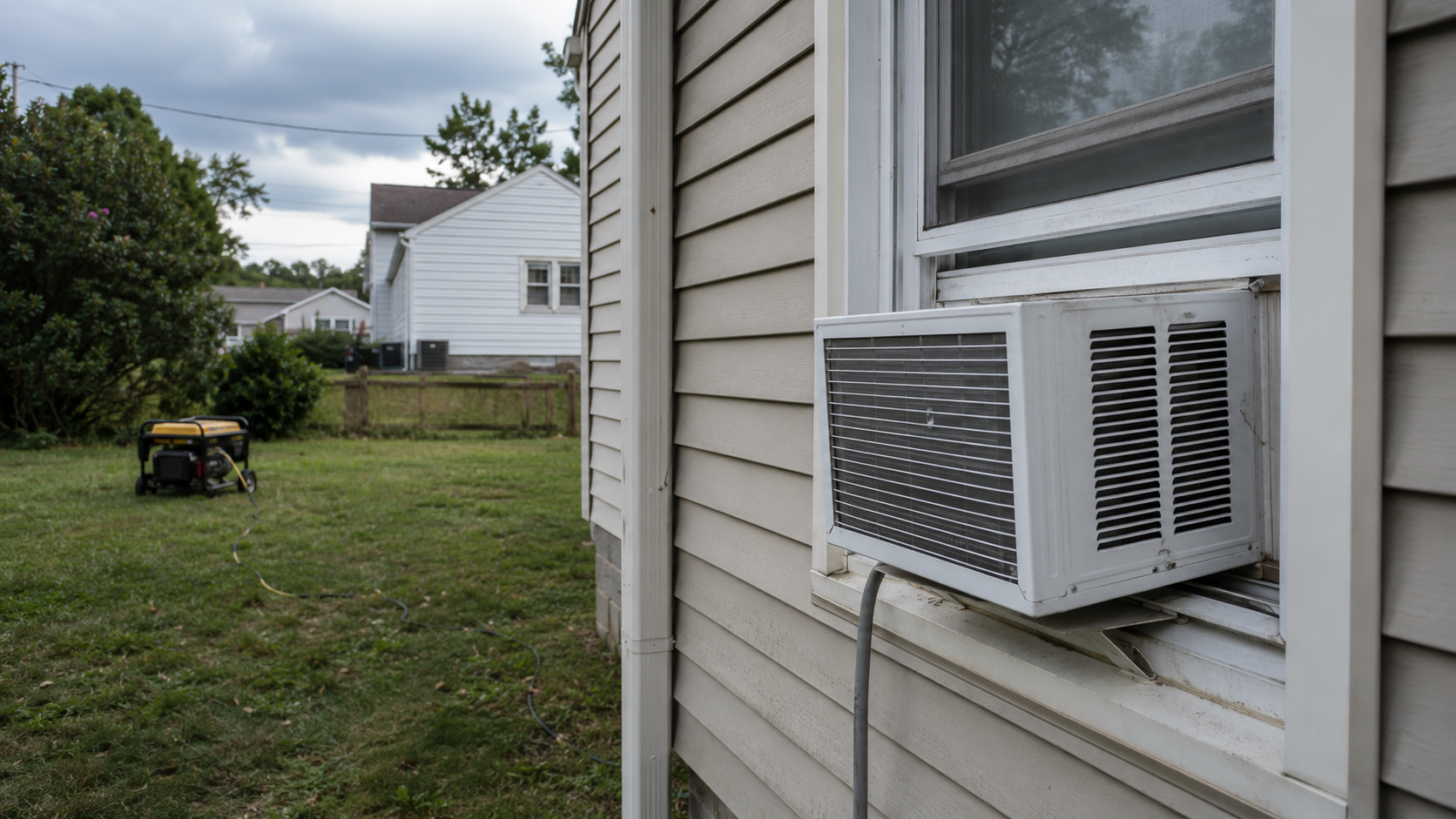
The air conditioner may be inside the house, but the generator must remain outdoors at least 20 feet from doors, windows, and vents, with its exhaust directed away from the home. Never operate a generator inside a garage, porch, shed, basement, or other enclosed area.
What Size Generator Do You Need for Central Air Conditioning?
Running central air conditioning from a portable generator is considerably more difficult than powering a window or portable unit. Most central AC systems require 240-volt power, have a large compressor startup surge, and depend on an indoor air handler or furnace blower that also consumes electricity.
Central AC Generator Size
Plan on at least 7,500 to 12,000 watts for many 2- to 3-ton central air conditioners. Larger systems may require 12,000 to 18,000 watts or more. These ranges are only starting points because the compressor’s actual startup demand can vary substantially between units.
The Outdoor Condenser Is Not the Only Load
The generator must power both the outdoor condenser and the indoor equipment that circulates air through the house. Depending on the HVAC system, this could include an air-handler blower, furnace controls, condensate pump, dampers, thermostats, and other electrical components.
If you calculate only the condenser load, the generator may not have enough capacity to operate the complete system. Additional household loads such as a refrigerator, freezer, well pump, or electric water heater can make the required generator considerably larger.
Example Scenario
Suppose a central AC and indoor blower require approximately 4,000 watts while operating. The refrigerator, freezer, lights, and chargers add another 800 watts. The generator must continuously supply at least 4,800 watts while still maintaining enough surge capacity to start the AC compressor or another motor-driven appliance.
Check the Generator’s Voltage
A large wattage rating does not automatically make a generator compatible with central air. The generator must provide the voltage required by the HVAC system. Most central air conditioners need 120/240-volt generator output. Some smaller portable generators supply only 120 volts and cannot operate a 240-volt central AC, regardless of their advertised wattage.
A Professional Connection Is Required
Central air conditioning cannot normally be connected to a generator with a standard extension cord. The home needs an approved transfer switch or generator interlock, a correctly sized inlet and cable, and a safe method for isolating the house from utility power.
Never Backfeed Your Home
Do not connect a generator to a dryer outlet, range outlet, or other household receptacle. Backfeeding can energize utility lines, electrocute workers, start a fire, and damage the generator or home wiring. Have the connection equipment installed by a qualified electrician.
Before purchasing a generator for central AC, have an HVAC technician or electrician measure the system’s actual startup current. This is especially important for older single-stage compressors, which may have a starting demand that exceeds the temporary surge capacity of many portable generators.
Can a Soft-Start Kit Reduce the Generator Size Needed?
A soft-start kit can make it easier for a portable generator to start some central air conditioners. It electronically controls how the compressor starts, reducing the sudden electrical surge that normally occurs when the thermostat calls for cooling.
Without a soft start, the compressor may demand more power for a fraction of a second than the generator can supply. The generator could stall, trip its breaker, experience a severe voltage drop, or fail to start the compressor. Reducing this startup demand may allow a properly sized portable generator to operate an AC that it could not start reliably before.
What a Soft Start Changes
A soft-start kit reduces compressor startup demand, but it does not substantially reduce the electricity required while the air conditioner is running. The generator must still provide enough continuous power for the condenser, indoor blower, and every other connected appliance.
The amount of improvement varies by air conditioner, compressor, soft-start model, outdoor temperature, and generator. Some systems experience a substantial reduction in startup current, while others receive a smaller benefit. A soft start should never be treated as a guarantee that an undersized generator will operate a central AC successfully.
Soft Starts and Hard-Start Kits Are Different
A hard-start kit and a soft-start kit are not interchangeable. A hard-start kit gives the compressor additional starting torque so it reaches operating speed faster. A soft start manages the startup process to reduce the sudden current demand placed on the electrical supply.
If the goal is to operate central air from a portable generator, confirm that the product is a genuine soft-start device designed for your specific HVAC system.
Check Compatibility Before Installation
Not every soft-start kit is compatible with every air conditioner. Variable-speed, inverter-driven, multi-stage, and communicating HVAC systems may have special requirements or may already control compressor startup electronically. Check with the AC manufacturer or a qualified HVAC technician before installing one.
After installation, the system’s startup current should be measured again. This provides a much more reliable generator-sizing figure than assuming a particular percentage reduction based on advertising claims.
How to Calculate the Generator Size Needed
Once you know the air conditioner’s running and starting wattage, calculate the power required by everything that may operate at the same time. Choosing a generator based only on the AC could leave insufficient capacity for basic equipment such as a refrigerator, freezer, lights, or well pump.
Step 1: Add the Running Wattage
List every appliance you plan to operate and add their running wattage together. This determines the minimum continuous output the generator must provide.
Step 2: Find the Largest Additional Starting Load
For each motor-driven appliance, subtract its running watts from its starting watts. Add the largest of those additional starting loads to the combined running wattage.
Generator Sizing Formula
Total running watts + largest additional starting load = minimum generator surge capacity
The additional starting load equals the appliance’s starting watts minus its running watts.
Generator Sizing Example
Suppose you want to operate the following equipment during an outage:
- Window air conditioner: 1,200 running watts and 2,800 starting watts
- Refrigerator: 200 running watts and 800 starting watts
- Lights and chargers: 100 running watts
The combined running load is 1,500 watts. The air conditioner has the largest additional starting load at 1,600 watts. Adding that surge to the running load produces a minimum temporary requirement of 3,100 watts.
Calculated Generator Requirement
The generator must continuously support at least 1,500 watts and temporarily supply at least 3,100 watts. A model rated for approximately 3,500 to 4,000 starting watts would provide a more practical margin than choosing one rated at exactly 3,100 watts.
This calculation assumes the air conditioner and refrigerator do not start simultaneously. Because compressor cycles are automatic, overlapping startup surges remain possible. Additional generator capacity reduces the chance of an overload when two motor-driven appliances start close together.
Leave Extra Capacity
Aim to keep the planned continuous load approximately 15% to 25% below the generator’s rated running output. This extra capacity helps accommodate changing loads, hot-weather performance, and appliances that consume more power than expected.
After choosing a generator, use our Generator Runtime and Fuel Calculator to estimate how long it can operate and how much fuel you may need during an extended outage.
How to Run an Air Conditioner From a Generator Safely
A properly sized generator can still be dangerous if it is connected or operated incorrectly. Carbon monoxide poisoning, electrical shock, fire, and damaged equipment are the primary risks. Set up the generator and connection equipment before an outage whenever possible.
Carbon Monoxide Danger
Operate a portable generator outdoors at least 20 feet from the house, with the engine exhaust directed away from doors, windows, crawlspaces, and vents. Never run one inside a house, garage, basement, shed, enclosed porch, or attached carport—even if the doors are open.
Use a Safe Electrical Connection
A window or portable air conditioner can usually connect directly to a suitable generator outlet. If an extension cord is necessary, use a heavy-duty outdoor cord rated for the AC’s voltage and amperage. Keep the cord as short as practical and inspect it for damaged insulation, loose connections, or overheated plugs.
Central air conditioning requires approved transfer equipment that prevents generator power from reaching utility lines. A qualified electrician should install the inlet, transfer switch or interlock, breaker, and correctly sized generator cable.
Start the Generator Before Adding the AC Load
Begin with all connected appliances switched off. Start the generator, allow it to stabilize according to the manufacturer’s directions, and then connect the required loads. Turn on the air conditioner before adding smaller optional appliances so its startup surge has access to as much generator capacity as possible.
Safe Generator Checklist
- Place the generator outdoors and away from all openings.
- Install working carbon monoxide alarms inside the house.
- Keep the generator dry without enclosing it or restricting ventilation.
- Use correctly rated outlets, cables, and extension cords.
- Never exceed the generator’s running or surge capacity.
- Turn the generator off and allow it to cool before refueling.
- Store fuel in approved containers away from flames and living areas.
- Follow the manufacturer’s grounding instructions and local electrical requirements.
Watch for Signs of an Overload
Disconnect the air conditioner if the generator repeatedly bogs down, trips its breaker, produces unstable voltage, or struggles every time the compressor starts. Lights dimming briefly may indicate a heavy startup load, but severe or prolonged voltage drops can damage motors and sensitive control boards.
Test Before an Emergency
Perform a supervised test while utility power is available. Confirm that the generator starts the air conditioner reliably, handles the remaining loads, and operates without overheated cords or tripped breakers. Testing during mild weather does not guarantee identical performance during extreme heat, so maintain adequate capacity.
Generator Features Worth Having
After determining the required running and starting wattage, compare the generator’s voltage, outlets, fuel options, and built-in safety features. The advertised wattage alone does not show whether a generator is suitable for your air conditioner.
- Clearly stated running and starting wattage ratings
- Automatic low-oil shutdown
- Built-in overload protection
- Carbon monoxide shutoff technology
- Fuel gauge or runtime display
- Electric start on larger models
- 120/240-volt output when powering central air
- Dual-fuel capability for additional fuel flexibility
Do not purchase a generator based only on the largest wattage number printed on its frame. That number is frequently the temporary surge rating rather than its continuous output.
For emergency cooling, a smaller inverter generator paired with an efficient window air conditioner is often more practical and fuel-efficient than operating central air throughout the entire house.
Recommended Products
For a small window air conditioner: The Champion 2,500-Watt Dual Fuel Inverter Generator provides 2,500 starting watts and 1,850 running watts on gasoline. Confirm that your AC’s measured startup demand fits within those limits.

For a larger window or portable air conditioner: The Westinghouse iGen5000DFc provides 5,000 peak watts and 3,900 running watts on gasoline. It supplies 120-volt power and is not intended to run a typical 240-volt central AC system.


For a compatible central air conditioner: The Micro-Air EasyStart Flex can reduce compressor startup demand on compatible residential systems. Confirm compatibility and installation requirements with an HVAC professional before purchasing.

Frequently Asked Questions
Can a 2,000-Watt Generator Run an Air Conditioner?
A 2,000-watt generator can run many small 5,000- to 8,000-BTU window air conditioners, provided the generator has enough surge capacity to start the compressor. It may not have enough capacity to operate the AC alongside a refrigerator or other large appliance.
Can a 3,500-Watt Generator Run an Air Conditioner?
A 3,500-watt generator can operate most small and midsize window or portable air conditioners. It may also support a refrigerator, lights, and chargers if the combined running and starting loads remain within the generator’s ratings. It is generally too small for conventional central air conditioning.
Will a 5,000-Watt Generator Run Central Air?
A 5,000-watt generator may run certain small or highly efficient central air conditioners after they have started, but it may not have enough surge capacity to start the compressor. It also provides little capacity for the indoor blower and other household loads. Do not assume a 5,000-watt model will operate central AC without checking the system’s startup requirements.
Can a Portable Generator Run a 3-Ton Central Air Conditioner?
Some large portable generators can operate a 3-ton central air conditioner, particularly when the AC has a compatible soft-start kit. The generator must provide 120/240-volt output, sufficient continuous wattage, and enough temporary surge capacity. The exact requirement should be based on the equipment label and measured startup current.
Can an Undersized Generator Damage an Air Conditioner?
Yes. An overloaded generator may produce unstable voltage or frequency, particularly when struggling to start a compressor. Repeated failed starts, prolonged voltage drops, and overheating can damage the air conditioner, generator, cords, or connection equipment.
Stop If the Generator Struggles
If the generator stalls, repeatedly trips its breaker, surges heavily, or cannot bring the compressor up to speed, disconnect the air conditioner. Do not keep attempting to start it. Recalculate the load and have the equipment evaluated before trying again.
Final Thoughts
The correct size cannot be determined from the air conditioner’s BTU rating or circuit breaker alone. Check the equipment label, calculate the combined running load, and make sure the generator can handle the compressor’s startup demand. Include every appliance that may operate at the same time and leave additional capacity instead of running the generator continuously at its limit.
Bottom Line
Choose a generator based on your air conditioner’s actual running and starting requirements. For emergency cooling, powering one efficient window unit is usually more practical and fuel-efficient than attempting to run central air throughout the entire house.
If the generator will connect to household wiring or power central air, have a qualified electrician install approved transfer equipment. A properly sized generator, safe outdoor placement, working carbon monoxide alarms, and a realistic fuel plan can provide dependable cooling without creating a second emergency during the outage.