Wilderness Survival Guide: 7 Essential Skills to Stay Alive
Getting lost in the wilderness can turn an ordinary hike or camping trip into a serious emergency. Changing weather, an unexpected injury, failed navigation equipment, or a missed trail junction can leave you facing conditions you never planned for.
This post contains affiliate links. I may earn a small commission at no extra cost to you. Learn more.
This wilderness survival guide explains seven essential skills that can help you stay safe, make better decisions, and improve your chances of being rescued. You’ll learn how to manage exposure, find and treat drinking water, build a fire safely, navigate unfamiliar terrain, signal for help, and conserve your energy.
Wilderness survival is not about proving how tough you are. It is about recognizing immediate threats, using available resources, and avoiding decisions that make an already difficult situation worse.
Whether you’re preparing for a backcountry trip or learning basic emergency skills, the best time to practice is before something goes wrong.
Wilderness Survival: What to Do First
- Stop and assess: Check for injuries, immediate hazards, and signs of worsening weather.
- Call for help: Contact emergency services or activate an emergency locator if you have one.
- Control exposure: Find protection from dangerous heat, cold, wind, and rain.
- Stay oriented: Avoid unnecessary movement that could make rescue more difficult.
- Manage water: Use carried supplies and identify safe treatment options.
- Signal your location: Make yourself easier to see or hear without creating additional hazards.
- Conserve energy: Prioritize essential tasks and avoid unnecessary risks.
Remember: The correct order depends on your circumstances. A serious injury, flash flood, extreme heat, or other immediate danger can change your priorities.
Understanding Wilderness Survival Priorities
Survival decisions become easier when you understand which threats require immediate attention.
A commonly taught guideline is the Rule of 3s:
- Approximately three minutes without oxygen
- Approximately three hours without adequate protection in extreme exposure
- Approximately three days without water
- Approximately three weeks without food
These numbers are rough teaching aids, not dependable survival deadlines. Actual outcomes vary substantially with temperature, physical condition, activity, hydration, injuries, and environmental conditions.
For example, dangerous heat illness can develop much faster than three hours, while hypothermia can occur in cool, wet conditions even when temperatures are above freezing.
The lesson is not to follow a rigid countdown. It is to address the most immediate threats first.
Use the STOP Method When You Become Lost
One practical approach is the STOP method:
- Stop: Avoid rushing into an unfamiliar area.
- Think: Consider your last known location and the circumstances that brought you here.
- Observe: Evaluate the weather, terrain, injuries, daylight, and available supplies.
- Plan: Choose the safest realistic course of action.
Check your phone for a usable location, saved map, or emergency calling capability. If you have a personal locator beacon or satellite emergency communicator, use it according to its instructions when emergency assistance is needed.
Remaining in a safe location can improve rescue prospects when people know your planned route. However, you may need to move if your current position is threatened by flooding, falling trees, wildfire, severe exposure, or another immediate hazard.
For a more detailed response plan, see our Lost in the Woods Survival Checklist.
1. Emergency Shelter: Protect Yourself From Exposure
Exposure is one of the most urgent wilderness hazards. Wind, precipitation, extreme temperatures, and contact with cold ground can rapidly affect your ability to function.
Your shelter strategy should match the environment. In cold or wet conditions, the goal is to reduce heat loss. In hot conditions, shade, ventilation, and limiting physical exertion may be more important.
Choosing a Safe Shelter Location
Before building or pitching a shelter, inspect the surrounding terrain.
- Avoid dry creek beds, drainage channels, and flood-prone low ground.
- Stay clear of dead trees, hanging limbs, and unstable rocks.
- Do not shelter beneath slopes that could produce rockfall or landslides.
- Consider wind direction and expected precipitation.
- Choose ground that drains reasonably well.
- Remain visible to rescuers when doing so does not compromise safety.
A sheltered location is not necessarily the lowest spot in the landscape. Cold air can collect in valleys, while exposed ridgelines may experience stronger winds and lightning hazards.
Building a Basic Debris Shelter
If you have no tent or tarp and suitable natural materials are available, a debris shelter may provide temporary protection.
- Choose a stable, safe location with adequate dry material.
- Position a sturdy ridgepole against secure supports.
- Place smaller branches along the sides to create a framework.
- Cover the structure with substantial layers of dry leaves, brush, or other suitable insulating debris.
- Add a thick layer of dry insulation beneath your body.
- Keep the entrance reasonably small while maintaining safe access and ventilation.
Natural shelters take time and energy to construct, and poorly built structures can collapse. Practice construction in controlled conditions before depending on the technique.
Do not cut living vegetation or collect materials where prohibited.
Why Ground Insulation Matters
Even a well-covered shelter may offer inadequate protection if you lie directly on cold ground.
Ground contact transfers heat away from your body. An insulated sleeping pad, dry vegetation, or other suitable material can help reduce this loss.
If you have a sleeping bag, keep it dry and protect it from contact with wet surfaces.
For more shelter options, read our Shelter Building Tools for Survival guide and Survival Camping Guide.
2. Fire: Warmth, Water Treatment, and Emergency Signaling
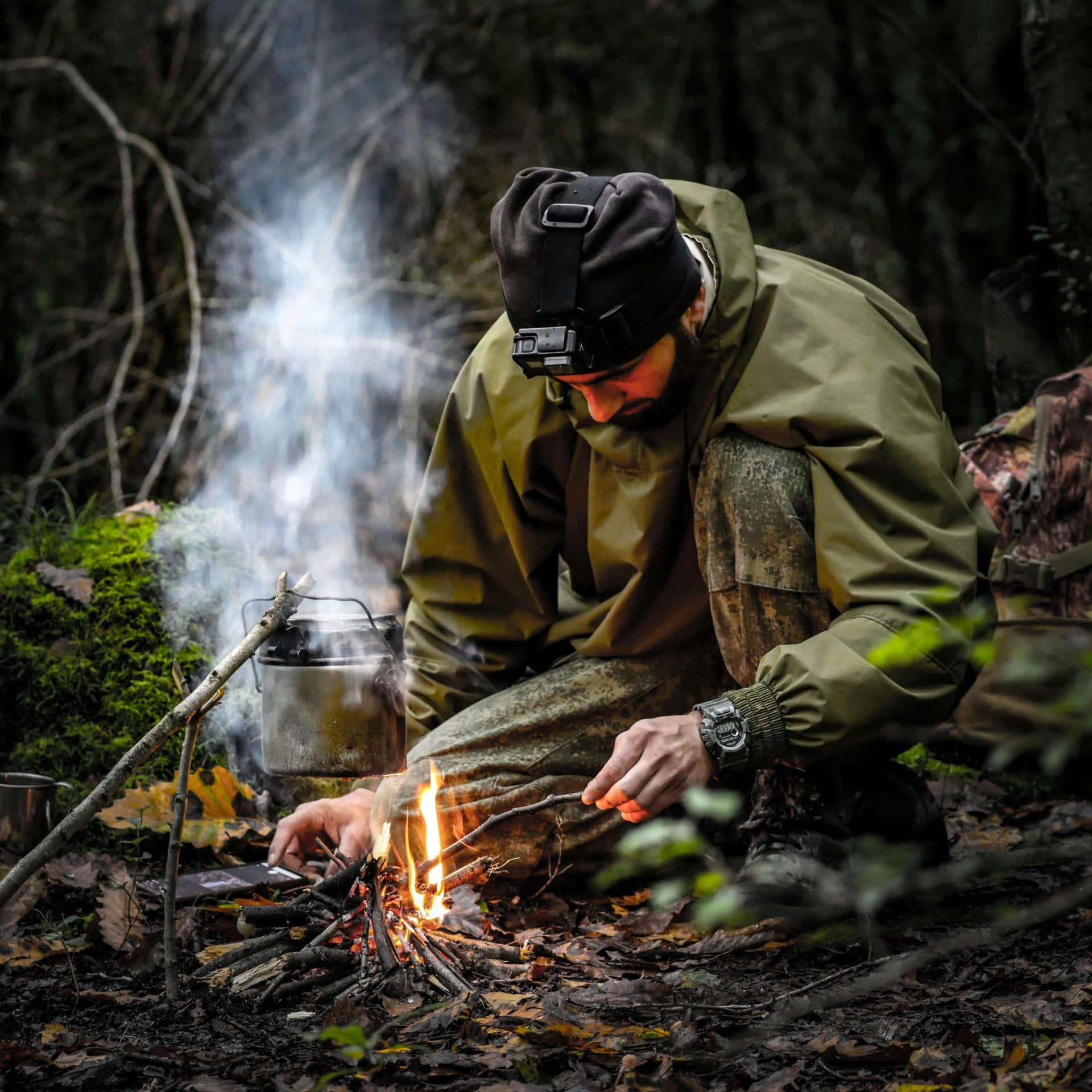
Fire can support wilderness survival by providing heat, allowing you to boil water, helping prepare food, and serving as a visible signal when conditions permit.
However, fire is not always safe or necessary. Wildfire restrictions, strong winds, dry vegetation, and limited fuel can make building one inappropriate.
Your clothing and shelter should provide adequate protection without depending entirely on a campfire.
Understanding Tinder, Kindling, and Fuel
Successful fire-starting begins with preparing materials in advance.
- Tinder: Fine, dry material that catches a spark or small flame.
- Kindling: Small, dry sticks that help establish combustion.
- Fuel: Larger pieces of wood that sustain the fire.
Gather enough appropriate material before attempting ignition. Start with tinder, gradually add kindling, and introduce larger fuel once the fire is established.
A lighter or waterproof matches are generally more reliable for emergencies than primitive friction methods.
Starting a Fire in Wet Conditions
Rain and moisture make ignition more difficult because energy is consumed heating and evaporating water before the fuel burns effectively.
Look for dry material protected beneath fallen branches or other sheltered locations, where collecting it is permitted.
Prepare fine tinder and progressively larger pieces of kindling. Protect the ignition area from rain without creating an enclosed fire hazard.
Our Starting a Fire in Wet Weather guide covers additional techniques.
Fire Safety in a Survival Situation
Never light a fire inside a tent, enclosed shelter, or other poorly ventilated space. Fire and fuel-burning equipment can produce deadly carbon monoxide.
Keep flames away from vegetation, clothing, sleeping materials, and shelter walls.
Follow local fire restrictions, maintain control of the fire, and extinguish it completely before leaving.
Do not assume smoke or flames will deter wildlife. Appropriate food storage and wildlife precautions remain necessary.
For further practice, explore our Primitive Fire-Starting Guide.
3. Drinking Water: Find It, Treat It, and Use It Wisely
Water is a critical wilderness survival resource. Dehydration can impair physical performance, concentration, and decision-making, especially during strenuous activity or hot weather.
Finding water does not automatically mean finding safe drinking water.
Streams, springs, lakes, and rainwater can contain microorganisms or environmental contaminants.
Finding Potential Water Sources
Depending on your environment, possible sources include:
- Accessible streams and rivers
- Springs and seeps
- Lakes and ponds
- Collected rainwater
- Water supplies at established facilities
Consider the risks involved in reaching a source. A steep riverbank, swift current, or unstable rock surface may present a greater immediate danger than your current water shortage.
Do not assume flowing or clear water is safe to drink.
Boiling Water for Microbial Safety
When chemical contamination is not suspected, boiling is an effective way to inactivate common disease-causing microorganisms.
Bring clear water to a rolling boil for one minute. At elevations above 6,500 feet, boil for three minutes.
Allow the water to cool naturally and store it in a clean container.
Boiling does not reliably remove dissolved chemicals, heavy metals, or salts.
Using Water Filters and Chemical Treatment
Purpose-built backpacking filters can be useful, but their capabilities vary.
Many common filters remove bacteria and protozoa while providing limited or no protection against viruses. Chemical disinfectants also differ in effectiveness, required contact time, and performance in cold or cloudy water.
Follow the manufacturer’s instructions and understand what contaminants the product is designed to address.
Homemade sand, charcoal, or cloth filters may reduce visible sediment but cannot be relied upon to make contaminated water safe.
What If Water Is Chemically Contaminated?
If you suspect contamination from fuel, pesticides, industrial waste, or other hazardous chemicals, ordinary boiling and basic camping filters may not make the water safe.
Seek another source and follow appropriate public health guidance.
For a detailed explanation, visit our Ultimate Water Purification Guide.
4. Food and Energy Conservation: Avoid Unnecessary Risks
Food is important for maintaining energy, but obtaining it is usually not the first priority during a short-term wilderness emergency.
Finding shelter, securing drinking water, managing injuries, and improving rescue prospects generally deserve attention before attempting to hunt or forage.
Carry adequate food for planned outdoor activities, plus an emergency reserve appropriate for your trip.
Conserve Energy Before Searching for Food
Traveling long distances, building unnecessary structures, or chasing wildlife can consume energy and increase the risk of injury.
Once immediate threats are controlled, evaluate how long you may need to remain in the area and what supplies are available.
Eat carried food as appropriate, manage physical exertion, and avoid strenuous activities that offer little benefit.
Understanding Wild Edible Plants
Foraging requires substantial local knowledge. Poisonous plants can resemble edible species, and some plants require specific preparation methods.
Never eat an unknown plant based solely on a photograph, phone identification application, or supposed universal edibility test.
Learning regional plant identification is worthwhile, but it should be practiced before an emergency with reliable references and experienced instruction.
Read our Wild Edible Plants Guide for introductory information.
Hunting, Fishing, and Trapping
These skills may have value in extended wilderness situations, but they require equipment, experience, legal awareness, and food safety knowledge.
Improvised trapping can injure non-target wildlife and may violate local regulations.
For most lost hikers, seeking rescue is a more realistic and safer strategy than attempting to live indefinitely from the land.
For emergency food planning before a trip, see our Survival Foods With a Long Shelf Life guide.
5. Navigation: Know When to Move and When to Stay
Navigation is about more than knowing which direction is north. It requires understanding your position, identifying safe routes, and recognizing when continued movement creates unnecessary risk.
One of the most important decisions in a wilderness emergency is whether to remain where you are or attempt to reach a known safe location.
Using a Map and Compass
Before entering unfamiliar terrain, learn to identify:
- Your starting location and planned route
- Major trail junctions and landmarks
- Rivers, ridgelines, valleys, and elevation changes
- Potential hazards and difficult crossings
- Safe exit routes and nearby access points
A paper topographic map and dependable compass provide useful backups when electronic navigation fails.
Practice orienting your map and comparing visible terrain with mapped features in familiar areas.
Using the Sun and Shadows
The shadow-stick method can provide an approximate east-west reference.
- Place a straight stick vertically in reasonably level ground.
- Mark the tip of its shadow.
- Wait approximately 15 to 30 minutes.
- Mark the new shadow tip.
- Draw a line from the first mark toward the second.
In ordinary conditions, the first mark is approximately west and the second approximately east.
This is an estimation technique, not a substitute for a properly used map and compass. Errors can arise from terrain, measurement, and environmental conditions.
See our Shadow Stick Method and How to Navigate Without a Compass guides.
When Staying Put Makes Sense
Remaining in a safe location may be the better choice when:
- Someone knows your intended route and expected return time.
- You have already requested rescue.
- You cannot confidently identify a safe route out.
- Darkness or weather makes travel dangerous.
- An injury limits your ability to move safely.
However, relocate when necessary to escape immediate threats such as rising water, wildfire, unstable terrain, or dangerous exposure.
Do not travel blindly based on a rough directional estimate.
6. Signaling for Rescue: Make Yourself Easier to Find
Survival becomes much more manageable when rescuers can locate you quickly.
Signaling should begin early rather than waiting until supplies are nearly exhausted.
Emergency Communication Devices
If cellular service is available, contact emergency services and provide your location as accurately as possible.
Modern smartphones may support emergency satellite features in certain regions and circumstances. Availability depends on the device, service, and location.
A personal locator beacon or satellite emergency communicator can provide additional protection for remote travel when properly registered, maintained, and used.
Emergency weather radios are useful for receiving information, but most ordinary weather radios cannot transmit a distress call.
Visual Signals
Useful visual signaling methods may include:
- Brightly colored clothing or shelter materials
- A reflective signaling mirror
- A flashlight or headlamp
- Large ground markers in an open area
- Other high-contrast materials visible from a distance
Position signals where they can be seen without exposing yourself to dangerous terrain or weather.
Audible Signals
A whistle can be more effective than shouting repeatedly, especially when fatigue or dehydration limits your voice.
Repeated groups of three whistle blasts are commonly used as a distress signal in some outdoor settings, although signal conventions vary.
Pause between signaling attempts to listen for a response.
Signal Fires and Smoke
Fire and smoke may attract attention, but they also create serious wildfire risks.
Do not start a signal fire during dangerous fire conditions or where prohibited. Use safer signaling methods whenever possible.
Our How to Signal for Help in the Wilderness guide covers additional rescue techniques.
For broader emergency communication planning, explore Off-Grid Communication Without Phone or Internet.
7. Survival Mindset: Make Better Decisions Under Stress
Wilderness emergencies are physically demanding, but decision-making is equally important.
Fear, exhaustion, dehydration, pain, and uncertainty can make it harder to evaluate options.
Being frightened does not mean you are incapable of responding effectively. A simple decision-making process can help reduce unnecessary mistakes.
Focus on Immediate Problems
Rather than trying to solve every problem at once, identify the next action that will meaningfully improve your safety.
For example:
- Move away from a hazardous location.
- Check an injury and provide appropriate first aid.
- Put on dry clothing or improve insulation.
- Contact emergency services.
- Prepare a visible signal.
Complete essential tasks before spending energy on lower-priority activities.
Use a Simple Routine
When waiting for assistance, establish a manageable routine that includes monitoring weather, checking supplies, maintaining shelter, and signaling when appropriate.
Take regular breaks, avoid unnecessary exertion, and reassess your condition.
Do not assume that determination alone can overcome dangerous environmental conditions. Recognizing when you need help is part of good survival judgment.
Practice Before an Emergency
Familiarity reduces the number of unfamiliar decisions you must make under pressure.
Practice using your shelter, navigation equipment, fire-starting supplies, and water treatment system during safe outdoor trips.
Our 100 Forgotten Survival Skills That Could Save Your Life guide provides additional skills to study.
Common Wilderness Survival Mistakes to Avoid
Many outdoor emergencies become more serious when small mistakes accumulate.
Leaving Without a Trip Plan
Always tell a reliable contact where you are going, which route you intend to follow, and when you expect to return.
Agree on when they should request assistance if you do not check in.
Depending Entirely on Your Phone
Phones can lose power, become damaged, or operate outside reliable cellular coverage.
Carry appropriate navigation backups and consider emergency satellite communication for remote trips.
Ignoring Weather Forecasts
Check expected conditions before departure and remain alert to changing weather.
Thunderstorms, flooding, extreme temperatures, and high winds can create hazards that equipment alone cannot solve.
Drinking Untreated Water
Clear water is not necessarily safe. Use an appropriate treatment method and avoid sources suspected of chemical contamination.
Walking Without a Reliable Direction
Unplanned travel can increase your distance from a known route and complicate rescue efforts.
Make a deliberate decision about movement based on your location, available information, and immediate safety.
Failing to Manage Body Temperature
Wet clothing, inadequate insulation, prolonged sun exposure, and excessive exertion can all contribute to dangerous conditions.
Pay attention to early signs of heat illness and hypothermia, and take corrective action promptly.
Waiting Too Long to Signal
Request help early when you recognize a genuine emergency. Do not wait until you are severely injured, dehydrated, or unable to communicate.
Wilderness Survival Gear Checklist
Good equipment cannot replace judgment, but it can make emergency tasks easier and reduce exposure to unnecessary risks.
Before entering the backcountry, consider carrying:
- Paper map and compass
- Charged phone with offline maps
- Emergency communication device appropriate for the area
- Weather-appropriate shelter or emergency bivy
- Insulating clothing and rain protection
- Extra food and sufficient drinking water
- Water filter or other suitable treatment supplies
- Headlamp with backup batteries
- Fire-starting equipment where appropriate
- First aid kit and necessary medications
- Whistle and visible signaling materials
- Knife or multitool
- Sun protection and insect protection
- Basic repair supplies
The exact contents depend on climate, terrain, trip duration, personal needs, and distance from emergency assistance.
Check the condition of your equipment before each trip and learn how to use every essential item.
How to Practice Wilderness Survival Skills Safely
You do not need to deliberately become lost or spend days without supplies to improve your survival abilities.
A structured practice plan is safer and more productive.
Week 1: Shelter and Exposure Protection
Practice setting up a tarp or tent, choosing safe campsites, and insulating yourself from the ground.
Week 2: Fire and Water
Practice fire-starting in a controlled, permitted location. Learn how to operate and maintain your water treatment equipment.
Week 3: Navigation
Use a map and compass on familiar trails. Practice identifying landmarks and maintaining awareness of your position.
Week 4: Signaling and Emergency Planning
Review emergency communication procedures, practice non-emergency signaling techniques, and prepare a realistic trip plan.
When you’re comfortable with these fundamentals, combine them during a short, accessible overnight camping trip with dependable backup equipment.
Frequently Asked Questions About Wilderness Survival
What is the most important wilderness survival skill?
Recognizing immediate danger and making sound decisions is fundamental. Shelter, safe drinking water, navigation, first aid, and emergency communication are especially important practical skills.
What should you do first if you get lost in the woods?
Stop moving unnecessarily, assess immediate hazards, check for injuries, and determine whether you can contact emergency services. Avoid wandering without a reliable route and consider remaining in a safe location where rescuers can find you.
How long can someone survive in the wilderness?
There is no reliable universal time limit. Survival depends on injuries, weather, access to water, physical condition, equipment, and the ability to obtain assistance. The Rule of 3s is only a rough reminder of priorities.
Should you stay put or try to hike out?
It depends on your circumstances. Staying in a safe location often helps when rescuers know your route or you have already requested assistance. Moving may be necessary to escape immediate danger or when you have a clearly identified safe exit.
Can you survive in the wilderness without equipment?
Traditional skills may help when equipment is lost, but survival without supplies is unpredictable and dangerous. Carrying dependable shelter, water, navigation, and emergency communication equipment substantially improves your options.
Is building a fire always necessary?
No. Fire can be useful, but it may be prohibited, unsafe, or unnecessary. Appropriate clothing, shelter, insulation, and a safe evacuation or rescue plan should not depend entirely on a campfire.
What is the best way to prepare for a wilderness emergency?
Learn basic survival and first aid skills, carry appropriate equipment, check weather and trail conditions, share a trip plan, and practice using your supplies before entering remote terrain.
Final Thoughts: Wilderness Survival Starts With Preparation
Wilderness survival is not a competition to see how long you can endure difficult conditions. It is the practical process of protecting yourself from immediate hazards, managing essential needs, and improving your chances of reaching safety.
Remember the seven core skills: shelter, fire, water, food management, navigation, signaling, and sound decision-making.
Learn how these skills work together, practice them in safe conditions, and carry dependable equipment whenever you travel beyond easy access to assistance.
The most valuable survival skill is often knowing what to do next—and what unnecessary risks to avoid.